Tag: sleep tips

  • “Why I Wake Up Tired Even After 8 Hours of Sleep”

    “Why I Wake Up Tired Even After 8 Hours of Sleep”

    I used to think sleep was simple. You close your eyes, you get your eight hours, you wake up feeling human again.

    That was the deal. That was what everyone said. Eight hours and you’re fine.

    Except I was getting my eight hours. Sometimes even nine. And I was still waking up every single morning feeling like I hadn’t slept at all. Groggy, heavy, eyes that didn’t want to open, a body that felt like it was made of concrete. The alarm would go off and my first thought — before anything else — was how long until I could go back to sleep.

    I thought I was just not a morning person. I thought it was normal. I thought everyone felt this way and just pushed through it better than I did.

    I was wrong on all three counts.

    The number was never the problem

    Here is what I had completely missed — sleep isn’t just about hours. It is about quality. And quality is something you cannot see just by looking at a number on your phone.

    You can spend eight hours in bed and still get terrible sleep. You can cycle through light sleep all night, barely dipping into the deep restorative stages your body actually needs, and wake up feeling worse than if you had slept for five hours straight and deeply.

    The hours were never the issue. What was happening inside those hours was.

    What was actually waking me up tired

    Once I started paying attention — really paying attention — I noticed a few things I had been completely ignoring.

    I was on my phone right up until the moment I closed my eyes. Sometimes I’d fall asleep mid-scroll, phone still in my hand, screen still glowing. I thought this was fine because I was tired enough to fall asleep anyway. What I didn’t realize was that the blue light from my screen was suppressing my melatonin — the hormone that tells my body it’s time for deep sleep. So even though I was unconscious, my body was not fully switching into the restorative mode it needed.

    My room was never fully dark. There was always a little light creeping in — from the street, from a charging light, from the gap under the door. Small things. Things I had stopped noticing. But my brain noticed. Even tiny amounts of light during sleep can disrupt your sleep cycles and pull you into lighter stages when your body should be going deeper.

    I was eating too close to bedtime. A late dinner, a snack at 11pm, sometimes both. Your body uses sleep to rest and repair — but if it is still busy digesting, it cannot fully commit to that process. I was asking my body to do two things at once all night and wondering why I woke up exhausted.

    My sleep schedule was completely inconsistent. Weekdays I would try to sleep by eleven. Weekends I would be up until two or three and sleep in until ten. I thought the weekend sleep was making up for the week. It wasn’t. It was confusing my body clock, making it harder to fall into deep sleep at the right times, and leaving me feeling jet-lagged every Monday morning without ever getting on a plane.

    The thing nobody mentions — sleep debt and stress

    There is also something called sleep debt — the accumulated tiredness that builds up when your body doesn’t get the quality rest it needs night after night. You cannot repay it with one long sleep on a Sunday. It takes consistent, quality nights over time to actually recover.

    And then there is stress. I was carrying a lot of it — the kind that doesn’t feel dramatic, just background noise. A low hum of worry that I had learned to live with. What I didn’t know is that stress keeps your cortisol levels elevated, and high cortisol at night is one of the most reliable ways to destroy sleep quality. Your body is supposed to be in a calm, safe state to sleep deeply. Stress tells it the opposite.

    I was falling asleep exhausted every night and waking up exhausted every morning, and the eight hours in between were doing far less for me than I thought.

    What I actually changed

    I put my phone down thirty minutes before sleeping. Not in another room — I wasn’t ready for that — but face down, notifications off, screen dark. Just thirty minutes of nothing. Reading, lying quietly, letting my mind slow down on its own.

    I made my room darker. Blackout curtains changed things more than I expected. The difference between sleeping in a dim room and a properly dark room is something you have to experience to believe.

    I fixed my sleep and wake time. Same time every day — including weekends. Not perfectly, but consistently enough that my body started to trust the schedule. Within two weeks I was waking up just before my alarm, which had never happened to me before in my life.

    I stopped eating after 8pm. This one was hard. But within days I noticed I was sleeping more deeply and waking up feeling lighter.

    I also started winding down intentionally. Not dramatically — no elaborate routines. Just a signal to my body that the day was ending. A warm shower. Dimming the lights an hour before bed. Keeping the evening quieter than the rest of the day.

    What changed

    I won’t pretend it was instant. The first week of fixing my schedule I felt worse before I felt better — my body was recalibrating and it was uncomfortable.

    But by week three something shifted. I started waking up and not immediately wanting to go back to sleep. I started having mornings where I felt — not energetic exactly, but okay. Present. Ready.

    That sounds like a small thing. For me it was enormous.

    Eight hours of bad sleep will always leave you more tired than six hours of good sleep. The number on the clock means nothing if what is happening inside those hours is working against you.

    Your body wants to rest. It wants to recover. It wants to give you the morning you keep hoping for. You just have to stop getting in its way.


  • “The One Night Question That Changed My Entire Life”

    “The One Night Question That Changed My Entire Life”

    I used to end my days the same way most people do. Phone in hand, scrolling through whatever was there — news, social media, other people’s highlights — until my eyes got heavy enough to justify putting it down. And then I’d lie in the dark with my thoughts, which were almost always a version of the same thing: everything I hadn’t done, everything that had gone wrong, everything I needed to do tomorrow that I probably wouldn’t do well enough either.

    It wasn’t dramatic. It wasn’t a crisis. It was just a quiet, persistent dissatisfaction that had become so familiar I’d stopped noticing it was there. Every day ended in a kind of low-grade verdict: not enough. Not productive enough, not disciplined enough, not far enough along.

    And then one evening, almost by accident, I asked myself a different question.

    The question that changed my nights

    I don’t remember what prompted it. I think I was just tired of the usual loop — the mental inventory of failures that played every night like a highlight reel of everything I wished had gone differently. And something in me, quietly exhausted by the exercise, asked instead: what did I do today that I’m proud of?

    I almost dismissed it. It felt soft. Indulgent. Like the kind of thing you’d tell a child to make them feel better, not something a grown adult asks themselves seriously at the end of a difficult day.

    But I let myself answer it anyway. And the answer surprised me.

    I’d had a hard day — genuinely hard, the kind where nothing went particularly well and I felt behind on everything. But I’d also sent a message to a friend I’d been meaning to check in on for weeks. I’d taken a short walk even though I didn’t feel like it. I’d chosen to make a proper meal instead of eating whatever was easiest. None of these things were significant. None of them would appear on a to-do list or a habit tracker. But when I actually looked for them, they were there — small, quiet things I’d done that day that deserved to be noticed.

    “I’d been ending every day counting what was missing. I’d never once tried counting what was there.”

    Why this question works when everything else didn’t

    REASON 01

    It trains your brain to look for evidence of your own worth

    Your brain finds what it looks for. When your default end-of-day question is “what did I fail at today,” your brain becomes very efficient at generating answers — and equally blind to everything that doesn’t fit that narrative. Asking “what am I proud of” gives your brain a completely different search instruction. It has to look for moments of effort, courage, care, or persistence that it would otherwise have scrolled straight past. And the more you practice that search, the more naturally your brain begins to conduct it throughout the day — noticing things worth being proud of as they happen, not just in retrospect.

    REASON 02

    It redefines what counts as a good day

    For most of my adult life, a good day was defined by output. How much I produced, how many things I checked off, how close I came to the ideal version of my routine. By that standard, most days were mediocre at best. But the question “what am I proud of” doesn’t care about output. It cares about character — about the choices you made, the way you showed up, the small acts of integrity and kindness that happen in ordinary moments and never get counted. By that standard, almost every day has something in it. You just have to be willing to look.

    REASON 03

    It makes the next day slightly better — without trying

    Something I didn’t anticipate when I started asking this question was how it would affect the following morning. When you end a day with a genuine sense of having done something worth being proud of — however small — you wake up with a different relationship to yourself. Not triumphant, not inflated, just slightly more solid. Slightly more on your own side. And that small shift in how you feel about yourself at the start of a day changes the quality of the choices you make throughout it. Pride in yesterday builds the foundation for a better today.

    REASON 04

    It is the most honest form of self-reflection I’ve found

    Most self-reflection questions point outward or forward — what went wrong, what needs fixing, what should be different tomorrow. This question points at something simpler and more personal: who were you today? Not what did you produce — who were you. It asks you to look at your actual behavior, your actual choices, your actual character as it showed up in real life rather than in ideal conditions. And that honesty — when it’s kind honesty, searching for what was good rather than excavating what was bad — is some of the most useful self-knowledge available to you.

    REASON 05

    It works even on the worst days

    This is what I find most remarkable about it. On genuinely terrible days — days where almost nothing went right, where I was not at my best, where I’m not sure I’d want to repeat a single hour of it — I have always, without exception, found something. It might be tiny. Getting out of bed when I didn’t want to. Not saying the thing I was tempted to say. Drinking water. Being kind to someone even when I had nothing left. The question doesn’t require a good day to produce a good answer. It just requires honesty and a willingness to look at the whole day — not just the parts that confirm the worst version of how it went.

    The answer doesn’t have to be impressive. “I drank my water” counts. “I didn’t give up when I wanted to” counts. “I was kind to someone who didn’t deserve it” counts. Pride doesn’t require achievement. It requires noticing — which is something you can do every single day regardless of how the day went.

    How to start tonight

    Before you put your phone down tonight, before the lights go off, ask yourself the question. Not as a performance, not as a journaling exercise, not as something you have to get right. Just ask it quietly, to yourself, and let whatever comes up come up.

    What did I do today that I’m proud of?

    It might take a moment. That’s okay. The first few times you ask it, your brain will try to redirect you to the failures — it’s used to going there. Gently bring it back. Keep looking until you find something real. It’s there. It always is.

    And if you want to go deeper, write it down. Not a long entry — just one line. “Today I’m proud that I…” and then the thing. That one line, written consistently over weeks and months, becomes something extraordinary to look back on. Not a record of your achievements. A record of who you were — on ordinary days, in real conditions, without an audience. That’s worth keeping.

    What this question has given me

    I’ve been asking this question every night for long enough now that it’s become automatic — the last real thought I have before I sleep. And what it’s given me isn’t confidence in the performance sense, the kind that comes from achieving things. It’s something quieter and more durable than that.

    It’s given me a more honest relationship with myself. A sense that I actually know who I am at the end of a day — not who I wish I was, not who I’m trying to become, but who I actually showed up as today. And more often than I expected, when I look honestly at that person, I find someone worth being proud of.

    Not because they did everything right. But because they tried. And noticed. And kept going. And asked the question.

    Tonight, before you sleep, ask yourself one question: what did I do today that I’m proud of? Let yourself answer honestly. Whatever comes up — however small — write it down or just hold it for a moment before you close your eyes. That question, asked every night, will quietly change the way you see yourself. Explore more on Quiet Growth for simple daily habits that support a calmer, more focused life.

  • Bedtime Habits to Reduce Stress and Anxiety — A Simple Night Routine That Works

    Bedtime Habits to Reduce Stress and Anxiety — A Simple Night Routine That Works

    Bedtime Habits to Reduce Stress and Anxiety — A Simple Night Routine That Works

    Better sleep doesn’t start at bedtime — it starts with the habits you build in the hour before. Choose one habit from this list, try it tonight, and build from there. Your mind and body will thank you for it. Explore more on Quiet Growth for simple daily habits that support a calmer, more focused life.

    If your mind comes alive the moment your head hits the pillow — replaying conversations, running through tomorrow’s to-do list, or just refusing to switch off — you’re not alone. Stress and anxiety peak at night for most people, and without the right habits in place, sleep becomes a battle instead of a rest.

    The good news is that a simple bedtime routine can genuinely change this. Not a complicated 12-step process — just a handful of consistent habits that signal to your brain it’s time to slow down. This guide walks you through exactly what those habits are and how to build them into your evenings starting tonight.

    Why bedtime habits matter for stress and anxiety

    Your nervous system doesn’t switch off automatically at bedtime. If you’ve spent the day in a state of stress, stimulation, and screen time, your brain is still running at full speed when you lie down. The cortisol in your system — the stress hormone — doesn’t just disappear because it’s dark outside.

    A consistent bedtime routine acts as a transition signal. It tells your brain that the active part of the day is over and rest is coming. Over time, these repeated signals become automatic — your body starts winding down the moment you begin the routine, before you’ve even gotten into bed.

    The goal of a bedtime routine isn’t to force yourself to sleep. It’s to create the conditions where sleep can happen naturally — by reducing stimulation, calming the nervous system, and clearing mental clutter before you lie down.

    👉 If you found this helpful, explore more posts on Quiet Growth

    https://quietgrowthu.wordpress.com/2026/04/15/how-to-build-study-habits-that-actually-stick-no-coaching-needed/

    9 bedtime habits to reduce stress and anxiety

    HABIT 01

    Set a consistent sleep time — and stick to it

    Your body has an internal clock called the circadian rhythm, and it works best when you keep regular sleep and wake times. Going to bed at wildly different times each night — early on weekdays, late on weekends — confuses this rhythm and makes it harder to fall asleep and wake up feeling rested. Pick a bedtime that allows 7 to 8 hours of sleep and honor it as consistently as you can, even on weekends. Within a few weeks, you’ll notice your body naturally starts feeling sleepy at that time.

    HABIT 02

    Put screens away 30 to 60 minutes before bed

    This is the single most impactful change you can make for sleep quality. Screens emit blue light that suppresses melatonin — the hormone that signals sleepiness — and keeps your brain alert when it should be winding down. But the bigger issue is mental: social media, news, messages, and videos keep your mind stimulated and engaged at exactly the moment it needs to be quieting. Try charging your phone in another room overnight. The improvement in how quickly you fall asleep and how deeply you sleep is noticeable within just 2 to 3 nights.

    HABIT 03

    Create a calm sleep environment

    Your environment has a powerful effect on your nervous system. A cluttered, bright, noisy room keeps your brain alert. A dark, cool, quiet room signals safety and rest. You don’t need to redecorate — small changes make a real difference. Dim your lights an hour before bed instead of switching straight from bright overhead lighting to darkness. Keep your bedroom tidy enough that it doesn’t create background anxiety. Use a fan or white noise if external sounds disturb you. Think of your bedroom as a space your brain associates exclusively with rest.

    HABIT 04

    Practice deep breathing to calm your nervous system

    When stress and anxiety are high, your breathing becomes shallow and fast — which keeps your body in a state of alertness. Slowing your breath deliberately reverses this. Try inhaling for 4 seconds, holding for 4, and exhaling slowly for 6 seconds. The extended exhale is the key — it activates the parasympathetic nervous system, which is your body’s rest and recovery mode. Do this for 3 to 5 minutes in bed or before you get in. Most people notice their heart rate slow and their muscles relax within just a few rounds.

    HABIT 05

    Write down your thoughts before you sleep

    One of the main reasons minds race at night is that unfinished thoughts and unresolved worries have nowhere to go. Journaling gives them an exit. Spend 5 to 10 minutes before bed writing freely — your worries, tomorrow’s tasks, anything that’s taking up mental space. Once it’s written down, your brain no longer needs to keep cycling back to it. You’ve recorded it. For extra calm, end your journaling with three specific things from today that you’re grateful for. This small shift moves your final thoughts of the day from stress to appreciation.

    HABIT 06

    Avoid heavy meals and caffeine in the evening

    What you eat and drink in the hours before bed directly affects how well you sleep. Heavy or spicy meals eaten close to bedtime force your digestive system to work hard when it should be winding down — which raises your body temperature and makes quality sleep harder. Caffeine has a half-life of about 5 to 6 hours, which means a coffee at 4pm still has half its caffeine in your system at 10pm. Try to eat your last main meal 2 to 3 hours before bed and switch to herbal tea or water after that.

    HABIT 07

    Replace scrolling with a calming activity

    The evening scroll habit is one of the hardest to break because it’s effortless and instantly stimulating. But your brain needs the opposite of stimulation before sleep — it needs gradual, gentle wind-down. Replace scrolling with something that occupies your mind lightly without overstimulating it. Reading a physical book is the most effective substitute — it’s engaging enough to distract from anxious thoughts but calm enough to make you genuinely sleepy. Light stretching, listening to quiet music, or even a simple puzzle work well too. The key is that the replacement is something you actually enjoy, not just something you’re forcing yourself to do.

    HABIT 08

    Do a quick body scan to release physical tension

    Stress doesn’t just live in your mind — it accumulates in your body throughout the day as tension in your shoulders, jaw, chest, and back. Most people carry this tension into bed without realizing it, which keeps the body in a low-level state of alertness. A simple body scan takes less than 5 minutes: starting from your feet, slowly move your attention upward through each part of your body, consciously releasing any tension you notice. By the time you reach the top of your head, your body is noticeably more relaxed and ready for sleep.

    HABIT 09

    End with gratitude — three specific things from today

    The last thoughts you have before sleeping influence the quality of your rest and how you feel when you wake up. Ending the day with gratitude — not generic gratitude, but three specific things that happened today — redirects your brain from stress and worry to appreciation and calm. It doesn’t have to be profound. “I’m grateful the coffee was good this morning” counts. The specificity is what matters — it forces your brain to actually search your day for positive moments, which is the whole point.

    A simple 30-minute bedtime routine

    Here’s a beginner-friendly structure you can follow straight away:

    60 min before Turn off screens. Dim the lights. Let your environment start winding down.

    30 min before Light stretching or reading. Nothing stimulating — this is wind-down time.

    15 min before Journal for 5 minutes. Write your worries and tomorrow’s tasks. End with 3 things you’re grateful for.

    In bed Deep breathing for 3 to 5 minutes. Body scan. Let sleep come naturally.

    You don’t need to do all 9 habits every night. Pick 3 that feel most relevant to you and do those consistently for two weeks. Once they feel natural, add one more. Simple and consistent beats complicated and abandoned every time.

    Why most bedtime routines fail

    The most common reason people abandon bedtime routines is that they try to change too much at once. Going from no routine to a strict 9-habit sequence overnight is overwhelming and unsustainable. Start with 2 or 3 habits, build gradually, and don’t treat a missed night as a failure — just pick up again the next evening.

    The second reason routines fail is inconsistency at weekends. Sleeping 2 hours later on Saturday and Sunday effectively gives you jet lag for Monday morning. Your circadian rhythm doesn’t know it’s the weekend — it just knows the schedule has shifted. Try to keep your sleep time within 30 to 45 minutes of your weekday time, even on days off.


  • Struggling to Sleep? Try This Simple Night Routine Tonight

    Struggling to Sleep? Try This Simple Night Routine Tonight

    It’s late. You’re tired. But the moment your head hits the pillow, your brain switches on — replaying conversations, running through tomorrow’s list, or just spinning with no particular direction. Sound familiar?

    The problem usually isn’t that you can’t sleep. It’s that you haven’t given your brain a proper signal that sleep is coming. Your body needs a transition — a wind-down period between the busyness of the day and the rest of the night. Without it, your nervous system stays in active mode long after you’ve gotten into bed.

    You don’t need a perfect sleep environment or a complicated routine. You just need to give your brain a clear, consistent signal that the day is over and rest is coming. Start with step one tonight — phone in another room. Just that. Build the rest from there. Explore more on Quiet Growth for simple daily habits that support a calmer, more focused life.

    This guide gives you a simple, step-by-step night routine you can start tonight — not eventually, not when you have more time, but tonight. It takes about 30 to 40 minutes and the results are noticeable within just a few days.

    The goal of this routine isn’t to force yourself to sleep. It’s to stop fighting sleep. When you remove the stimulation, calm the nervous system, and clear the mental clutter, sleep comes naturally. You just have to get out of your own way.

    Why you’re struggling to sleep — the real reason

    Most sleep problems aren’t about the bedroom or the mattress or even stress levels directly. They’re about what happens in the hour before bed. Screens keep your brain stimulated. Unresolved thoughts from the day keep circling. Irregular sleep times confuse your body clock. And then you lie down and wonder why you can’t switch off.

    The fix is a consistent pre-sleep routine that interrupts all three of those patterns — reducing stimulation, clearing mental clutter, and anchoring your body to a regular sleep rhythm. Here’s how to build one.

    The step-by-step night routine

    STEP 01 — 60 minutes before bed

    Put your phone in another room

    Not face down on the table. Not on silent beside the bed. In another room. This sounds extreme but it’s the single most effective change you can make for sleep quality. Your phone is a source of blue light that suppresses melatonin, and a constant source of mental stimulation — every notification, every potential message, every urge to check “just quickly” keeps your brain alert. When it’s physically not in the room, that temptation disappears entirely. Use a basic alarm clock instead. If you resist this step, ask yourself honestly — is your phone actually helping you sleep?

    STEP 02 — 55 minutes before bed

    Dim every light in the room

    Bright overhead lighting in the evening is one of the most underestimated sleep disruptors. Your brain uses light as its primary signal for time of day — bright light means daytime, darkness means sleep. When you go from a bright room to complete darkness the moment you get into bed, your brain is confused and melatonin production is delayed. Start dimming your lights an hour before sleep — use lamps, lower overhead brightness, or switch to warmer tones. This gradual light reduction is one of the fastest ways to feel genuinely sleepy at your intended bedtime.

    STEP 03 — 45 minutes before bed

    Do something calm with your hands and mind

    This is your wind-down activity — something that occupies you lightly without overstimulating. Reading a physical book is the most effective option. Gentle stretching, a simple puzzle, or listening to calm music also work well. The key is that it’s something you genuinely enjoy, not something you’re forcing yourself to do. This isn’t deprivation — it’s actively choosing something better than scrolling. Most people discover within a few nights that this wind-down period is actually the part of the day they look forward to most.

    STEP 04 — 20 minutes before bed

    Do a short brain dump in a journal

    Take 5 to 10 minutes to write down everything that’s taking up space in your head — worries, tomorrow’s tasks, unfinished thoughts, anything that’s been circling. Don’t edit or organize it, just get it out. Your brain keeps recycling unresolved thoughts because it’s afraid of forgetting them. Once they’re written down, it can let go. Finish your journaling with three specific things from today that went well or that you’re grateful for. This shifts your final conscious thoughts from stress to something more positive — which directly affects the quality of your sleep and how you feel when you wake up.

    STEP 05 — 10 minutes before bed

    Prepare your environment for sleep

    Cool your room down slightly if you can — the ideal sleep temperature is slightly cooler than your daytime comfort level, and your body naturally drops in temperature as it prepares for sleep. Make sure the room is as dark as possible. If external noise is an issue, try a white noise app or a fan. Do your skincare routine, brush your teeth, change into comfortable clothes. These small physical rituals are part of the sleep signal — they tell your brain that sleep is minutes away, which helps melatonin production accelerate right on cue.

    STEP 06 — in bed

    Use deep breathing to finish the transition

    Once you’re in bed, do 5 minutes of slow, deliberate breathing before you try to sleep. Inhale for 4 seconds, hold for 4, exhale slowly for 6 to 8 seconds. The extended exhale is what matters most — it activates the parasympathetic nervous system, which is your body’s rest-and-digest mode, the opposite of fight-or-flight. You’ll feel your heart rate slow, your muscles relax, and your thoughts begin to quiet. If your mind wanders, gently bring attention back to your breath without frustration. This isn’t meditation — it’s just giving your nervous system permission to finally switch off.

    What to do if you still can’t sleep

    If you’ve done all of this and you’re still lying awake after 20 minutes, get up. This sounds counterintuitive but staying in bed while awake trains your brain to associate the bed with wakefulness — the opposite of what you want. Go to another room, sit quietly in dim light, and do something calm — reading, gentle stretching, or simply sitting — until you feel genuinely sleepy. Then go back to bed.

    Don’t look at your phone. Don’t turn on bright lights. Don’t check the time repeatedly. The goal is to break the mental association between bed and frustration, and rebuild it as a place your body and brain automatically associate with rest.

    The single most important thing you can do tonight is also the simplest: go to bed at the same time and wake up at the same time as yesterday — including weekends. Sleep consistency is the foundation everything else builds on. Without it, even the best bedtime routine will only partially work.

    Your complete 40-minute night routine at a glance

    60 min before Phone in another room. Dim all lights.

    45 min before Wind-down activity — reading, stretching, or calm music.

    20 min before Journal — brain dump everything, end with 3 specific gratitudes.

    10 min before Cool the room, prepare physically for sleep.

    In bed 5 minutes of deep breathing. Let sleep come on its own.

    👉 Explore more on Quiet Growth to improve your mindset step by step.

  • Strict vs Flexible Morning Routine — Which One Is Right for You?

    Strict vs Flexible Morning Routine — Which One Is Right for You?

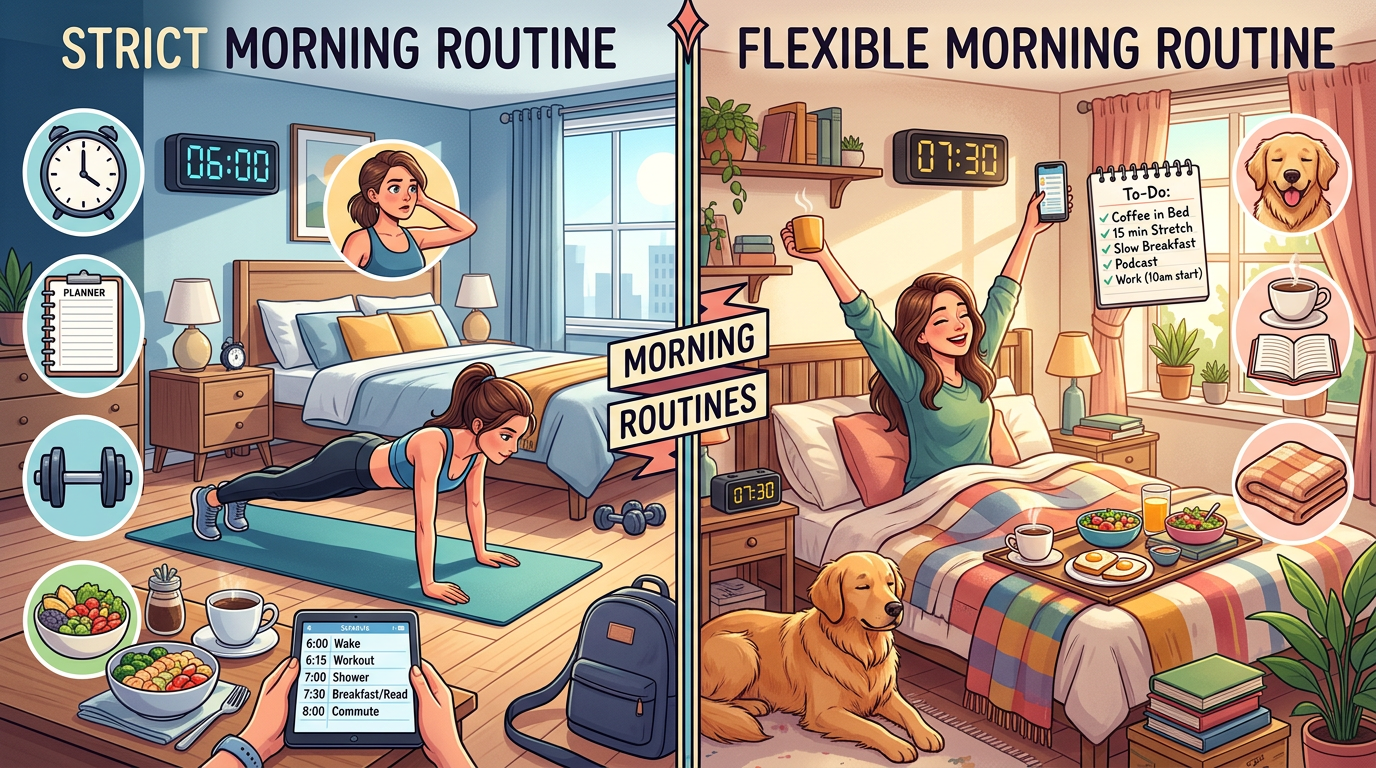
    If you’ve ever tried to follow someone else’s morning routine and failed, there’s a good chance the problem wasn’t you — it was the type of routine. Some people genuinely thrive with a fixed, structured schedule. Others do better with flexibility and freedom. The key is knowing which one fits your personality, lifestyle, and goals.

    This post breaks down both approaches honestly — what they look like in practice, who they work for, who they don’t, and how to figure out which one is right for you. No one-size-fits-all advice here.

    There’s no wrong answer here — only the routine that works for your life. Start where you are, be honest about what you need, and adjust as you go. Explore more on Quiet Growth for simple daily habits that support a calmer, more focused life.

    What each type of routine actually looks like

    The case for a strict morning routine

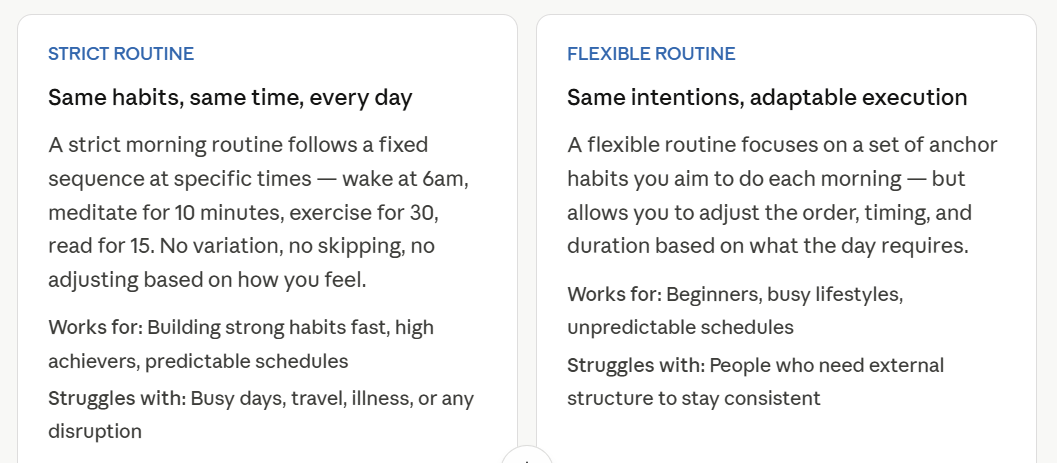
    A strict routine works because it removes decision-making entirely. When your alarm goes off at 6am, you don’t ask yourself whether you feel like meditating — you just do it because that’s what happens at 6am. This kind of automaticity is incredibly powerful. The habit becomes so ingrained that willpower and motivation become almost irrelevant.

    Strict routines also build discipline in a way that spills over into other areas of your life. When you show up for your routine regardless of how you feel, you develop a relationship with consistency that changes how you approach work, health, and goals generally. Many high performers swear by fixed morning routines for exactly this reason.

    The downside is rigidity. Life is unpredictable — a sick child, an early flight, a bad night’s sleep — and a strict routine has no room for these. When it gets disrupted, people who rely on strict routines often feel like they’ve failed and abandon the whole thing. One disruption becomes a reason to quit.

    If you try a strict routine and one disruption causes you to abandon it entirely — that’s a sign flexibility might suit you better. Resilience to disruption is just as important as consistency.

    The case for a flexible morning routine

    A flexible routine works because it’s sustainable. It acknowledges that no two mornings are the same and builds that reality into the design. Instead of “I must meditate at 6:15am for exactly 10 minutes,” the flexible version is “I aim to meditate at some point this morning.” The intention is the same — the rigidity is gone.

    For beginners especially, flexibility is far more forgiving. It lets you build habits gradually without the crushing guilt of missing a step in a fixed sequence. You might only do two of your five habits on a rushed Monday — but you still did something, the habit still exists, and Tuesday is a fresh start. That’s what keeps people going long term.

    The risk with flexibility is that “flexible” can quietly become “optional.” Without any structure at all, mornings drift back to scrolling and rushing. A flexible routine still needs anchor habits — specific things you commit to — just without the rigid time constraints.

    Which one is right for you — a simple guide

    Answer these four questions honestly and your answer will become clear:

    1. How predictable is your daily schedule?

    A Very predictable — same time every day

    B Varies a lot — different each day

    2. How do you feel when you miss a planned habit?

    A Motivated to get back on track tomorrow

    B Discouraged and tempted to give up

    3. Are you building a routine for the first time?

    A No — I’ve had routines before and they stuck

    B Yes — this is new territory for me

    4. What’s your relationship with structure generally?

    A I thrive with clear rules and schedules

    B Too much structure stresses me out

    MOSTLY A ANSWERS

    A strict routine is likely a good fit for you

    You have a predictable schedule, handle disruption well, and respond positively to structure. Try building a fixed sequence of 4 to 5 habits at consistent times and stick to it for 30 days. Add accountability — tell someone your routine or track it in a journal.

    MOSTLY B ANSWERS

    A flexible routine is likely a better fit for you

    Your schedule is unpredictable, you’re newer to routines, or rigid structure tends to backfire on you. Choose 3 anchor habits you’ll aim to do each morning without a fixed time. Focus on doing them consistently rather than perfectly — and add more structure gradually as they become natural.

    The best approach for most people — start flexible, add structure later

    If you’re genuinely unsure, start flexible. Most people who try to build a strict routine from scratch fail within two weeks because the gap between their current habits and the new routine is too large. A flexible routine bridges that gap — it gets habits into place first, then allows structure to develop naturally as the habits become automatic.

    Think of it this way: a flexible routine is the foundation, and a strict routine is what you can build on top once the foundation is solid. You don’t start construction with the roof.

    Whatever you choose — strict or flexible — the single most important factor is what you do the morning after a disruption. If you get straight back to your routine, it will last. If one bad morning becomes an excuse to quit, it won’t. Your response to disruption matters more than the routine itself.

    👉 If you found this helpful, explore more posts on Quiet Growth

  • 7 Easy Steps for a Stress-Free Morning Routine

    7 Easy Steps for a Stress-Free Morning Routine

    How you start your morning sets the tone for everything that follows. But for most people, mornings feel rushed, reactive, and stressful — checking the phone before getting out of bed, skipping breakfast, running out the door already feeling behind.

    A stress-free morning doesn’t happen by accident — it’s built one small habit at a time. Pick one step from this list, do it tomorrow, and keep going from there. Your mornings — and your mindset — will gradually transform. Explore more on Quiet Growth for simple daily habits that support a calmer, more focused life.

    The good news is you don’t need to wake up at 5am or follow a complicated routine to change that. These 7 simple steps are designed for real life — no perfection required, just a few intentional habits done consistently. Even on your busiest mornings, most of these take just a few minutes each.

    Why your morning routine matters for mental health

    Your brain is most impressionable in the first 30 minutes after waking. Whatever you feed it during that window — calm or chaos, intention or distraction — shapes your mental state for hours afterwards. A structured morning routine doesn’t just improve productivity. It reduces anxiety, builds emotional stability, and gives you a sense of control before the day’s demands take over.

    You don’t need a perfect routine. You need a consistent one. Here are 7 steps to build it.

    Start with just 2 or 3 of these steps, not all 7 at once. Once those feel natural — usually after 2 weeks — add another. Building slowly is what makes it last.

    👉 Explore more on Quiet Growth to improve your mindset step by step.

    https://quietgrowthu.wordpress.com/2026/04/21/strict-vs-flexible-morning-routine-which-one-works-better/

    The 7 steps

    STEP 01

    Wake up without rushing — give yourself 5 to 10 minutes

    Most stressful mornings start the same way: the alarm goes off and you immediately reach for your phone. Before you know it, 20 minutes have passed and you’re behind before you’ve even stood up. Instead, when your alarm goes off, leave your phone face down. Sit up slowly, take a few deep breaths, and let your body wake up at its own pace. Five minutes of calm at the start is worth more than an extra 20 minutes of scrolling.

    STEP 02

    Drink a full glass of water before anything else

    After 7 or 8 hours of sleep your body is mildly dehydrated, and dehydration — even at mild levels — directly affects your mood, concentration, and energy. Drinking water first thing is the simplest and most effective thing you can do in the first few minutes of your day. Keep a glass on your bedside table the night before so it’s the first thing you reach for, not your phone.

    STEP 03

    Practice deep breathing for 2 to 5 minutes

    You don’t need to meditate for 30 minutes to feel the benefit of breathwork. Even 2 to 5 minutes of intentional breathing activates your body’s relaxation response, lowers cortisol, and clears the mental fog of just waking up. Try this: inhale slowly for 4 seconds, hold for 4 seconds, exhale for 6 seconds. The longer exhale is what signals calm to your nervous system. Repeat 5 to 8 times and notice how different you feel.

    STEP 04

    Do gentle movement or stretching

    You don’t need a full workout — 5 to 10 minutes of light movement is enough to wake your body up properly. After hours of stillness, your muscles are tight and your blood flow is slow. A short stretch, a walk around the block, or a few simple yoga poses gets circulation going, releases physical tension, and triggers the release of endorphins that lift your mood. On days when you have more time, do more. On rushed days, even 5 minutes counts.

    STEP 05

    Write your thoughts — even just for 5 minutes

    Journaling in the morning doesn’t have to be deep or meaningful. Just open a notebook and write whatever is on your mind — how you slept, how you’re feeling, one thing you’re grateful for, one thing you’re looking forward to. Getting thoughts out of your head and onto paper clears mental clutter, reduces anxiety, and builds self-awareness over time. It also gives your mind a chance to process before the day’s demands pile on. Five minutes is enough.

    STEP 06

    Protect your morning from negative inputs

    What you consume in the morning stays with you for hours. Starting the day with negative news, social media comparison, or stressful messages immediately puts your brain into a reactive, anxious state. Try to delay checking your phone, news apps, and social media until you’ve completed at least a few of these steps. You’re not ignoring the world — you’re just choosing to show up to it from a calmer, more grounded place.

    STEP 07

    Set one clear, achievable goal for the day

    Before the day pulls you in ten directions, take two minutes to decide what actually matters today. Not a to-do list of twenty things — just one clear priority. Ask yourself: if I only accomplish one thing today, what should it be? Write it down. This simple habit reduces decision fatigue, gives your day direction, and creates a sense of focus that carries through even the most chaotic afternoons. Finishing that one thing at the end of the day feels genuinely satisfying.

    How to stay consistent even on hard days

    The biggest threat to any morning routine isn’t laziness — it’s the expectation of perfection. When you miss a step or have a chaotic morning, you feel like you’ve failed and give up entirely. Don’t. Missing one day doesn’t break a habit. Giving up because of one missed day does.

    On tough mornings, shrink the routine down to its smallest version: drink water, take three deep breaths, set one intention. That’s it. Two minutes. The habit stays alive and you start the next day without guilt.

    Prepare the night before to make mornings easier. Set out your water glass, put your journal on the bedside table, and decide your one goal for tomorrow before you sleep. Removing friction the night before is the secret to consistency in the morning.

    Frequently asked questions

    How long should a morning routine take?

    As little as 15 to 20 minutes is enough to follow all 7 steps at a basic level. On days when you have more time, expand each step. On rushed days, compress to the essentials. The routine should fit your life, not the other way around.

    Do I have to do all 7 steps every day?

    No. Start with 2 or 3 that feel most natural to you and build from there. Even following 3 of these steps consistently will make a noticeable difference in how your mornings feel within two weeks.

    What if I’m not a morning person?

    These steps work regardless of what time you wake up. You don’t need to be a morning person — you just need a few intentional minutes at the start of your day, whatever time that is. Consistency at your natural wake time beats an earlier alarm you’ll never keep.

    How soon will I notice a difference?

    Most people notice a calmer, more focused start to the day within 3 to 5 days of following even a basic version of this routine. The deeper benefits — reduced anxiety, better mood, improved focus — build gradually over 2 to 4 weeks of consistency.

    Is journaling really necessary?

    It’s optional but highly effective. If writing feels like too much, just sit quietly for 5 minutes instead. The goal is to give your mind a moment of reflection before the day begins — journaling is simply one of the best ways to do that.

  • “Busy People Swear By These Morning Habits”

    “Busy People Swear By These Morning Habits”

    Most morning routine guides assume you have an hour to spare, a quiet house, and the willpower of an Olympic athlete. If that’s not your reality — you’re rushing, short on time, and just trying to get through the day — this guide is for you.

    Your morning doesn’t have to be perfect to be powerful. Pick one habit from this list, do it tomorrow, and build from there. Small steps, done consistently, change everything. Explore more on Quiet Growth for simple habits that support a calmer, more focused life.

    These flexible morning habits are designed to work with your real life, not against it. You don’t need to wake up at 5am or follow a rigid 12-step routine. You just need a few small, intentional habits done consistently — even on the messiest mornings.

    Why flexible routines work better than strict ones

    Strict morning routines fail for one simple reason: life is unpredictable. The baby wakes up early. You slept badly. You have an early meeting. One disruption throws the whole routine off — and then you feel like you’ve failed before the day has even started.

    A flexible routine works differently. Instead of a fixed sequence of steps, you have a small set of anchor habits that you can fit into whatever time you have — 10 minutes or 30. The routine adapts to your day, not the other way around.

    The goal isn’t a perfect morning. The goal is a better morning than if you’d done nothing at all. Even 10 intentional minutes beats an hour of aimless scrolling.

    5 flexible morning habits to build right now

    HABIT 01

    Wake up at a consistent time — even on weekends

    You don’t need to wake up early. You need to wake up consistently. Your body’s internal clock regulates energy, mood, and focus — and it works best when you honor it with a regular wake time. If you currently wake up at different times each day, start by picking one time and sticking to it for two weeks. The difference in how energized and alert you feel will be noticeable, even if the time itself isn’t dramatically earlier than before.

    HABIT 02

    Drink water before you do anything else

    After 6 to 8 hours of sleep, your body is mildly dehydrated — and even mild dehydration affects your mood, concentration, and energy levels. Drinking one or two glasses of water first thing is the simplest and fastest habit you can add to your morning. It takes 30 seconds, costs nothing, and the impact on how awake and alert you feel is real. Keep a glass of water on your bedside table the night before to make it effortless.

    HABIT 03

    Give your mind 10 minutes before your phone

    You don’t need 30 phone-free minutes — even 10 makes a difference. Before you check messages, social media, or news, give your mind a short window of calm. Sit quietly, look out a window, or just breathe. Those first few minutes after waking are when your brain is most impressionable — starting them with notifications and other people’s content immediately puts you in a reactive state. Starting them in quiet keeps you grounded and in control of your own mood.

    HABIT 04

    Move your body — even just for 5 minutes

    You don’t need a full workout. Five minutes of stretching, a short walk around the block, or even just standing up and rolling your shoulders is enough to get blood flowing, shake off the grogginess, and signal to your body that it’s time to be awake. On days when you have more time, do more. On days when you have almost none, do five minutes. The habit stays intact either way — which is exactly the point of a flexible routine.

    HABIT 05

    Set one clear intention for the day

    Before the day takes over, ask yourself one question: what is the one thing I most want to accomplish today? Not a full to-do list — just one thing. This single habit reduces decision fatigue, gives your day a clear direction, and means that even if everything else goes sideways, you have one anchor to come back to. Write it down if you can, even just on a sticky note. Getting it out of your head and onto paper makes it real.

    Three versions — pick what fits your morning

    No two mornings are the same. Here are three versions of this routine depending on how much time you have:

    10-MINUTE VERSION

    For rushed mornings

    Drink water (1 min) → 5 minutes of light stretching → Set your one intention for the day (2 min) → No phone until you leave the house.

    20-MINUTE VERSION

    For average mornings

    Drink water → 10 minutes of quiet or light movement → Write your intention → Read a few pages or listen to something useful while getting ready.

    30-MINUTE VERSION

    For unhurried mornings

    Drink water → 10 minutes of movement → 5 minutes of silence or breathing → Write 3 things you’re grateful for → Set your intention for the day → Eat a proper breakfast before touching your phone.

    On days when everything goes wrong, fall back to the 10-minute version. Keeping any version of the routine alive on hard days is what builds the long-term habit. A small win is still a win.

    What to avoid in the morning

    The two biggest morning mistakes are checking your phone immediately and trying to do too much. Both leave you feeling scattered before the day has even started. Checking your phone first thing hands control of your mood to whoever posted last night. Trying to do a 12-step routine when you’re already running late just creates guilt and frustration.

    Keep your morning simple enough that you can actually do it — on tired days, on busy days, and on the days when nothing goes to plan. That simplicity is what makes it last.

    👉 Explore more on Quiet Growth to improve your mindset step by step.

  • Simple Morning Routine for Mental Clarity (Beginner-Friendly Guide)

    Simple Morning Routine for Mental Clarity (Beginner-Friendly Guide)

    A simple morning routine for mental clarity can change the entire tone of your day — before work, before meetings, before the noise begins. You don’t need a complicated 2-hour routine or a perfectly quiet house. You just need a few intentional habits done consistently.

    If you often wake up feeling groggy, rushed, or already behind — this guide is for you. Let’s build a morning that actually works.

    Why your morning matters more than you think

    The first 30 minutes after you wake up set the tone for everything that follows. When you check your phone immediately, scroll through news or notifications, your brain shifts straight into reactive mode — responding to everyone else’s priorities before you’ve even had a moment to think about your own.

    A simple, intentional morning routine breaks that pattern. It gives your mind a calm, structured start — which means better focus, less stress, and more energy through the day.

    You don’t need a perfect morning. You need a consistent one. Even 20–30 minutes of intentional habits makes a real difference over time.

    8 simple habits for a clearer morning

    HABIT 01

    Wake up at the same time every day

    Your body has an internal clock — and it works best when you respect it. Waking up at a consistent time each day regulates your sleep cycle, reduces morning grogginess, and makes it easier to fall asleep at night. You don’t need to wake up at 5am. Pick a time that fits your life and stick to it, even on weekends.

    HABIT 02

    Avoid your phone for the first 30 minutes

    This is one of the highest-impact changes you can make. Checking your phone first thing floods your brain with information, opinions, and other people’s urgencies — before you’ve had a single moment of calm. Try leaving your phone face down or in another room for the first 30 minutes. Use that time for yourself instead.

    HABIT 03

    Drink water before anything else

    After 6–8 hours of sleep, your body is mildly dehydrated — and even mild dehydration affects your mood, focus, and energy. Drinking one or two glasses of water first thing wakes up your body, kickstarts your metabolism, and helps your brain shift into gear. It takes 30 seconds and makes a noticeable difference.

    HABIT 04

    Move your body — even lightly

    You don’t need a full gym session. Even 5–10 minutes of gentle movement — stretching, a short walk, or light yoga — improves blood flow, reduces stiffness, and releases endorphins that lift your mood. Movement signals to your body that it’s time to be awake and alert. Start small and build from there.

    HABIT 05

    Spend 5 minutes in silence

    Before the noise of the day starts, give yourself a few minutes of quiet. This could be simple deep breathing, sitting with a cup of tea, or a short meditation. Silence in the morning clears mental clutter, lowers cortisol levels, and helps you feel grounded before you face the day. It doesn’t have to be spiritual — just still.

    HABIT 06

    Write down your three priorities for the day

    One of the biggest causes of stress and distraction is not knowing what actually matters today. Before you open your laptop or check messages, write down three things you want to accomplish. Not a to-do list of twenty items — just three. This small habit reduces decision fatigue, gives your day direction, and makes you feel in control rather than reactive.

    HABIT 07

    Read or listen to something positive

    Feed your mind something useful early in the day. A few pages of a good book, a short podcast, or a single article on something you want to learn — it doesn’t need to be long. Starting the day with intentional input, rather than random social media scrolling, builds knowledge gradually and sets a constructive tone for the hours ahead.

    HABIT 08

    Eat a simple, nourishing breakfast

    Your brain runs on fuel. Skipping breakfast or grabbing something sugary affects your concentration and energy levels by mid-morning. It doesn’t have to be elaborate — oats, eggs, fruit, or even a banana with peanut butter is enough. The goal is to give your body steady energy, not a quick spike followed by a crash.

    A beginner 30-minute morning plan

    If you’re just starting out, here’s a simple structure you can follow straight away:

    0–5 minWake up, drink water, no phone

    5–10 minLight stretching or a short walk

    10–15 minSit in silence or do deep breathing

    15–25 minWrite your 3 priorities and read a few pages

    25–30 minEat a simple breakfast

    Don’t try to add all 8 habits at once. Pick two or three that feel manageable and do those consistently for two weeks. Then add one more. Small steps build lasting routines.

    Common mistakes to avoid

    The most common reason morning routines fail is overcomplication. People design a perfect 2-hour routine, struggle to keep up, miss one day, feel like they’ve failed, and quit entirely. Keep yours simple enough that you can do it even on a tired Tuesday.

    The second mistake is skipping sleep to wake up earlier. A morning routine built on poor sleep will always fall apart. Your routine should work with your sleep, not against it. If you want to wake up earlier, go to bed earlier — start by 15 minutes at a time.

    👉 If you found this helpful, explore more posts on Quiet Growth