
eM1i5ISxWu3jPHusH-h-gEyTdmWkUiDw3kvO46j5xeA relief | Quiet Growth U

Tag: relief

  • 15 Things to Do When Anxiety Hits — Simple Techniques That Actually Help

    15 Things to Do When Anxiety Hits — Simple Techniques That Actually Help

    Anxiety doesn’t wait for a convenient moment. It shows up in the middle of a work meeting, at 2am when you should be sleeping, or out of nowhere on an otherwise ordinary Tuesday. And when it hits, knowing what to actually do — not just “calm down” — makes all the difference.

    Anxiety is uncomfortable — but it’s manageable. You don’t have to white-knuckle your way through it or wait for it to pass on its own. Next time it hits, try one thing from this list. Just one. That’s enough to start shifting the feeling. Explore more on Quiet Growth for simple daily habits that support a calmer, more focused life.

    This list gives you 15 concrete things you can do the moment anxiety shows up. Some take 30 seconds. Some take a few minutes. None of them require experience, equipment, or a quiet room. They just require you to try one.

    When anxiety hits — 15 things to try right now

    You don’t need to do all 15. Read through the list, pick 2 or 3 that feel most natural to you, and keep those as your go-to tools. Having a small personal toolkit ready before anxiety hits is far more effective than trying to remember what to do in the middle of it.

    Do this first — 30 seconds

    01 Take one slow, deep breath — just one

    Not five, not ten — just one. Inhale slowly through your nose for 4 seconds, and exhale even more slowly through your mouth for 6 to 8 seconds. That extended exhale activates your parasympathetic nervous system — your body’s built-in calm response. One breath won’t fix everything, but it interrupts the physical spiral immediately and gives your brain a fraction of a second to catch up with your body. From there, everything else becomes slightly more possible.

    02 Name what you’re feeling out loud or in your head

    Say it — “I’m feeling anxious right now.” It sounds almost too simple, but naming an emotion creates measurable distance between you and the feeling. Your brain shifts from being inside the anxiety to observing it. You’re no longer drowning — you’re watching the wave from slightly further back. Researchers call this affect labelling, and it consistently reduces the intensity of emotional responses. You’re not suppressing the feeling — you’re just giving it a name instead of letting it run the show unnamed.

    03 Feel your feet on the floor

    Press both feet flat on the ground and notice the sensation — the pressure, the temperature, the texture beneath you. This sounds almost too simple to work, but grounding through physical sensation is one of the fastest ways to interrupt an anxiety spiral. Anxiety pulls you into your head and into the future. Physical sensation pulls you back into your body and into the present moment. Right now, your feet are on the ground. That’s real. That’s here. Start there.

    Use your senses — 2 to 5 minutes

    04 Try the 5-4-3-2-1 grounding technique

    Look around and name 5 things you can see. Then 4 things you can physically feel. Then 3 sounds you can hear. Then 2 things you can smell. Then 1 thing you can taste. This technique forces your brain to engage with your immediate physical environment — which is the direct opposite of what anxiety does, which is pull you into imagined future scenarios. By the time you reach number one, your nervous system has usually shifted noticeably. It works because it’s impossible to be fully caught in anxious thought while also actively engaging all five senses.

    05 Hold something cold in your hands

    Pick up a cold glass of water, hold an ice cube, or run cold water over your wrists. The physical sensation of cold is sharp and immediate — it gives your nervous system something concrete and real to focus on rather than the abstract threat your anxious brain has constructed. It also lowers your heart rate slightly and interrupts the physical symptoms of anxiety — the flushed skin, the racing pulse, the tight chest. It takes about 30 seconds and costs nothing.

    👉 Explore more on Quiet Growth to improve your mindset step by step.

    https://quietgrowthu.wordpress.com/2026/04/30/i-tried-every-productivity-hack-to-build-self-discipline-nothing-worked-until-i-did-this/

    06 Make a warm drink slowly and mindfully

    Go to the kitchen, boil the kettle, make a cup of tea or warm water with lemon — and pay attention to every step. The sound of the water. The warmth of the mug in your hands. The smell of the drink. The ritual of making something simple and nourishing for yourself. This works on two levels: it gives you a physical grounding activity that engages your senses, and it gives your anxious mind a clear, simple task to focus on — which interrupts the spiral without requiring you to force your thoughts to stop.

    07 Step outside for two minutes

    Fresh air, natural light, and a change of physical environment work faster than most people expect. Even two minutes outside — standing on a balcony, walking to the end of the street, or sitting in a garden — can meaningfully reduce anxiety symptoms. Nature exposure lowers cortisol levels. The change of environment breaks the mental loop. The physical movement, even just walking slowly, shifts energy that anxiety has locked in your body. You don’t need a park or a forest. A pavement and some sky is enough.

    Move your body — 5 minutes

    08 Shake your body — literally

    Stand up and shake your hands, arms, and legs for 60 seconds. Roll your shoulders. Shake out your neck gently. This might feel ridiculous, but it’s rooted in how animals naturally discharge stress from their nervous system after a threat has passed. Anxiety stores physical tension in the body — shaking releases it. You’ll probably feel slightly silly doing it and noticeably better afterwards. Do it in private if you need to, but do it.

    09 Do 5 minutes of slow, gentle movement

    Not a workout — just movement. Slow neck rolls, gentle shoulder stretches, walking slowly around the room. Anxiety lives in the body as much as the mind — tight chest, tense jaw, shallow breathing, clenched hands. Gentle movement releases that physical tension deliberately and sends a signal to your nervous system that the threat is over and your body is safe. Five minutes is enough to feel the shift. You don’t need a mat or a routine. Just move gently and breathe.

    10 Put on a song and just listen

    Music directly affects your nervous system — calm, slow music lowers heart rate and cortisol, and familiar music activates the brain’s reward centers which counters the threat response anxiety triggers. Put on one song you genuinely love — something that feels safe or comforting — and just listen. Not as background noise while you scroll. Actually sit and listen. Let it be the only thing happening for three minutes. Music is one of the fastest emotional regulators available to you and it costs nothing.

    Clear your mind — 5 to 10 minutes

    11 Write down exactly what you’re anxious about

    Open a notebook or even your phone notes and write down the specific thought or fear that’s driving the anxiety. Don’t edit it — just get it out of your head and onto the page. Anxiety feels enormous and shapeless when it’s circling inside your mind. Written down, it becomes specific and contained — something you can actually look at rather than something swallowing you whole. Often the act of writing it down reveals that the fear, while real, is smaller and more manageable than it felt inside your head.

    12 Ask yourself — is this happening right now?

    Anxiety almost always lives in the future — something that might happen, could go wrong, or hasn’t occurred yet. When anxiety peaks, pause and ask yourself honestly: is what I’m afraid of actually happening right now, in this moment? Usually the answer is no. Right now, in this moment, you are physically safe. The threat is imagined or anticipated — which doesn’t make the feeling less real, but it does mean the present moment is safer than your anxious brain is telling you it is. Returning to the present, even briefly, loosens anxiety’s grip.

    13 Call or text someone you trust — just to connect

    You don’t have to explain your anxiety or ask for help. Just connect. Send a voice note. Text a friend something casual. Call someone and talk about something completely unrelated to how you’re feeling. Human connection — even brief, even digital — activates the part of your nervous system associated with safety and calm. Isolation makes anxiety worse. Connection, even small connection, interrupts it. You don’t need to be understood right now. You just need to not be alone with it.

    Longer options — when you have more time

    14 Do box breathing for 5 minutes

    Box breathing is one of the most well-researched breathing techniques for anxiety. Inhale for 4 seconds, hold for 4, exhale for 4, hold for 4 — and repeat. The equal rhythm creates a calming, predictable pattern for your nervous system to follow. It’s used by everyone from therapists to military personnel to manage high-stress situations. Five minutes of box breathing measurably reduces cortisol and heart rate. Set a timer, find a quiet spot, and just breathe in the box. Your body knows what to do — you just have to give it the space to do it.

    15 Do a full body scan to release physical tension

    Lie down or sit comfortably and slowly move your attention through your body from feet to head. At each area — feet, calves, thighs, stomach, chest, shoulders, jaw, forehead — notice any tension and consciously release it as you exhale. Most people discover they’ve been holding significant physical tension in their shoulders, jaw, and chest without realizing it. Anxiety and physical tension feed each other — releasing the physical tension deliberately breaks the cycle from the body upward. By the time you reach the top of your head, your nervous system is usually noticeably calmer than when you began.

    Save this post or screenshot the list so you have it ready before anxiety hits. In the middle of an anxiety episode, remembering what to do is hard. Having a list you can glance at removes that barrier entirely.

    Frequently asked questions

    What is the fastest way to stop anxiety in the moment?

    Deep breathing combined with grounding — feel your feet on the floor, take one slow breath, and name what you’re feeling. Together these three things interrupt the physical and mental anxiety response within 60 seconds for most people. They work because they engage the body, the breath, and the observing mind simultaneously.

    Why does anxiety feel worse at night?

    Because the distractions of the day are gone. During the day, your brain is occupied with tasks, people, and demands — which keeps anxious thoughts from taking centre stage. At night, in the quiet and the dark, there’s nothing competing for your attention, so anxious thoughts surface and feel amplified. A consistent bedtime routine that gradually reduces stimulation is one of the most effective ways to manage nighttime anxiety.

    Are these techniques a substitute for therapy?

    No. These are practical coping tools for managing anxiety symptoms in the moment — they’re not a treatment for anxiety disorders. If anxiety is frequent, intense, or significantly affecting your daily life, speaking to a mental health professional is important and worth pursuing. These techniques work best alongside professional support, not instead of it.

    Why do some techniques work one day and not another?

    Because anxiety varies in intensity, cause, and physical expression from day to day. A technique that works brilliantly for mild anxiety might not be enough for a more intense episode. That’s why having a toolkit of several options is more useful than relying on one. Try different ones and notice which work best for you at different intensity levels.

    How do I know if what I’m feeling is anxiety or something else?

    Common anxiety symptoms include racing heart, shallow breathing, tight chest, racing thoughts, difficulty concentrating, and a sense of dread or impending danger without a clear cause. If you’re unsure whether what you’re experiencing is anxiety or a physical health issue, always consult a doctor. Some physical conditions can produce anxiety-like symptoms and are worth ruling out.

  • I Tried Every Productivity Hack to Build Self-Discipline. Nothing Worked — Until I Did This.

    I Tried Every Productivity Hack to Build Self-Discipline. Nothing Worked — Until I Did This.

    If you’ve tried every system and nothing has stuck — it’s not because you’re undisciplined. It’s because you’ve been solving the wrong problem. Start with one small habit tomorrow. Be curious when it’s hard. Come back when you drift. That’s the whole practice. Explore more on Quiet Growth for simple daily habits that support a calmer, more focused life.

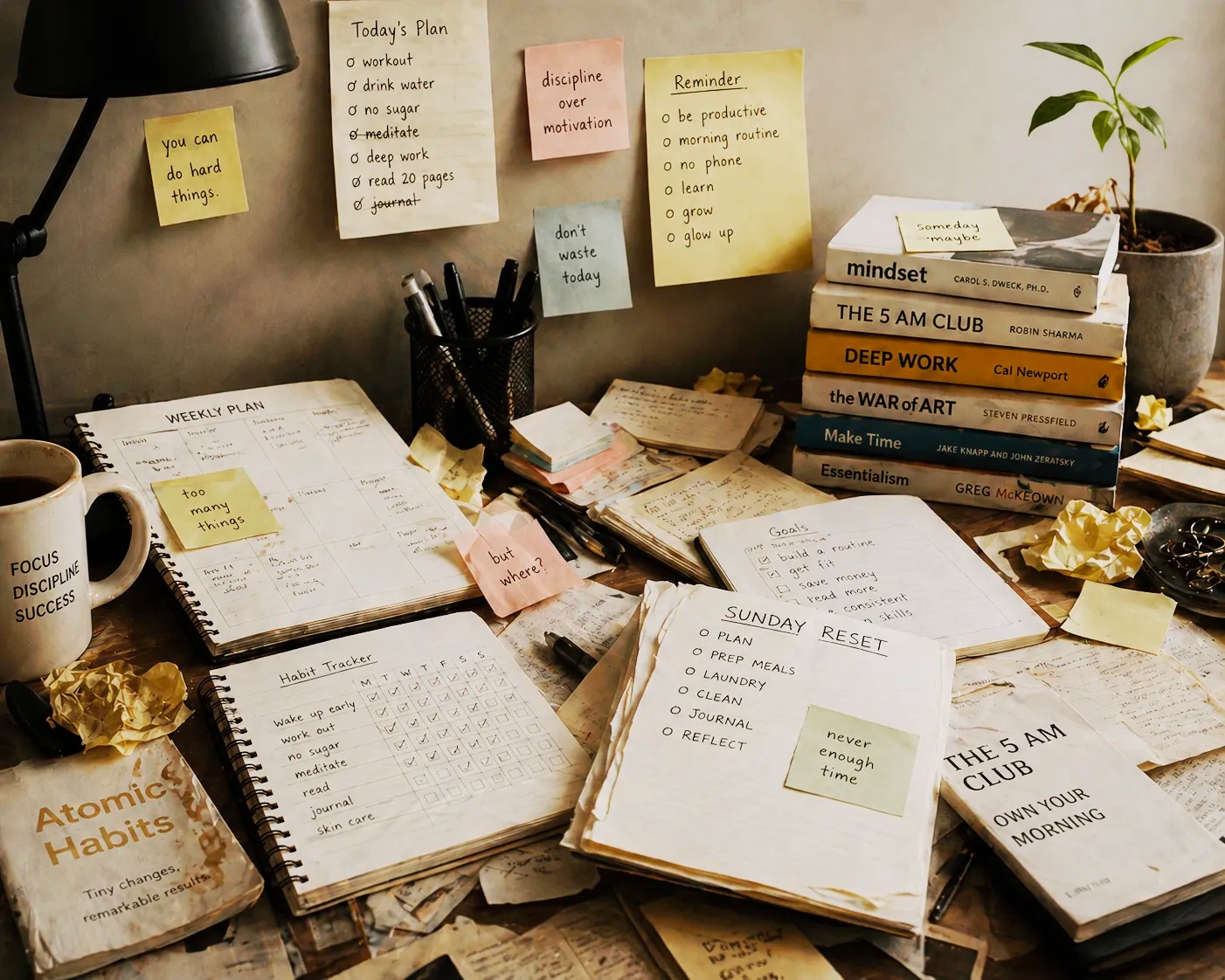
    I had a shelf full of self-help books. A color-coded planner. Three different habit tracking apps on my phone. I’d watched more YouTube videos about discipline and productivity than I’d like to admit. I knew about the Pomodoro technique, time blocking, the 5am club, cold showers, and the power of atomic habits.

    And yet — every single Monday, I was starting over. Same goals. Same intentions. Same quiet promise to myself that this week would be different.

    It never was.

    What I didn’t understand then — and what took me an embarrassingly long time to figure out — is that I was solving the wrong problem. I kept looking for a better system when what I actually needed was a completely different relationship with myself.

    The moment everything shifted

    It happened on a Tuesday evening. I’d missed the gym again. I’d opened my laptop to work on a project and ended up watching videos for two hours instead. I sat there feeling that familiar wave of self-disgust — the same internal monologue I’d had dozens of times before. “You’re so lazy. You have no discipline. What is wrong with you.”

    And then, for the first time, I stopped and actually listened to what I was saying to myself.

    I would never speak to a friend that way. Not once. If a friend told me they’d missed the gym and lost a couple of hours to distraction, I’d tell them it was fine, ask what got in the way, and help them think about tomorrow. I wouldn’t tell them they were fundamentally broken.

    So why was I doing it to myself — and expecting it to help?

    “Discipline built on self-criticism is like trying to grow a plant by stepping on it. The pressure doesn’t help it grow. It just damages the roots.”

    That night I didn’t download a new app or start a new system. I just sat with one question: what if being harsh with myself is actually the thing that’s been keeping me stuck?

    👉 Explore more on Quiet Growth to improve your mindset step by step.

    https://quietgrowthu.wordpress.com/2026/04/21/7-easy-steps-for-a-stress-free-morning-routine/

    What I learned about self-discipline that no productivity guru told me

    Over the months that followed, I started paying attention differently. Instead of asking “how do I force myself to do this,” I started asking “what is actually making this hard?” And the answers surprised me.

    INSIGHT 01

    Willpower was never the problem

    I’d spent years believing I simply didn’t have enough willpower — that other people had some reserve of mental strength I was born without. What I discovered is that willpower is a limited resource that depletes through the day for everyone. The people I admired for their discipline weren’t using more willpower than me. They’d built habits and environments that meant they needed almost none. They weren’t stronger. They were smarter about design.

    INSIGHT 02

    I was trying to change too much at once

    Every new system I tried involved overhauling my entire life simultaneously. New morning routine, new diet, new exercise habit, new work schedule — all at once, all perfectly. My brain was overwhelmed before I’d even started. When I finally committed to changing just one thing — one tiny thing — and doing only that for three weeks, something clicked. The habit stuck. And building on one solid habit turned out to be infinitely easier than trying to rebuild everything from scratch every Monday.

    INSIGHT 03

    Self-criticism was making things worse — not better

    Every time I criticized myself for failing, I increased the discomfort associated with the habit I was trying to build. My brain started linking the habit with shame and failure — which made avoidance more likely next time, not less. When I replaced self-criticism with curiosity — genuinely asking what got in the way rather than punishing myself for it — I started getting useful information instead of just feeling bad. And useful information led to actual change.

    INSIGHT 04

    My environment was working against me

    I had my phone on my desk while trying to work. I kept snacks in easy reach when I was trying to eat better. I had Netflix open in the background during “focus time.” I was relying entirely on willpower in an environment specifically designed to undermine it. When I changed my environment — phone in another room, workspace cleared, distractions physically removed — my behavior changed without me having to try nearly as hard. The discipline was in the design, not the doing.

    INSIGHT 05

    Rest was not the enemy of discipline

    I used to treat rest as a reward to be earned — something I’d allow myself once everything was done perfectly. But everything was never done perfectly, so I was always either pushing through exhaustion or collapsing into guilt-ridden rest. When I started planning rest deliberately — treating it as a requirement rather than a weakness — my consistency over time improved dramatically. A rested version of me showing up at 80% every day for six months produced more than a burned-out version grinding for three weeks and quitting.

    The most important shift wasn’t a new system or a better app. It was deciding to be on my own side. Discipline becomes sustainable the moment you stop treating yourself as the obstacle and start treating yourself as someone worth supporting.

    What actually changed — and what I do differently now

    I still miss days. I still drift sometimes. But the difference now is what happens next. Instead of a spiral of guilt that derails the whole week, I notice, I get curious, I adjust, and I come back. Usually by the next day. Sometimes the same evening.

    The returning is the discipline. Not the perfection.

    I have one habit I focus on at a time. My environment is set up to support me rather than tempt me. When something doesn’t work, I ask why instead of just pushing harder. I rest when I need to and I don’t apologise for it. And I celebrate small wins — genuinely, not as a performance — because the brain learns through positive feedback and I’ve stopped waiting for a grand achievement to feel good about my progress.

    None of this came from a new app or a better color-coded planner. It came from changing the question — from “how do I force myself” to “how do I support myself.”

    Where to start if you’re in the same place I was

    If any of this sounds familiar — the endless new systems, the Monday restarts, the self-criticism that feels productive but isn’t — here’s the simplest possible place to begin.

    Choose one habit. The smallest version of it you can imagine. Not “exercise every day” but “put on my shoes.” Not “journal every morning” but “open my notebook.” Do that one thing tomorrow. Notice how it feels. Be curious if it doesn’t happen. Come back the day after without guilt.

    That’s it. That’s the whole system. Everything else grows from there.

    You don’t need more discipline. You need a kinder, smarter relationship with yourself. Start there — and watch how much easier everything else becomes.

  • “This One Positive Mindset Shift Can Change Your Entire Life”

    “This One Positive Mindset Shift Can Change Your Entire Life”

    A positive mindset isn’t something you either have or don’t have. It’s something you build — one small habit at a time. Start with today. One intention, one moment of gratitude, one reframed thought. That’s enough for now.

    Building a positive mindset doesn’t mean smiling through everything or pretending life is perfect. It means training yourself to respond to challenges with clarity and calm instead of panic and self-doubt. And that’s something anyone can learn — including you.

    The good news is you don’t need a dramatic life change to get there. Small, consistent daily habits are what actually shift how you think over time. This guide walks you through exactly what those habits are and how to build them one step at a time.

    What a positive mindset actually means

    A lot of people confuse a positive mindset with toxic positivity — the idea that you should always be happy and never acknowledge anything negative. That’s not what this is about.

    A genuinely positive mindset means you acknowledge difficulties honestly, but you don’t let them define you. You focus on what you can control, learn from what goes wrong, and keep moving forward even when it’s hard. It’s not about how you feel — it’s about how you respond.

    You’re not trying to eliminate negative thoughts. You’re training yourself to not be controlled by them. That’s a very different goal — and a much more achievable one.

    10 habits to build a positive mindset

    HABIT 01

    Start your day with intention, not your phone

    The first few minutes after you wake up set the tone for everything that follows. When you reach for your phone immediately, you hand control of your mood to whoever posted last night. Instead, take 5 minutes to breathe, stretch, or simply sit quietly before the day begins. It’s a small shift that creates a big difference in how grounded you feel through the day.

    HABIT 02

    Notice and reframe your inner self-talk

    The voice inside your head is talking constantly — and for most people, it’s not very kind. “I’m not good enough,” “I always mess this up,” “everyone else has it figured out.” These thoughts feel like facts but they’re not. Start noticing them. When a harsh thought appears, ask yourself: would I say this to a friend? If not, reframe it. Not “I’m terrible at this” but “I’m still learning this.” Over time, this rewires how your brain narrates your life.

    HABIT 03

    Focus on what you can control

    A huge amount of anxiety and negativity comes from spending mental energy on things you have no power over — other people’s opinions, past mistakes, uncertain outcomes. Every time you catch yourself there, gently redirect to what you can actually influence: your effort, your response, your next action. This one shift alone can dramatically reduce daily stress.

    HABIT 04

    Practice gratitude — but make it specific

    Generic gratitude lists (“I’m grateful for my health, my family, my home”) quickly become automatic and lose their impact. Instead, try to be specific every day. “I’m grateful that my colleague helped me with that task today.” “I’m grateful the weather was nice on my walk.” Specificity makes your brain actually search for the good in your day — which is the whole point. Just 3 specific things each evening is enough.

    HABIT 05

    Be intentional about what you consume

    Your mindset is shaped by what you feed it daily. Constant negative news, social media comparison, and people who drain your energy all quietly pull your thinking in a darker direction. You don’t need to cut everything out — just become more deliberate. Follow accounts that genuinely inspire you. Read a few pages of something useful each day. Spend more time with people who build you up. Small inputs, consistent over time, reshape your inner world.

    HABIT 06

    Take care of your body — it affects your mind directly

    Poor sleep makes everything feel harder and more threatening than it is. Skipping meals affects concentration and mood. Sitting still all day builds tension in your body that shows up as mental irritability. These aren’t separate issues — your physical state and mental state are deeply connected. Even small improvements here — sleeping 30 minutes more, going for a short walk, drinking more water — have a measurable impact on how positively you think.

    HABIT 07

    Build a simple stress management habit

    Stress is unavoidable — but letting it build unchecked is what damages your mindset over time. You need a release valve. For some people it’s deep breathing. For others it’s a short walk, journaling, or even just sitting in silence for 5 minutes. The specific method matters less than the consistency. Pick one thing that genuinely calms you down and use it every day — not just when you’re at breaking point.

    HABIT 08

    Take action — even imperfect action

    One of the fastest ways to build a positive mindset is to stop waiting until you feel ready. Confidence doesn’t come before action — it comes from action. Start something small, finish it, and notice how that feels. Then do it again. Each small win builds evidence that you are capable, which gradually replaces the self-doubt with something more useful: proof.

    HABIT 09

    Let go of the need to be perfect

    Perfectionism is one of the most common hidden causes of a negative mindset. When the standard is perfection, everything short of it feels like failure — which means you feel like you’re failing constantly. Replace the goal of perfection with the goal of progress. Progress is measurable, achievable, and motivating. Perfection is a moving target that keeps you stuck.

    HABIT 10

    Be patient — mindset change takes time

    You didn’t develop your current thinking patterns overnight, and you won’t replace them overnight either. Expect slow, uneven progress. Some days will feel like you’ve gone backwards. That’s completely normal. What matters is that you keep showing up. The compound effect of small daily habits is real — you just have to give it enough time to work.

    A simple daily routine to support your mindset

    Here’s a beginner-friendly structure you can follow straight away — it takes less than 15 minutes total:

    Morning5 minutes of quiet before your phone. Set one intention for the day.

    Afternoon When a negative thought appears, name it and redirect to what you can control.

    Evening Write 3 specific things you’re grateful for from today.

    Before bed Reflect on one small win from the day — no matter how small.

    Don’t try to build all 10 habits at once. Pick two that feel most relevant to you right now and do those consistently for two weeks. Then add one more. Slow is sustainable.

    The most common mindset mistakes

    The biggest mistake is expecting fast results. Mindset change is slow and invisible at first — like planting seeds. Most people give up before anything grows. The second most common mistake is trying to suppress negative thoughts entirely. Pushing thoughts away makes them stronger. Acknowledging them without judgment, then redirecting, is far more effective.

    The third mistake is comparing your inner world to other people’s outer world. What you see on social media is a highlight reel — not someone’s full reality. Comparison on those terms is always unfair to yourself.

    👉 Explore more on Quite Growth to improve your mindset step by step.

  • How to Reduce Overthinking — Simple Techniques That Actually Work

    How to Reduce Overthinking — Simple Techniques That Actually Work

    Overthinking is exhausting. One small worry turns into ten, a simple decision feels impossible, and your mind just won’t quiet down. If that sounds familiar, you’re not alone — and you’re not broken. You just need a few simple techniques to interrupt the pattern.

    Overthinking isn’t a flaw — it’s a habit. And habits can be changed. Start with one technique from this list today, use it consistently, and watch how much quieter your mind becomes over time.

    You don’t need hours of meditation or a therapist’s couch. The techniques in this guide are practical, beginner-friendly, and take just a few minutes. The key is knowing which ones to use and when.

    Why overthinking is so hard to stop

    Most people try to stop overthinking by telling themselves to “just stop thinking about it.” That almost never works. Trying to suppress a thought actually makes it stronger — your brain treats it as important and keeps bringing it back.

    The real solution isn’t to silence your thoughts. It’s to change your relationship with them. When you learn to observe thoughts without getting caught up in them, they naturally lose their grip on you. That’s what these techniques help you do.

    8 techniques to reduce overthinking

    TECHNIQUE 01

    Use deep breathing to slow the spiral

    When your mind races, your breathing becomes shallow — and shallow breathing keeps your nervous system in a stressed state. Slowing your breath breaks that cycle. Try inhaling for 4 seconds, holding for 4, and exhaling for 6 seconds. Repeat for 2 to 3 minutes. The longer exhale is key — it activates your body’s relaxation response and brings your focus back to the present moment almost immediately.

    TECHNIQUE 02

    Name what you’re feeling

    Overthinking often feels chaotic because all your thoughts are tangled together. One of the simplest ways to create distance from them is to label what’s happening. Pause, notice the thought, and give it a name — “this is worry,” “this is fear,” “this is doubt.” It sounds almost too simple, but naming a thought creates just enough mental distance for you to stop being swept away by it. You’re observing it, not living inside it.

    TECHNIQUE 03

    Ground yourself in the present moment

    Overthinking pulls you into the past (“I should have done that differently”) or the future (“what if this goes wrong”). Grounding brings you back to right now. Look around and name 5 things you can see, 4 things you can physically feel, and 3 sounds you can hear. This simple exercise interrupts the thought loop by forcing your brain to engage with what’s real and immediate — not imagined or remembered.

    TECHNIQUE 04

    Schedule a “worry time”

    Trying to ban all worried thoughts backfires — your brain rebels. Instead, give your worries a time slot. Set aside 10 to 15 minutes each day, write your worries down during that time, and then gently postpone any worried thought that shows up outside that window with “I’ll think about that at worry time.” Over days and weeks, this trains your brain to stop treating every moment as the right time to panic. It sounds strange but it genuinely works.

    TECHNIQUE 05

    Write your thoughts down

    Your mind feels crowded when everything is swirling around inside it with nowhere to go. Journaling gives your thoughts an exit. Spend 5 to 10 minutes writing freely — don’t edit, don’t judge, just let it out. Once a thought is on paper, your brain no longer needs to keep cycling back to it. You’ve recorded it. This alone can reduce mental noise significantly, especially before bed when overthinking tends to peak.

    TECHNIQUE 06

    Reduce the triggers you can control

    Some habits quietly feed overthinking without you realising it. Too much social media, especially late at night, floods your brain with comparison and information. Poor sleep makes every thought feel more threatening than it is. Constantly consuming negative news keeps your nervous system on edge. You don’t need to cut everything out — just become aware of which habits leave you feeling worse, and start there.

    TECHNIQUE 07

    Take one small action

    Overthinking grows in inaction. The longer you sit with a problem without doing anything about it, the bigger it feels. A useful rule: if something takes less than 5 minutes, do it now. For bigger things, take just one small step — send the message, make the list, book the appointment. Action, even tiny action, breaks the paralysis and reminds your brain that you are capable of moving forward.

    TECHNIQUE 08

    Build a short daily mindfulness practice

    You don’t need a long meditation session. Even 2 minutes of focused breathing in the morning, eating one meal without your phone, or walking without headphones — these small acts of presence build your ability to stay in the moment over time. Mindfulness isn’t about achieving a quiet mind. It’s about noticing when you’ve drifted and gently coming back. The more you practice, the easier that becomes.

    A simple daily routine to manage overthinking

    Here’s an easy structure you can follow each day — it takes less than 20 minutes in total:

    Morning2 minutes of deep breathing before you check your phone. Set your three priorities for the day.

    Afternoon When you feel a thought spiral starting, name it and do the 5-4-3 grounding exercise.

    Evening10 minutes of free journaling. Write whatever’s on your mind without editing.

    Before bed No phone for the last 30 minutes. Let your mind wind down naturally.

    Don’t try all 8 techniques at once. Pick one, use it consistently for a week, and notice what shifts. Then add another. Small changes done consistently beat big changes done once.

    What not to do

    The biggest mistake is trying to force your thoughts to stop. Fighting your own mind is exhausting and counterproductive. The goal isn’t to have no thoughts — it’s to stop letting every thought control how you feel.

    The second mistake is expecting instant results. Overthinking is a habit that built up over months or years. Changing it takes consistent practice, not one perfect day. Be patient with yourself — noticing that you’re overthinking is already progress.

     Follow Quiet Growth U for more simple lifestyle improvements.