
Tag: emotional health

  • Why You Overthink Decisions That Don’t Matter — And What’s Actually Going On

    Why You Overthink Decisions That Don’t Matter — And What’s Actually Going On

    I once spent forty-five minutes deciding what to order at a restaurant. Not a life-changing restaurant. Not a particularly unusual menu. An ordinary Tuesday evening, an ordinary dinner, and somehow forty-five minutes of my finite life went into a decision that I will not remember making in six months and that carried approximately zero consequence either way.

    And the frustrating thing — the thing that made it worse — is that I knew it didn’t matter while I was doing it. I knew, intellectually and clearly, that the difference between the pasta and the risotto was not going to alter the trajectory of my life in any meaningful way. And I ordered the pasta anyway, and felt vaguely uncertain about it until the food arrived, at which point I thought about whether I should have ordered the risotto, and then I ate the pasta and it was fine, and I have not thought about it since.

    But in the moment — in the forty-five minutes of the moment — it felt like it mattered. Not intensely, not dramatically, but with just enough weight to keep me from simply choosing and moving on. And that feeling — the feeling that a low-stakes decision somehow requires extended deliberation — is something I’ve been trying to understand ever since, because it doesn’t just happen at restaurants. It happens everywhere. What to reply to a message. Which route to take. Whether to bring a jacket. What to say in an email that doesn’t really require that much thought. Small things, ordinary things, things that in any rational assessment of the situation could be decided in thirty seconds and forgotten immediately — and yet somehow aren’t.

    “The overthinking was never really about the decision. It was about something else entirely — something wearing the decision’s clothes.”

    What I eventually understood is that overthinking small decisions is almost never actually about the decision. The decision is just the surface. Underneath it — running quietly, shaping the whole process without announcing itself — is something more fundamental. For some people it is a deep-rooted fear of making the wrong choice, even in low-stakes situations, because somewhere in the past making the wrong choice had consequences that were painful enough to leave a mark. The nervous system learned that decisions are risky. And now it applies that learning indiscriminately, to the pasta and the risotto, to the jacket and no jacket, to the reply that really doesn’t need this much thought.

    For others it is something adjacent to perfectionism — the belief, operating mostly below consciousness, that there is a right answer to every question and that the task is to find it before committing. Which means that even trivial decisions get subjected to the same exhausting search for the optimal outcome that genuinely important decisions warrant. The brain doesn’t automatically calibrate the effort to the stakes. You have to do that manually. And if nobody has ever taught you how — or if the habit of thoroughness was praised often enough that it calcified into a default mode — you end up applying the same cognitive resources to dinner choices that you apply to career decisions, and wondering why you’re tired all the time.

    There is also, I think, something about control. Small decisions are one of the few places in life where you have complete authority over the outcome — nobody else’s preferences, no external constraints, just you and the choice. And for people who carry a general background anxiety about the parts of their life they cannot control, that complete authority can paradoxically make the decision harder rather than easier. The stakes feel higher because the responsibility is entirely yours. If it goes wrong — if the pasta is disappointing, if the jacket was unnecessary, if the reply landed badly — there is nobody else to share that with. It was your call. Which means it is your fault. Which means, for an anxious brain, it is worth getting right. Even if right and wrong are essentially indistinguishable from each other.

    “An anxious brain does not triage by importance. It treats everything as potentially important — because the cost of missing something is higher, in its calculation, than the cost of overthinking everything.”

    Once I understood this — that the overthinking was a symptom rather than a habit, a signal rather than a character flaw — something changed in how I approached it. Not immediately, not completely, but gradually and in a direction that has held. The change was not about making faster decisions, exactly. It was about changing the question I was asking when a decision arrived. Instead of which option is best — a question with no reliable answer for most small choices — I started asking does this actually matter. And if the honest answer was no, I gave myself a rule: decide in thirty seconds and move on. Not because the decision wasn’t worth making carefully but because careful, for something that doesn’t matter, is a form of overthinking disguised as thoroughness.

    I started noticing when I was spending more mental energy on a decision than its actual stakes warranted — which is easier to notice than it sounds, because there is usually a moment, somewhere in the middle of an extended deliberation about something trivial, when a part of you becomes aware that this has gone on longer than it needed to. That moment of awareness is the signal. Not to criticize yourself for overthinking, but to recognize it as the signal it is — that something other than the decision itself is driving the process — and to gently, deliberately, choose anyway.

    Because here is what I have learned, slowly and through a lot of unnecessarily extended restaurant deliberations: most small decisions are genuinely reversible, and most of the ones that aren’t reversible are still not as consequential as the overthinking makes them feel. The pasta is fine. The reply is fine. The jacket is fine either way. The thirty seconds you save by deciding faster do not add up to very much individually. But the cumulative effect of not spending your cognitive energy on decisions that don’t require it — of reserving that energy for the things that actually do — is significant. You are less tired. Less anxious. More present for the things that matter because you haven’t been depleted by the things that don’t.

    And occasionally — when the overthinking returns, as it does, as it probably always will to some extent — I try to remember to be curious about it rather than frustrated. To ask what it is telling me rather than just willing it to stop. Because the overthinking is not random. It shows up more when I’m stressed, more when I’m tired, more when something elsewhere in my life feels uncertain or out of control. It is a signal from a nervous system that is carrying more than it’s letting on — and the pasta was just where it chose to put that down for a moment.

    That is worth knowing. Not because it makes the overthinking stop. But because understanding it means you can respond to it with something more useful than frustration — with a little curiosity, a little self-compassion, and eventually, a decision. Any decision. Because almost always, that is genuinely enough.

    Next time you catch yourself overthinking something small, ask one question honestly: does this actually matter? If the answer is no — decide in thirty seconds. Not because the decision isn’t real, but because the overthinking is costing you more than the decision ever could.

    The overthinking is not the problem. It is the signal. Start listening to what it is telling you — and then make the decision anyway. Any decision. Almost always, that is enough. Explore more on Quiet Growth for simple daily habits that support a calmer, more focused life.


  • Cringing at Your Past Self Is Actually Something to Be Proud Of

    Cringing at Your Past Self Is Actually Something to Be Proud Of

    It hits you at random. In the shower, on the commute, in the ten minutes before sleep when your brain apparently decides it is an excellent time to replay every embarrassing thing you have ever said or done. A memory surfaces — something you said in a meeting three years ago, a message you sent that you would never send now, a version of yourself that felt completely fine at the time and makes you physically wince to think about today. The shoulders tense. The eyes close. You make a sound that isn’t quite a word. You would very much like to not have been the person who did that.

    And here is the thing nobody says out loud about that feeling — the cringe, the retroactive embarrassment, the quiet horror at who you used to be. Nobody tells you that it is one of the clearest signs of growth you will ever experience. Because you cannot cringe at a version of yourself you haven’t grown beyond. The reason that old message makes you wince, the reason that photo from five years ago makes you laugh-grimace, the reason certain memories produce that very specific kind of embarrassment — is that you are not that person anymore. You have moved. And the cringe is just the distance between then and now, made visible.

    Think about it for a moment. The things from your past that don’t make you cringe — the choices you’re still proud of, the things you said that still sound right, the decisions that hold up — those are the places where your past self and your present self are in alignment. The cringe only happens at the gap. And a gap requires movement. You are cringing because you have grown. That feeling you have been treating as evidence of your fundamental terribleness is actually evidence of your development — just wearing very uncomfortable clothes.

    “You cannot cringe at who you no longer are unless you have become someone different. The cringe is not the proof of your failure. It is the proof of your distance from it.”

    But knowing that doesn’t always make it easier to feel. In the actual moment of cringe — when the memory is vivid and the embarrassment is sitting right there in your chest — it does not feel like growth. It feels like confirmation of everything you have quietly suspected about yourself. And most people handle it the way you probably handle it — by avoiding it. Not looking at old photos from certain periods. Not rereading old journals. Not talking about who you were before you knew better. Keeping the past self at a careful distance, as though the further you push them away the less they have to do with you.

    The trouble is that hiding from your past self is not the same as moving past them. The memories you avoid are the ones that keep the most power over you. The past self you refuse to look at continues to shape how you feel about yourself today — precisely because you have never properly sat with them, accounted for them, or made any kind of peace with the fact that they existed and were you. And they were you. That is the part that makes it hard. Not the specific thing they did or said or believed — but the fact that it was your face, your voice, your name attached to it.

    Here is what your past self was actually doing, though. They were navigating life with the information, the maturity, the self-awareness, and the emotional resources they had at the time. Which were less than you have now. Not because they were lesser — but because they were earlier. The confident opinion you held at twenty that makes you cringe today was held confidently because you didn’t yet have the experiences that would complicate it. The thing you said that landed badly was said without the communication skills that would have caught it. The decision that looks obviously wrong in retrospect was made without the information that retrospect provides.

    Your past self was not stupid. They were earlier. And there is a meaningful difference between those two things that most of the shame surrounding the cringe ignores entirely. Stupidity implies an absence of capacity. Earliness implies an absence of experience. You had the capacity. You hadn’t yet had the life that would teach you what to do with it. Nobody arrives at wisdom without passing through every version of themselves that didn’t have it yet — including the ones that are currently making your future self cringe in ways you cannot yet imagine.

    “Your past self was not a worse version of you. They were an earlier version — doing their best with what they had, which was less than you have now, which is less than you will have later.”

    The shift that changes everything — from cringing with shame to something closer to laughing with affection — requires only one thing to change: the relationship you have with imperfection. Shame treats imperfection as evidence of fundamental inadequacy. Affection treats it as evidence of being human — which is inevitable, forgivable, and even a little endearing when seen from enough distance. You can see this in the way other people tell stories about their past selves. The friend who recounts their most catastrophic phase with genuine warmth and laughter — that person has found the distance that turns cringe into story. And story is something you can share. Something that connects rather than isolates. Something that makes other people exhale and quietly think — me too.

    Your past self deserves that treatment. Not the sanitizing version — not pretending they didn’t say the thing or hold the misguided opinion or make the questionable choice. The honest version. The one that sees them clearly, understands what they were working with, and responds with the same patient warmth you would offer to anyone who was earlier in their journey and doing their imperfect best.

    When the cringe comes — and it will — try something different this time. Instead of immediately flinching away from it, let it sit for just a moment. Ask it what it is showing you. What do you understand now that you didn’t understand then? What has changed? What does that gap tell you about how you have moved? Because the cringe, examined rather than avoided, becomes one of the most honest and specific measures of your own growth available to you. It shows you exactly where you have been and how far you have come — which is something a habit tracker or a journal prompt cannot always do.

    And when you can — tell the stories. The ones you have been keeping private because they are embarrassing, because they don’t fit the version of yourself you prefer to present. Tell them with the honesty and warmth that distance makes possible. You will find, almost without exception, that the stories you were most ashamed of are the ones that most reliably make other people say — quietly, with relief — I thought it was just me.

    It was never just you. It was never a sign that you were uniquely broken or uniquely behind or uniquely incapable of getting it right. It was the universal, unglamorous, entirely necessary experience of being a person who is still growing — which is all any of us are, at every stage, in every version of ourselves we have ever been or will ever be.

    Your past self did their best. Your present self is doing theirs. And your future self will look back at today — at this version of you, with your current certainties and your current blind spots and your current confident opinions that will later complicate — with exactly the same mixture of affection and mild amusement you now bring to your past. That is not failure. That is the shape of a life that keeps growing. Quiet, continuous, imperfect, entirely human growth.

    The cringe, when you learn to read it right, is just the sound of it happening.

    Next time a cringe memory surfaces — instead of fleeing it, ask one question: what do I know now that I didn’t know then? The answer is your growth made visible. That gap between who you were and who you are is not something to be ashamed of. It is something to be grateful for.

    Your past self did their best. Your present self is doing theirs. And your future self will look back at today with the same affection and mild amusement you now bring to your past. That is not failure — that is growth. Quiet, continuous, entirely human growth. Explore more on Quiet Growth for simple daily habits that support a calmer, more focused life.

  • The Quiet Power of Solitude — And What Happens When You Finally Sit With Yourself

    The Quiet Power of Solitude — And What Happens When You Finally Sit With Yourself

    You are rarely alone. Even when there is nobody physically present, you are accompanied — by your phone, by music, by podcasts, by the background noise of something playing that you’re not quite watching. The silence that used to exist between one thing and the next has been almost entirely filled in. The commute, the meal, the five minutes before sleep, the moment between waking and beginning the day — all of it occupied, all of it accompanied, none of it quiet.

    And you have gotten very good at not noticing that this is the case. Because the noise is comfortable. Because the silence, when it occasionally arrives, feels faintly uncomfortable — like a room that’s slightly too empty, like a conversation that has paused a beat too long. Because somewhere along the way, without particularly deciding to, you learned to be slightly afraid of your own company.

    This post is about what happens when you stop filling the silence. When you sit with yourself — genuinely, without a screen or a soundtrack or anything to hide behind — and discover that the person you meet there is someone worth knowing.

    The life that never had a quiet moment

    Think about the last time you were genuinely alone with your own thoughts — not distracted, not occupied, not consuming anything. Not falling asleep, not doing something that required attention. Just sitting, or walking, or existing, without any input from outside yourself.

    For most people, the honest answer is that they cannot remember. Not because solitude is impossible but because it has become unfamiliar — and unfamiliar things are easy to avoid without quite realizing you are avoiding them. The phone fills the gap before the discomfort of the gap has time to register. The earbud goes in before the silence has a chance to say anything. The scroll begins before the stillness can settle.

    And what gets lost in all of that filling — what quietly disappears when every moment is accompanied — is your relationship with yourself. Because that relationship, like any other, requires time and attention and the willingness to simply be present with the other person. When you never give yourself that time, never sit with your own thoughts long enough to hear what they actually are, you end up living at a slight remove from your own inner life. Functioning, relating, producing — but not quite knowing, at any deep level, what you actually think, feel, want, or are.

    “You can spend an entire life in the company of other people and the noise of the world and never once properly meet yourself. Solitude is where that meeting happens.”

    What solitude is not

    Solitude is not loneliness. This distinction matters more than it might initially seem, because the two feel similar from the outside — both involve being alone — but they are entirely different experiences from the inside. Loneliness is the pain of unwanted isolation, the feeling of being disconnected from others against your will. Solitude is the deliberate, chosen experience of being with yourself — and it is, when genuinely accessed, not painful at all. It is nourishing in a way that almost nothing else is.

    Solitude is also not the same as being physically alone. You can be alone in a room and not be in solitude — if your phone is in your hand and your attention is fractured across seventeen different inputs, you are alone but not solitary. And you can be in a crowded place and find something approaching solitude — in a moment of genuine internal stillness, a few minutes of walking without headphones, a pause in which you are actually present with yourself rather than present with whatever the screen is showing you.

    What defines solitude is not the absence of other people. It is the presence of yourself — your full, undistracted, unhurried attention turned inward rather than outward. That experience is rarer than being physically alone, and more valuable. And it is almost entirely unavailable to people who have filled every quiet moment with noise.

    What you find when you sit with yourself

    The first thing most people find, when they first attempt genuine solitude, is discomfort. Thoughts that had been kept at bay by noise and occupation start surfacing — worries, memories, questions without answers, feelings that were easier to not feel while something else had your attention. This discomfort is real and it is the primary reason most people reach for the phone within minutes of any extended quiet. It is not weakness. It is simply the experience of meeting a backlog — the accumulated internal material that has been waiting, patiently, for a moment of stillness in which to be acknowledged.

    If you stay with the discomfort — if you resist the reflex to fill it — something shifts. The thoughts that felt threatening become, gradually, just thoughts. The feelings that seemed too big to sit with reveal themselves to be manageable when actually felt rather than avoided. The noise inside, which seemed to require external noise to drown it out, gradually quiets on its own. Not completely, not permanently — but enough for something else to become audible beneath it.

    That something else is you. Not the performed version — the one that knows what to say in conversations, that functions well and presents appropriately and meets the expectations of other people. The actual version. The one that has opinions you haven’t articulated, preferences you haven’t honored, values you haven’t examined, fears you haven’t named, and a perspective on your own life that is more honest and more useful than anything anyone else can offer you — if you are willing to be still long enough to hear it.

    Solitude is where self-knowledge lives. Not the self-knowledge that comes from personality tests or other people’s observations or the image you present to the world. The self-knowledge that comes from being genuinely, quietly present with yourself — noticing what you feel when nobody is watching, what you think when nobody is asking, what you want when the noise has quieted enough for want to surface at all.

    “In the noise, you know what everyone else thinks and feels and wants. In the silence, you find out what you do.”

    What regular solitude does over time

    The first and most significant thing it does is make you more honest with yourself. When you spend regular time in your own company — genuinely, without distraction — you gradually become less able to sustain the comfortable fictions that constant occupation makes easy. The situation you have been telling yourself is fine reveals itself, in quiet, as not fine. The direction you have been moving in shows itself, in stillness, as not quite the direction you actually want. The relationship, the job, the habit, the belief — things that were easier to not examine while everything was loud become harder to avoid when the noise is gone. This is uncomfortable. It is also one of the most valuable things that can happen to a person.

    The second thing solitude does is make you more creative. The default mode network — the brain’s resting state, associated with creative thinking and the making of novel connections — activates most fully in quiet and stillness. Ideas that would never have arrived in a scheduled brainstorm, solutions that focused effort cannot reach, perspectives that only emerge when the analytical mind is briefly at rest — these are the products of genuine solitude. Some of the most significant thinking in human history has happened in quiet — in walks, in silence, in the deliberate absence of external stimulation. That capacity is available to you in any quiet moment you are willing to protect.

    The third thing is that it makes you significantly better company for other people. This is perhaps the most counterintuitive gift of solitude — that time spent alone, genuinely and intentionally, makes your time with others richer, more present, and more genuinely connected. When you know yourself well — when you have spent enough time in your own company to understand what you actually think and feel and want — you bring that clarity into your relationships. You are less reactive, less dependent on others to tell you who you are, less likely to lose yourself in the noise of what other people need and expect from you. You arrive in conversations as someone who is actually there — not performing presence, but genuinely present.

    How to begin — and why five minutes is enough

    You do not need a retreat or a meditation practice or a significant restructuring of your life to access solitude. You need five minutes and the willingness to not fill them.

    Tomorrow morning, before your phone, sit somewhere quiet for five minutes. Not to meditate, not to journal, not to plan — just to sit. Let whatever thoughts arrive arrive. Notice them without following them. Notice the room, the light, the sounds outside. Notice how your body feels. Notice what surfaces when there is nothing to respond to and nothing to consume. Stay with it even if it feels slightly uncomfortable. Five minutes is short enough that the discomfort never becomes overwhelming — and long enough to make contact with something real.

    Do it again the next morning. And the one after that. Extend it slightly when it starts to feel more comfortable — to ten minutes, then fifteen. Take a walk without headphones once a week. Eat one meal without a screen. Sit in a park or beside a window for a few minutes without anything to do. Create small, regular pockets of genuine quiet in a life that has been filling every gap with noise.

    What you are building, in those small pockets, is a relationship — the most important one you will ever have. The one with yourself. And like any relationship worth having, it requires time, attention, and the willingness to show up even when it is slightly uncomfortable — especially when it is slightly uncomfortable. Because the discomfort, almost always, is where the most useful things live.

    The quality of your relationship with yourself determines the quality of everything else — your relationships, your work, your decisions, your sense of direction and purpose. Solitude is not a luxury or an indulgence. It is maintenance for the most important relationship in your life. Give it five minutes today.

    The thing about quiet growth

    The name of this blog is not accidental. Quiet growth — the kind that happens slowly, internally, without performance or announcement — is almost entirely dependent on solitude. You cannot grow quietly if you are never quiet. You cannot evolve silently if the silence is always filled. The most significant changes in how you understand yourself, how you move through the world, what you choose and why — these happen in the spaces between the noise. In the moments you protect from occupation. In the five minutes before the phone, the walk without the podcast, the evening without the screen.

    Solitude is not the absence of growth. It is the condition in which growth becomes possible. Give yourself some. Today, if you can. Five minutes. A quiet room. No phone. Just you — and the version of yourself that has been waiting, patiently, for you to show up and listen.

    Today — before your phone, before the noise begins — sit somewhere quiet for five minutes. Don’t meditate, don’t plan, don’t journal. Just sit. Let whatever arrives arrive. That is the beginning of the most important relationship you will ever build. Explore more on Quiet Growth for simple daily habits that support a calmer, more focused life.

  • Do you know? The Pressure to Be Positive Is Making Your Mental Health Worse

    Do you know? The Pressure to Be Positive Is Making Your Mental Health Worse

    You’re having a hard day. Not a catastrophic one — just hard. You’re tired, a little low, carrying something heavy that you can’t quite name. And then someone says it.

    “Just think positive.”

    “Focus on the good things.”

    “Everything happens for a reason.”

    And instead of feeling better, you feel worse. Not just because the advice didn’t help — but because now you feel guilty for not feeling better. Like your inability to simply choose positivity is its own kind of failure. Like your bad mood is a personal failing rather than a human experience.

    If that sounds familiar — this post is for you.

    The world that told you to just be positive

    You grew up in a world that was deeply uncomfortable with negative emotion. Sadness was something to fix. Anger was something to suppress. Anxiety was something to push through. And the solution offered — almost universally — was some version of positive thinking.

    Be grateful. Look on the bright side. Choose happiness. Good vibes only.

    You tried. Of course you tried. You kept gratitude journals and repeated affirmations and smiled through things that deserved tears. You got very good at performing okay ness — at presenting a version of yourself that seemed fine, seemed positive, seemed like someone who had it together.

    And underneath that performance, the real feelings — the ones you weren’t allowed to have — kept building. Because emotions don’t disappear when you ignore them. They just find other ways out. Anxiety that was supposed to be thought-positive away shows up as physical tension. Sadness that was supposed to be gratitude-journaled into perspective shows up as a heaviness that never quite lifts. Anger that was supposed to be reframed into a learning opportunity shows up as resentment that poisons everything quietly from the inside.

    “Forcing positivity doesn’t heal negative emotions. It just buries them somewhere darker and harder to reach.”

    👉 If you found this helpful, explore more posts on Quiet Growth

    What toxic positivity actually does to you

    THE DAMAGE 01

    It teaches you that your real feelings are wrong

    When every difficult emotion is met with a positivity script, the implicit message is that the emotion itself is the problem. That you shouldn’t feel sad, or anxious, or angry — and that feeling those things makes you somehow weak, ungrateful, or broken. Over time, you internalize that message. You stop trusting your own emotional responses. You become an expert at second-guessing whether what you feel is valid — and that self-doubt is its own form of suffering layered on top of the original one.

    THE DAMAGE 02

    It makes you feel more alone in your pain

    When you share something difficult and receive a positivity platitude in return, you don’t just feel helped. You feel unseen. The gap between what you were feeling and what you were told to feel creates a loneliness that is worse than the original pain. Because now you’re not just struggling — you’re struggling alone, in a world that seems to expect you to be fine. And the lonelier the struggle feels, the harder it becomes to reach out next time. The positivity culture that was supposed to connect people is actually isolating them.

    THE DAMAGE 03

    It prevents you from actually processing what’s wrong

    Emotions exist for a reason. Sadness signals loss and the need to grieve. Anger signals a boundary that’s been crossed. Anxiety signals a threat that needs attention. When you bypass these signals with forced positivity, you skip the processing that would actually resolve them. The feeling doesn’t complete its natural cycle — it gets interrupted, suppressed, and stored. And stored emotions don’t dissolve. They accumulate. Until one day something small tips the balance and everything that was being held back comes flooding out at once — and you have no idea why you’re crying over something that shouldn’t matter this much.

    THE DAMAGE 04

    It turns self-awareness into self-criticism

    When you’ve been taught that positive people are healthy people and negative feelings are signs of weakness, noticing your own difficult emotions becomes a source of shame rather than information. Instead of asking “what is this feeling trying to tell me,” you ask “why am I feeling this — what’s wrong with me.” The self-awareness that could have been a tool for growth becomes a weapon you use against yourself. Every difficult emotion becomes evidence of your failure to be the positive, together, healthy person you’re supposed to be.

    THE DAMAGE 05

    It makes genuine happiness harder to reach

    Real joy — the kind that feels full and genuine rather than performed — requires contrast. It requires the ability to feel the full range of human emotion, including the difficult ones. When you spend your energy suppressing the lows, you also blunt the highs. The emotional range narrows. Everything starts to feel flat — not quite sad, not quite happy, just a kind of numb, that you perform convincingly while privately wondering why you don’t feel more. The positivity that was supposed to make you happier has paradoxically made genuine happiness harder to access.

    You are not obligated to feel positive. You are not obligated to reframe every hard thing into a lesson. Sometimes hard things are just hard — and the most mentally healthy response is to let them be hard, feel what comes up, and move through it at your own pace.

    What actually helps — instead of forced positivity

    The alternative to toxic positivity isn’t toxic negativity. It isn’t wallowing, catastrophizing, or giving up on feeling better. It’s something quieter and more honest — it’s called emotional acknowledgment, and it’s one of the most powerful things you can do for your mental health.

    It starts with stopping. When something difficult comes up, instead of immediately reaching for a reframe or a bright side, you pause. You notice what’s there. You name it — not to someone else necessarily, but to yourself. “I’m feeling sad right now. I’m feeling overwhelmed. I’m feeling afraid.” Just that. No fixing, no reframing, no positivity overlay.

    And then you let it be there for a moment. Not forever. Not without limit. Just long enough for it to complete its natural cycle — to be felt, acknowledged, and released rather than suppressed and stored.

    This is what allows emotions to actually pass. Not forcing them away — letting them move through. And what you discover when you stop fighting your difficult feelings is that they are, almost without exception, more manageable than the energy you were spending to avoid them.

    A different kind of positive thinking

    None of this means giving up on hope, gratitude, or a genuinely optimistic outlook on life. Those things are real and valuable. But real optimism isn’t the absence of negative emotion — it’s the confidence that you can feel difficult things and survive them. That hard days are part of a life that also contains good ones. That you don’t have to be positive all the time to be okay.

    The healthiest people you will ever meet are not the ones who never feel sad, anxious, or angry. They’re the ones who feel those things fully, without shame, and trust themselves to come back to okay on the other side. That’s the kind of mental health worth building. Not a performance of positivity — a genuine resilience that comes from knowing yourself well enough to feel everything and still be alright.

    Next time someone tells you to just be positive — or next time you tell yourself that — try this instead. Ask: what am I actually feeling right now? Name it. Let it be there for a moment. Then ask: what do I actually need? The answer will be far more useful than any positivity script.

    What to do starting today

    You don’t have to overhaul anything. You don’t need a new system or a new routine. You just need to give yourself one permission that maybe nobody has given you before — the permission to feel what you actually feel, without immediately trying to fix it, reframe it, or replace it with something more palatable.

    Start small. The next time a difficult emotion comes up, pause before you reach for a bright side. Name what’s there. Let it sit for two minutes. Notice what happens. You might be surprised to find that being honest with yourself about how you feel is less frightening — and far more relieving — than you expected.

    Quiet growth isn’t always about adding something new. Sometimes it’s about removing something that was never actually helping — like the pressure to be positive all the time. Letting that go might be the most genuinely positive thing you do all week.

    You don’t have to be positive to be okay. You just have to be honest. With yourself, about what you’re feeling, in whatever quiet moment you can find. That honesty — uncomfortable as it sometimes is — is where real healing begins. Explore more on Quiet Growth for simple daily habits that support a calmer, more focused life.

  • Why Self-Improvement Can Sometimes Make You Feel Worse

    Why Self-Improvement Can Sometimes Make You Feel Worse

    There was a period in my life when I was doing everything right. I was waking up early, journaling every morning, meditating, tracking my habits, reading personal development books, eating well, exercising regularly, and going to bed at a reasonable hour.

    And I was absolutely miserable.

    Not in an obvious way. Not in the way where you know something is wrong. It was more of a quiet, persistent heaviness — a feeling that no matter how much I did, it was never quite enough. That I was always one habit away from being the person I was supposed to be. That everyone else was growing faster, doing more, becoming better — and I was falling behind in my own self-improvement journey.

    Which is a sentence that sounds ridiculous when you say it out loud. Falling behind in your own journey. But that’s exactly how it felt.

    When the cure becomes the problem

    I’d started the whole thing from a good place. I was going through a difficult period and self-improvement felt like something I could control — a way to feel better by becoming better. And for a while, it worked. The structure helped. The habits helped. The sense of progress helped.

    But somewhere along the way, the tools I was using to feel better became the measuring stick by which I decided whether I was allowed to feel good about myself. Miss a meditation session — bad day. Skip the journaling — failed. Eat something unplanned — setback. Stay up too late — starting over.

    The self-improvement journey, which was supposed to be about growth, had quietly become about performance. I wasn’t growing toward something. I was running from something — from the feeling that who I currently was wasn’t good enough.

    “I wasn’t doing self-improvement. I was doing self-punishment with better branding.”

    That line came from something I wrote in my journal on a particularly difficult evening, and it stopped me completely. Because it was true. Every habit, every routine, every goal had been framed around fixing myself. And when you spend all your time trying to fix something, you spend all your time telling yourself it’s broken.

    The dark side of self-improvement nobody talks about

    Here’s what the self-help industry rarely mentions: the same tools that can genuinely improve your life can also, in the wrong hands — or the wrong mindset — make you feel significantly worse about yourself.

    THE PROBLEM 01

    Constant self-improvement implies you are constantly not enough

    When improvement becomes a permanent project with no end point, the implicit message is that you are perpetually lacking. There’s always another habit to build, another weakness to address, another area to optimize. This is great for the self-help industry. It is not always great for your mental health. At some point, growth has to coexist with acceptance — the genuine belief that you are already a whole person, not a broken one under construction.

    THE PROBLEM 02

    Comparison disguised as inspiration

    Social media feeds full of morning routines, productivity setups, habit trackers, and transformation stories can feel motivating — until they don’t. Until 6am becomes the time you’re supposed to wake up. Until a “good” morning means two hours of structured rituals. Until someone else’s highlight reel becomes the standard against which you measure your ordinary Tuesday. What starts as inspiration quietly becomes a source of chronic inadequacy. And the more deeply invested you are in self-improvement, the more content you consume — and the more comparisons you make.

    THE PROBLEM 03

    Habits become a source of guilt rather than growth

    A habit tracker that shows a broken streak doesn’t just record a missed day. For many people it produces a genuine emotional response — shame, disappointment, the feeling of having failed. And that feeling, repeated often enough, creates an association between self-improvement and negative emotion. Eventually the habit — the thing that was supposed to help — becomes something to avoid because avoiding it hurts less than doing it imperfectly.

    👉 Explore more posts on Quiet Growth

    THE PROBLEM 04

    Rest feels like failure

    When productivity and self-improvement become deeply intertwined with your sense of self-worth, rest stops feeling like recovery and starts feeling like laziness. Taking a day off becomes something to justify. Doing nothing becomes uncomfortable. You find yourself unable to simply exist without the anxiety that you should be doing something more — something better, something more productive, something that makes you more of the person you’re trying to become.

    THE PROBLEM 05

    You lose sight of why you started

    Most people begin a self-improvement journey because they want to feel better — calmer, more confident, more at peace, more capable. But when the journey becomes its own obsession, the original goal gets buried under layers of routines, goals, metrics, and comparisons. You’re working so hard at improving that you’ve stopped noticing whether you actually feel any better. The means has swallowed the end entirely.

    Self-improvement should make your life feel more like yours — not less. If your growth journey is leaving you feeling more anxious, more inadequate, and more exhausted than when you started, something in the approach needs to change. Not you. The approach.

    What I changed — and what actually helped

    The shift for me didn’t come from doing more or doing better. It came from asking a question I’d never thought to ask before: am I doing this because I genuinely want to, or because I’m afraid of what it means if I don’t?

    The answer was uncomfortable. Most of my habits at that point were fear-driven. Fear of being lazy. Fear of falling behind. Fear of becoming someone I didn’t want to be. And fear is a terrible foundation for sustainable growth — it produces compliance, not change. It produces the performance of improvement without the feeling of it.

    So I stripped everything back. I kept three habits that genuinely made me feel better — not habits I thought I should have, but ones I actually noticed a difference from. Everything else I let go of, at least temporarily. And I made one rule for myself: if a habit was making me feel worse about myself, it wasn’t serving its purpose and I was allowed to stop.

    I also started paying attention to what was already working in my life — what I was already doing well, already getting right, already handling better than I gave myself credit for. Self-improvement had trained me to look for gaps. I had to deliberately retrain myself to also look for strengths.

    A different way to think about growth

    Growth doesn’t have to mean fixing. It can mean expanding — adding to who you already are rather than replacing who you currently are. It can mean getting curious about yourself rather than critical. It can mean moving toward something you genuinely want rather than away from something you’re afraid of becoming.

    The most sustainable version of self-improvement I’ve found is one that starts from a place of self-respect rather than self-rejection. One that says “I’m already a whole person and I’m choosing to grow” rather than “I’m not enough yet and I need to fix that.”

    That shift sounds small. It isn’t. It changes everything about how growth feels — and how long it lasts.

    You are not a project. You are a person. Growth is something you get to choose — not something you owe anyone, including yourself. The moment self-improvement starts feeling like self-punishment, it’s time to step back and ask why.

    https://quietgrowthu.wordpress.com/2026/04/30/i-tried-every-productivity-hack-to-build-self-discipline-nothing-worked-until-i-did-this/

    What to do if this sounds like you

    If you recognize yourself in any of this — the exhaustion, the guilt, the feeling that you’re always behind in your own journey — start here. Pick just two or three habits that genuinely make you feel better, not just ones you think you should have. Let the rest go for now. Give yourself explicit permission to rest without justifying it. Pay attention to what’s already going well. And ask yourself regularly — honestly — does this feel like growth, or does it feel like punishment?

    Because growth that makes you feel consistently worse about yourself isn’t growth. It’s just suffering with a productivity overlay. And you deserve better than that.

    If you’ve been on a self-improvement journey that’s left you feeling more broken than when you started — this is your permission to slow down, strip back, and begin again from a kinder place. Quiet, gentle growth is still growth. And it lasts a lot longer. Explore more on Quiet Growth for simple daily habits that support a calmer, more focused life.

  • Why You Can’t Focus — 12 Real Reasons and Exactly How to Fix Them

    Why You Can’t Focus — 12 Real Reasons and Exactly How to Fix Them

    You sit down to work. You open your laptop. And then — nothing. Your mind wanders, your phone pulls at you, the same paragraph gets read three times without actually landing. You’re physically present but mentally somewhere else entirely.

    If this sounds familiar, you don’t have a focus problem. You have a distraction problem — and those are two very different things. Focus is your brain’s natural state when conditions are right. Distraction is what happens when those conditions are consistently wrong.

    This post breaks down the 12 most common reasons concentration disappears — and exactly what to do about each one. No vague advice, no “just try harder.” Just specific, actionable fixes for real focus problems.

    You don’t need to fix all 12. Read through the list, identify the 2 or 3 that feel most like you, and start there. Fixing your biggest distraction source will have more impact than making small improvements across everything.

    12 reasons you can’t focus — and how to fix each one

    Environment problems

    01 Your phone is within reach

    Research shows that having your phone on your desk — even face down, even silent — reduces your available cognitive capacity. Your brain is quietly monitoring it for potential notifications even when you’re not consciously thinking about it. The fix is physical distance, not willpower. Put your phone in another room during focus sessions. If that’s not possible, put it in a bag or drawer out of your line of sight. Out of sight genuinely means out of mind — and the improvement in focus is immediate and noticeable.

    02 Your workspace is cluttered or uncomfortable

    A cluttered environment creates background cognitive load — your brain processes visual information constantly, and clutter gives it more to process. This is low-level but cumulative. A tidy, minimal workspace reduces that background noise and signals to your brain that this is a space for focused work. You don’t need a perfect home office. A cleared corner of a table, good lighting, and a comfortable chair is enough. Spend 5 minutes setting up your space before you start — it pays back far more than 5 minutes in improved focus.

    03 Notifications are constantly interrupting you

    Every notification — email, message, social media, news — pulls your attention away from what you’re doing. But the real damage isn’t the 3 seconds you spend glancing at it. It’s the 10 to 20 minutes it takes your brain to fully return to deep focus after an interruption. Turn off all non-essential notifications during work periods. Not on silent — off entirely. Check messages and emails at set times rather than responding to every ping as it arrives. You’re not missing anything that can’t wait 90 minutes.

    👉 Explore more on Quiet Growth to improve your mindset step by step.

    https://quietgrowthu.wordpress.com/2026/04/29/how-to-stop-procrastinating-7-simple-strategies-that-actually-work/

    Mind and body problems

    04 You’re not sleeping enough

    Sleep deprivation is the single most damaging thing you can do to your concentration — and most people are operating on less sleep than they need. Even one hour less than your optimal amount measurably reduces attention span, working memory, and the ability to filter out distractions. If focus is a consistent problem, look at your sleep before anything else. No productivity technique compensates for a chronically tired brain. Aim for 7 to 8 hours, keep a consistent sleep time, and protect the hour before bed from screens and stimulation.

    05 You’re dehydrated without realizing it

    Mild dehydration — the kind most people experience daily — directly impairs concentration, short-term memory, and mental processing speed. Your brain is roughly 75% water and is extremely sensitive to fluid levels. If you typically drink coffee in the morning and then very little throughout the day, dehydration is almost certainly contributing to your afternoon focus collapse. Keep water visible on your desk and drink consistently through the day — not just when you feel thirsty. Thirst is a late signal that dehydration has already begun.

    06 You’re trying to focus at the wrong time of day

    Your brain has natural peaks and troughs in cognitive performance through the day — and they’re different for everyone. Most people have a peak focus window in the morning, a dip in early afternoon, and a secondary peak in late afternoon. Working on your hardest, most focus-intensive tasks during your natural trough and then wondering why you can’t concentrate is like trying to run uphill in sand. Identify your peak focus window and protect it fiercely for deep work. Save emails, admin, and low-effort tasks for your trough periods.

    07 You haven’t moved your body today

    Physical movement increases blood flow to the prefrontal cortex — the part of your brain responsible for focus, decision-making, and filtering out distractions. Even a 10-minute walk measurably improves cognitive performance for up to 2 hours afterwards. If you’ve been sitting still for hours and your concentration has evaporated, getting up and moving is often faster and more effective than any other intervention. Step outside, walk around the block, do a few minutes of stretching. Your brain will return to your desk noticeably sharper than it left.

    Task and mindset problems

    08 The task is too vague to start

    Your brain struggles to focus on something undefined. “Work on the project” is not a task — it’s a category. Your mind doesn’t know where to begin, so it wanders instead. Before you sit down to focus, spend 2 minutes clarifying exactly what you’re going to do. Not “work on the report” but “write the introduction section of the report — approximately 200 words.” Specific, bounded tasks give your brain a clear target. And a clear target is far easier to focus on than a vague intention.

    09 You’re trying to multitask

    Multitasking is a myth — your brain doesn’t actually do two things simultaneously. It switches rapidly between tasks, and each switch costs time and cognitive energy. What feels like multitasking is actually rapid task-switching, and it’s one of the most efficient ways to destroy your concentration and produce mediocre work across everything. Single-task deliberately. Close every tab that isn’t related to what you’re working on. Do one thing until it’s done or until your time block ends. The output quality improvement is immediate and significant.

    10 You’re not taking real breaks

    Sustained concentration without breaks degrades rapidly after 45 to 90 minutes. Your brain needs genuine rest periods to consolidate what it’s processed and prepare for the next focus session. But scrolling through social media during a “break” isn’t rest — it’s just a different kind of stimulation. A real break means stepping away from screens entirely — walking, stretching, making a drink, looking out a window. Try working in 45 to 90 minute focused blocks followed by 10 to 15 minute genuine rest breaks. Your total output will increase even though you’re working fewer consecutive hours.

    11 Your mind is full of unfinished thoughts

    The Zeigarnik effect — a well-documented psychological phenomenon — means your brain actively holds onto unfinished tasks and uncompleted thoughts, cycling back to them repeatedly to make sure they aren’t forgotten. If your mind keeps drifting to things you need to do, conversations you need to have, or worries you haven’t resolved, it’s not a focus failure — it’s your brain doing its job. The fix is a brain dump before you start working. Spend 5 minutes writing down everything that’s taking up mental space. Once it’s written down, your brain releases it — and focus becomes dramatically easier.

    12 You’re stressed or anxious about something unrelated

    Stress and anxiety consume cognitive resources — the same resources you need for concentration. When your brain is managing a background threat, it has less capacity for focused work. This is a feature, not a bug — your brain is prioritizing survival over productivity, which is exactly what it’s designed to do. Pushing through stressed distraction with sheer willpower rarely works. A better approach is to acknowledge the stress briefly — write it down, name it, take a few slow breaths — and then return to work. Even partially addressing the emotional state frees up cognitive capacity for focus.

    The most powerful focus habit you can build is a consistent pre-work ritual — the same 5-minute sequence every time you sit down to do focused work. Brain dump, water, phone away, one clear task written down. Done consistently, this ritual becomes a focus trigger your brain recognizes and responds to automatically.

    Poor focus isn’t a character flaw — it’s a solvable problem. Pick the one reason from this list that feels most like you and fix that one thing this week. Just one. That single change will likely improve your concentration more than any productivity app or motivational video ever could. Explore more on Quiet Growth for simple daily habits that support a calmer, more focused life.
  • 15 Things to Do When Anxiety Hits — Simple Techniques That Actually Help

    15 Things to Do When Anxiety Hits — Simple Techniques That Actually Help

    Anxiety doesn’t wait for a convenient moment. It shows up in the middle of a work meeting, at 2am when you should be sleeping, or out of nowhere on an otherwise ordinary Tuesday. And when it hits, knowing what to actually do — not just “calm down” — makes all the difference.

    Anxiety is uncomfortable — but it’s manageable. You don’t have to white-knuckle your way through it or wait for it to pass on its own. Next time it hits, try one thing from this list. Just one. That’s enough to start shifting the feeling. Explore more on Quiet Growth for simple daily habits that support a calmer, more focused life.

    This list gives you 15 concrete things you can do the moment anxiety shows up. Some take 30 seconds. Some take a few minutes. None of them require experience, equipment, or a quiet room. They just require you to try one.

    When anxiety hits — 15 things to try right now

    You don’t need to do all 15. Read through the list, pick 2 or 3 that feel most natural to you, and keep those as your go-to tools. Having a small personal toolkit ready before anxiety hits is far more effective than trying to remember what to do in the middle of it.

    Do this first — 30 seconds

    01 Take one slow, deep breath — just one

    Not five, not ten — just one. Inhale slowly through your nose for 4 seconds, and exhale even more slowly through your mouth for 6 to 8 seconds. That extended exhale activates your parasympathetic nervous system — your body’s built-in calm response. One breath won’t fix everything, but it interrupts the physical spiral immediately and gives your brain a fraction of a second to catch up with your body. From there, everything else becomes slightly more possible.

    02 Name what you’re feeling out loud or in your head

    Say it — “I’m feeling anxious right now.” It sounds almost too simple, but naming an emotion creates measurable distance between you and the feeling. Your brain shifts from being inside the anxiety to observing it. You’re no longer drowning — you’re watching the wave from slightly further back. Researchers call this affect labelling, and it consistently reduces the intensity of emotional responses. You’re not suppressing the feeling — you’re just giving it a name instead of letting it run the show unnamed.

    03 Feel your feet on the floor

    Press both feet flat on the ground and notice the sensation — the pressure, the temperature, the texture beneath you. This sounds almost too simple to work, but grounding through physical sensation is one of the fastest ways to interrupt an anxiety spiral. Anxiety pulls you into your head and into the future. Physical sensation pulls you back into your body and into the present moment. Right now, your feet are on the ground. That’s real. That’s here. Start there.

    Use your senses — 2 to 5 minutes

    04 Try the 5-4-3-2-1 grounding technique

    Look around and name 5 things you can see. Then 4 things you can physically feel. Then 3 sounds you can hear. Then 2 things you can smell. Then 1 thing you can taste. This technique forces your brain to engage with your immediate physical environment — which is the direct opposite of what anxiety does, which is pull you into imagined future scenarios. By the time you reach number one, your nervous system has usually shifted noticeably. It works because it’s impossible to be fully caught in anxious thought while also actively engaging all five senses.

    05 Hold something cold in your hands

    Pick up a cold glass of water, hold an ice cube, or run cold water over your wrists. The physical sensation of cold is sharp and immediate — it gives your nervous system something concrete and real to focus on rather than the abstract threat your anxious brain has constructed. It also lowers your heart rate slightly and interrupts the physical symptoms of anxiety — the flushed skin, the racing pulse, the tight chest. It takes about 30 seconds and costs nothing.

    👉 Explore more on Quiet Growth to improve your mindset step by step.

    https://quietgrowthu.wordpress.com/2026/04/30/i-tried-every-productivity-hack-to-build-self-discipline-nothing-worked-until-i-did-this/

    06 Make a warm drink slowly and mindfully

    Go to the kitchen, boil the kettle, make a cup of tea or warm water with lemon — and pay attention to every step. The sound of the water. The warmth of the mug in your hands. The smell of the drink. The ritual of making something simple and nourishing for yourself. This works on two levels: it gives you a physical grounding activity that engages your senses, and it gives your anxious mind a clear, simple task to focus on — which interrupts the spiral without requiring you to force your thoughts to stop.

    07 Step outside for two minutes

    Fresh air, natural light, and a change of physical environment work faster than most people expect. Even two minutes outside — standing on a balcony, walking to the end of the street, or sitting in a garden — can meaningfully reduce anxiety symptoms. Nature exposure lowers cortisol levels. The change of environment breaks the mental loop. The physical movement, even just walking slowly, shifts energy that anxiety has locked in your body. You don’t need a park or a forest. A pavement and some sky is enough.

    Move your body — 5 minutes

    08 Shake your body — literally

    Stand up and shake your hands, arms, and legs for 60 seconds. Roll your shoulders. Shake out your neck gently. This might feel ridiculous, but it’s rooted in how animals naturally discharge stress from their nervous system after a threat has passed. Anxiety stores physical tension in the body — shaking releases it. You’ll probably feel slightly silly doing it and noticeably better afterwards. Do it in private if you need to, but do it.

    09 Do 5 minutes of slow, gentle movement

    Not a workout — just movement. Slow neck rolls, gentle shoulder stretches, walking slowly around the room. Anxiety lives in the body as much as the mind — tight chest, tense jaw, shallow breathing, clenched hands. Gentle movement releases that physical tension deliberately and sends a signal to your nervous system that the threat is over and your body is safe. Five minutes is enough to feel the shift. You don’t need a mat or a routine. Just move gently and breathe.

    10 Put on a song and just listen

    Music directly affects your nervous system — calm, slow music lowers heart rate and cortisol, and familiar music activates the brain’s reward centers which counters the threat response anxiety triggers. Put on one song you genuinely love — something that feels safe or comforting — and just listen. Not as background noise while you scroll. Actually sit and listen. Let it be the only thing happening for three minutes. Music is one of the fastest emotional regulators available to you and it costs nothing.

    Clear your mind — 5 to 10 minutes

    11 Write down exactly what you’re anxious about

    Open a notebook or even your phone notes and write down the specific thought or fear that’s driving the anxiety. Don’t edit it — just get it out of your head and onto the page. Anxiety feels enormous and shapeless when it’s circling inside your mind. Written down, it becomes specific and contained — something you can actually look at rather than something swallowing you whole. Often the act of writing it down reveals that the fear, while real, is smaller and more manageable than it felt inside your head.

    12 Ask yourself — is this happening right now?

    Anxiety almost always lives in the future — something that might happen, could go wrong, or hasn’t occurred yet. When anxiety peaks, pause and ask yourself honestly: is what I’m afraid of actually happening right now, in this moment? Usually the answer is no. Right now, in this moment, you are physically safe. The threat is imagined or anticipated — which doesn’t make the feeling less real, but it does mean the present moment is safer than your anxious brain is telling you it is. Returning to the present, even briefly, loosens anxiety’s grip.

    13 Call or text someone you trust — just to connect

    You don’t have to explain your anxiety or ask for help. Just connect. Send a voice note. Text a friend something casual. Call someone and talk about something completely unrelated to how you’re feeling. Human connection — even brief, even digital — activates the part of your nervous system associated with safety and calm. Isolation makes anxiety worse. Connection, even small connection, interrupts it. You don’t need to be understood right now. You just need to not be alone with it.

    Longer options — when you have more time

    14 Do box breathing for 5 minutes

    Box breathing is one of the most well-researched breathing techniques for anxiety. Inhale for 4 seconds, hold for 4, exhale for 4, hold for 4 — and repeat. The equal rhythm creates a calming, predictable pattern for your nervous system to follow. It’s used by everyone from therapists to military personnel to manage high-stress situations. Five minutes of box breathing measurably reduces cortisol and heart rate. Set a timer, find a quiet spot, and just breathe in the box. Your body knows what to do — you just have to give it the space to do it.

    15 Do a full body scan to release physical tension

    Lie down or sit comfortably and slowly move your attention through your body from feet to head. At each area — feet, calves, thighs, stomach, chest, shoulders, jaw, forehead — notice any tension and consciously release it as you exhale. Most people discover they’ve been holding significant physical tension in their shoulders, jaw, and chest without realizing it. Anxiety and physical tension feed each other — releasing the physical tension deliberately breaks the cycle from the body upward. By the time you reach the top of your head, your nervous system is usually noticeably calmer than when you began.

    Save this post or screenshot the list so you have it ready before anxiety hits. In the middle of an anxiety episode, remembering what to do is hard. Having a list you can glance at removes that barrier entirely.

    Frequently asked questions

    What is the fastest way to stop anxiety in the moment?

    Deep breathing combined with grounding — feel your feet on the floor, take one slow breath, and name what you’re feeling. Together these three things interrupt the physical and mental anxiety response within 60 seconds for most people. They work because they engage the body, the breath, and the observing mind simultaneously.

    Why does anxiety feel worse at night?

    Because the distractions of the day are gone. During the day, your brain is occupied with tasks, people, and demands — which keeps anxious thoughts from taking centre stage. At night, in the quiet and the dark, there’s nothing competing for your attention, so anxious thoughts surface and feel amplified. A consistent bedtime routine that gradually reduces stimulation is one of the most effective ways to manage nighttime anxiety.

    Are these techniques a substitute for therapy?

    No. These are practical coping tools for managing anxiety symptoms in the moment — they’re not a treatment for anxiety disorders. If anxiety is frequent, intense, or significantly affecting your daily life, speaking to a mental health professional is important and worth pursuing. These techniques work best alongside professional support, not instead of it.

    Why do some techniques work one day and not another?

    Because anxiety varies in intensity, cause, and physical expression from day to day. A technique that works brilliantly for mild anxiety might not be enough for a more intense episode. That’s why having a toolkit of several options is more useful than relying on one. Try different ones and notice which work best for you at different intensity levels.

    How do I know if what I’m feeling is anxiety or something else?

    Common anxiety symptoms include racing heart, shallow breathing, tight chest, racing thoughts, difficulty concentrating, and a sense of dread or impending danger without a clear cause. If you’re unsure whether what you’re experiencing is anxiety or a physical health issue, always consult a doctor. Some physical conditions can produce anxiety-like symptoms and are worth ruling out.

  • I Tried Every Productivity Hack to Build Self-Discipline. Nothing Worked — Until I Did This.

    I Tried Every Productivity Hack to Build Self-Discipline. Nothing Worked — Until I Did This.

    If you’ve tried every system and nothing has stuck — it’s not because you’re undisciplined. It’s because you’ve been solving the wrong problem. Start with one small habit tomorrow. Be curious when it’s hard. Come back when you drift. That’s the whole practice. Explore more on Quiet Growth for simple daily habits that support a calmer, more focused life.

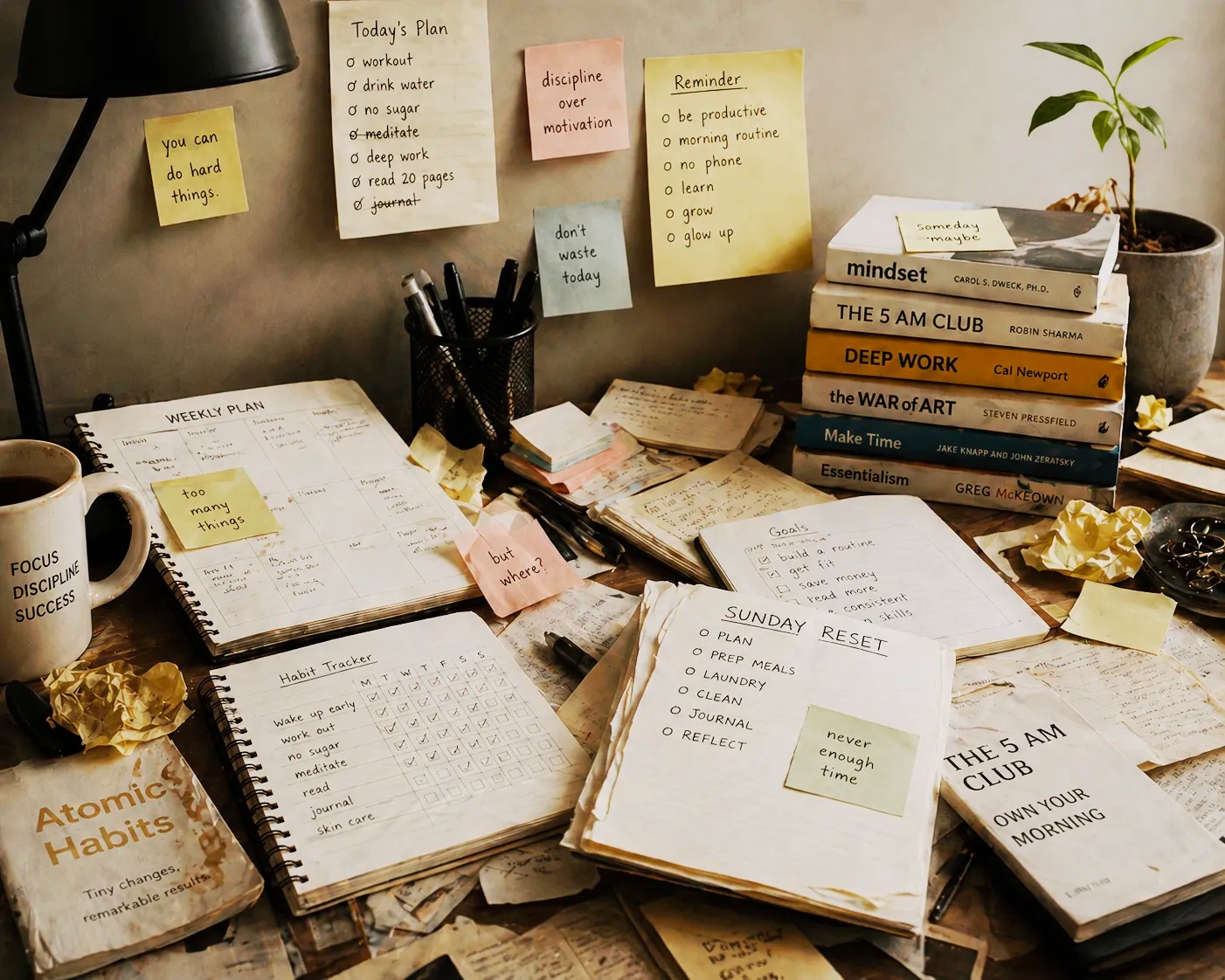
    I had a shelf full of self-help books. A color-coded planner. Three different habit tracking apps on my phone. I’d watched more YouTube videos about discipline and productivity than I’d like to admit. I knew about the Pomodoro technique, time blocking, the 5am club, cold showers, and the power of atomic habits.

    And yet — every single Monday, I was starting over. Same goals. Same intentions. Same quiet promise to myself that this week would be different.

    It never was.

    What I didn’t understand then — and what took me an embarrassingly long time to figure out — is that I was solving the wrong problem. I kept looking for a better system when what I actually needed was a completely different relationship with myself.

    The moment everything shifted

    It happened on a Tuesday evening. I’d missed the gym again. I’d opened my laptop to work on a project and ended up watching videos for two hours instead. I sat there feeling that familiar wave of self-disgust — the same internal monologue I’d had dozens of times before. “You’re so lazy. You have no discipline. What is wrong with you.”

    And then, for the first time, I stopped and actually listened to what I was saying to myself.

    I would never speak to a friend that way. Not once. If a friend told me they’d missed the gym and lost a couple of hours to distraction, I’d tell them it was fine, ask what got in the way, and help them think about tomorrow. I wouldn’t tell them they were fundamentally broken.

    So why was I doing it to myself — and expecting it to help?

    “Discipline built on self-criticism is like trying to grow a plant by stepping on it. The pressure doesn’t help it grow. It just damages the roots.”

    That night I didn’t download a new app or start a new system. I just sat with one question: what if being harsh with myself is actually the thing that’s been keeping me stuck?

    👉 Explore more on Quiet Growth to improve your mindset step by step.

    https://quietgrowthu.wordpress.com/2026/04/21/7-easy-steps-for-a-stress-free-morning-routine/

    What I learned about self-discipline that no productivity guru told me

    Over the months that followed, I started paying attention differently. Instead of asking “how do I force myself to do this,” I started asking “what is actually making this hard?” And the answers surprised me.

    INSIGHT 01

    Willpower was never the problem

    I’d spent years believing I simply didn’t have enough willpower — that other people had some reserve of mental strength I was born without. What I discovered is that willpower is a limited resource that depletes through the day for everyone. The people I admired for their discipline weren’t using more willpower than me. They’d built habits and environments that meant they needed almost none. They weren’t stronger. They were smarter about design.

    INSIGHT 02

    I was trying to change too much at once

    Every new system I tried involved overhauling my entire life simultaneously. New morning routine, new diet, new exercise habit, new work schedule — all at once, all perfectly. My brain was overwhelmed before I’d even started. When I finally committed to changing just one thing — one tiny thing — and doing only that for three weeks, something clicked. The habit stuck. And building on one solid habit turned out to be infinitely easier than trying to rebuild everything from scratch every Monday.

    INSIGHT 03

    Self-criticism was making things worse — not better

    Every time I criticized myself for failing, I increased the discomfort associated with the habit I was trying to build. My brain started linking the habit with shame and failure — which made avoidance more likely next time, not less. When I replaced self-criticism with curiosity — genuinely asking what got in the way rather than punishing myself for it — I started getting useful information instead of just feeling bad. And useful information led to actual change.

    INSIGHT 04

    My environment was working against me

    I had my phone on my desk while trying to work. I kept snacks in easy reach when I was trying to eat better. I had Netflix open in the background during “focus time.” I was relying entirely on willpower in an environment specifically designed to undermine it. When I changed my environment — phone in another room, workspace cleared, distractions physically removed — my behavior changed without me having to try nearly as hard. The discipline was in the design, not the doing.

    INSIGHT 05

    Rest was not the enemy of discipline

    I used to treat rest as a reward to be earned — something I’d allow myself once everything was done perfectly. But everything was never done perfectly, so I was always either pushing through exhaustion or collapsing into guilt-ridden rest. When I started planning rest deliberately — treating it as a requirement rather than a weakness — my consistency over time improved dramatically. A rested version of me showing up at 80% every day for six months produced more than a burned-out version grinding for three weeks and quitting.

    The most important shift wasn’t a new system or a better app. It was deciding to be on my own side. Discipline becomes sustainable the moment you stop treating yourself as the obstacle and start treating yourself as someone worth supporting.

    What actually changed — and what I do differently now

    I still miss days. I still drift sometimes. But the difference now is what happens next. Instead of a spiral of guilt that derails the whole week, I notice, I get curious, I adjust, and I come back. Usually by the next day. Sometimes the same evening.

    The returning is the discipline. Not the perfection.

    I have one habit I focus on at a time. My environment is set up to support me rather than tempt me. When something doesn’t work, I ask why instead of just pushing harder. I rest when I need to and I don’t apologise for it. And I celebrate small wins — genuinely, not as a performance — because the brain learns through positive feedback and I’ve stopped waiting for a grand achievement to feel good about my progress.

    None of this came from a new app or a better color-coded planner. It came from changing the question — from “how do I force myself” to “how do I support myself.”

    Where to start if you’re in the same place I was

    If any of this sounds familiar — the endless new systems, the Monday restarts, the self-criticism that feels productive but isn’t — here’s the simplest possible place to begin.

    Choose one habit. The smallest version of it you can imagine. Not “exercise every day” but “put on my shoes.” Not “journal every morning” but “open my notebook.” Do that one thing tomorrow. Notice how it feels. Be curious if it doesn’t happen. Come back the day after without guilt.

    That’s it. That’s the whole system. Everything else grows from there.

    You don’t need more discipline. You need a kinder, smarter relationship with yourself. Start there — and watch how much easier everything else becomes.

  • “This One Positive Mindset Shift Can Change Your Entire Life”

    “This One Positive Mindset Shift Can Change Your Entire Life”

    A positive mindset isn’t something you either have or don’t have. It’s something you build — one small habit at a time. Start with today. One intention, one moment of gratitude, one reframed thought. That’s enough for now.

    Building a positive mindset doesn’t mean smiling through everything or pretending life is perfect. It means training yourself to respond to challenges with clarity and calm instead of panic and self-doubt. And that’s something anyone can learn — including you.

    The good news is you don’t need a dramatic life change to get there. Small, consistent daily habits are what actually shift how you think over time. This guide walks you through exactly what those habits are and how to build them one step at a time.

    What a positive mindset actually means

    A lot of people confuse a positive mindset with toxic positivity — the idea that you should always be happy and never acknowledge anything negative. That’s not what this is about.

    A genuinely positive mindset means you acknowledge difficulties honestly, but you don’t let them define you. You focus on what you can control, learn from what goes wrong, and keep moving forward even when it’s hard. It’s not about how you feel — it’s about how you respond.

    You’re not trying to eliminate negative thoughts. You’re training yourself to not be controlled by them. That’s a very different goal — and a much more achievable one.

    10 habits to build a positive mindset

    HABIT 01

    Start your day with intention, not your phone

    The first few minutes after you wake up set the tone for everything that follows. When you reach for your phone immediately, you hand control of your mood to whoever posted last night. Instead, take 5 minutes to breathe, stretch, or simply sit quietly before the day begins. It’s a small shift that creates a big difference in how grounded you feel through the day.

    HABIT 02

    Notice and reframe your inner self-talk

    The voice inside your head is talking constantly — and for most people, it’s not very kind. “I’m not good enough,” “I always mess this up,” “everyone else has it figured out.” These thoughts feel like facts but they’re not. Start noticing them. When a harsh thought appears, ask yourself: would I say this to a friend? If not, reframe it. Not “I’m terrible at this” but “I’m still learning this.” Over time, this rewires how your brain narrates your life.

    HABIT 03

    Focus on what you can control

    A huge amount of anxiety and negativity comes from spending mental energy on things you have no power over — other people’s opinions, past mistakes, uncertain outcomes. Every time you catch yourself there, gently redirect to what you can actually influence: your effort, your response, your next action. This one shift alone can dramatically reduce daily stress.

    HABIT 04

    Practice gratitude — but make it specific

    Generic gratitude lists (“I’m grateful for my health, my family, my home”) quickly become automatic and lose their impact. Instead, try to be specific every day. “I’m grateful that my colleague helped me with that task today.” “I’m grateful the weather was nice on my walk.” Specificity makes your brain actually search for the good in your day — which is the whole point. Just 3 specific things each evening is enough.

    HABIT 05

    Be intentional about what you consume

    Your mindset is shaped by what you feed it daily. Constant negative news, social media comparison, and people who drain your energy all quietly pull your thinking in a darker direction. You don’t need to cut everything out — just become more deliberate. Follow accounts that genuinely inspire you. Read a few pages of something useful each day. Spend more time with people who build you up. Small inputs, consistent over time, reshape your inner world.

    HABIT 06

    Take care of your body — it affects your mind directly

    Poor sleep makes everything feel harder and more threatening than it is. Skipping meals affects concentration and mood. Sitting still all day builds tension in your body that shows up as mental irritability. These aren’t separate issues — your physical state and mental state are deeply connected. Even small improvements here — sleeping 30 minutes more, going for a short walk, drinking more water — have a measurable impact on how positively you think.

    HABIT 07

    Build a simple stress management habit

    Stress is unavoidable — but letting it build unchecked is what damages your mindset over time. You need a release valve. For some people it’s deep breathing. For others it’s a short walk, journaling, or even just sitting in silence for 5 minutes. The specific method matters less than the consistency. Pick one thing that genuinely calms you down and use it every day — not just when you’re at breaking point.

    HABIT 08

    Take action — even imperfect action

    One of the fastest ways to build a positive mindset is to stop waiting until you feel ready. Confidence doesn’t come before action — it comes from action. Start something small, finish it, and notice how that feels. Then do it again. Each small win builds evidence that you are capable, which gradually replaces the self-doubt with something more useful: proof.

    HABIT 09

    Let go of the need to be perfect

    Perfectionism is one of the most common hidden causes of a negative mindset. When the standard is perfection, everything short of it feels like failure — which means you feel like you’re failing constantly. Replace the goal of perfection with the goal of progress. Progress is measurable, achievable, and motivating. Perfection is a moving target that keeps you stuck.

    HABIT 10

    Be patient — mindset change takes time

    You didn’t develop your current thinking patterns overnight, and you won’t replace them overnight either. Expect slow, uneven progress. Some days will feel like you’ve gone backwards. That’s completely normal. What matters is that you keep showing up. The compound effect of small daily habits is real — you just have to give it enough time to work.

    A simple daily routine to support your mindset

    Here’s a beginner-friendly structure you can follow straight away — it takes less than 15 minutes total:

    Morning5 minutes of quiet before your phone. Set one intention for the day.

    Afternoon When a negative thought appears, name it and redirect to what you can control.

    Evening Write 3 specific things you’re grateful for from today.

    Before bed Reflect on one small win from the day — no matter how small.

    Don’t try to build all 10 habits at once. Pick two that feel most relevant to you right now and do those consistently for two weeks. Then add one more. Slow is sustainable.

    The most common mindset mistakes

    The biggest mistake is expecting fast results. Mindset change is slow and invisible at first — like planting seeds. Most people give up before anything grows. The second most common mistake is trying to suppress negative thoughts entirely. Pushing thoughts away makes them stronger. Acknowledging them without judgment, then redirecting, is far more effective.

    The third mistake is comparing your inner world to other people’s outer world. What you see on social media is a highlight reel — not someone’s full reality. Comparison on those terms is always unfair to yourself.

    👉 Explore more on Quite Growth to improve your mindset step by step.

  • How to Reduce Overthinking — Simple Techniques That Actually Work

    How to Reduce Overthinking — Simple Techniques That Actually Work

    Overthinking is exhausting. One small worry turns into ten, a simple decision feels impossible, and your mind just won’t quiet down. If that sounds familiar, you’re not alone — and you’re not broken. You just need a few simple techniques to interrupt the pattern.

    Overthinking isn’t a flaw — it’s a habit. And habits can be changed. Start with one technique from this list today, use it consistently, and watch how much quieter your mind becomes over time.

    You don’t need hours of meditation or a therapist’s couch. The techniques in this guide are practical, beginner-friendly, and take just a few minutes. The key is knowing which ones to use and when.

    Why overthinking is so hard to stop

    Most people try to stop overthinking by telling themselves to “just stop thinking about it.” That almost never works. Trying to suppress a thought actually makes it stronger — your brain treats it as important and keeps bringing it back.

    The real solution isn’t to silence your thoughts. It’s to change your relationship with them. When you learn to observe thoughts without getting caught up in them, they naturally lose their grip on you. That’s what these techniques help you do.

    8 techniques to reduce overthinking

    TECHNIQUE 01

    Use deep breathing to slow the spiral

    When your mind races, your breathing becomes shallow — and shallow breathing keeps your nervous system in a stressed state. Slowing your breath breaks that cycle. Try inhaling for 4 seconds, holding for 4, and exhaling for 6 seconds. Repeat for 2 to 3 minutes. The longer exhale is key — it activates your body’s relaxation response and brings your focus back to the present moment almost immediately.

    TECHNIQUE 02

    Name what you’re feeling

    Overthinking often feels chaotic because all your thoughts are tangled together. One of the simplest ways to create distance from them is to label what’s happening. Pause, notice the thought, and give it a name — “this is worry,” “this is fear,” “this is doubt.” It sounds almost too simple, but naming a thought creates just enough mental distance for you to stop being swept away by it. You’re observing it, not living inside it.

    TECHNIQUE 03

    Ground yourself in the present moment

    Overthinking pulls you into the past (“I should have done that differently”) or the future (“what if this goes wrong”). Grounding brings you back to right now. Look around and name 5 things you can see, 4 things you can physically feel, and 3 sounds you can hear. This simple exercise interrupts the thought loop by forcing your brain to engage with what’s real and immediate — not imagined or remembered.

    TECHNIQUE 04

    Schedule a “worry time”

    Trying to ban all worried thoughts backfires — your brain rebels. Instead, give your worries a time slot. Set aside 10 to 15 minutes each day, write your worries down during that time, and then gently postpone any worried thought that shows up outside that window with “I’ll think about that at worry time.” Over days and weeks, this trains your brain to stop treating every moment as the right time to panic. It sounds strange but it genuinely works.

    TECHNIQUE 05

    Write your thoughts down

    Your mind feels crowded when everything is swirling around inside it with nowhere to go. Journaling gives your thoughts an exit. Spend 5 to 10 minutes writing freely — don’t edit, don’t judge, just let it out. Once a thought is on paper, your brain no longer needs to keep cycling back to it. You’ve recorded it. This alone can reduce mental noise significantly, especially before bed when overthinking tends to peak.

    TECHNIQUE 06

    Reduce the triggers you can control

    Some habits quietly feed overthinking without you realising it. Too much social media, especially late at night, floods your brain with comparison and information. Poor sleep makes every thought feel more threatening than it is. Constantly consuming negative news keeps your nervous system on edge. You don’t need to cut everything out — just become aware of which habits leave you feeling worse, and start there.

    TECHNIQUE 07

    Take one small action

    Overthinking grows in inaction. The longer you sit with a problem without doing anything about it, the bigger it feels. A useful rule: if something takes less than 5 minutes, do it now. For bigger things, take just one small step — send the message, make the list, book the appointment. Action, even tiny action, breaks the paralysis and reminds your brain that you are capable of moving forward.

    TECHNIQUE 08

    Build a short daily mindfulness practice

    You don’t need a long meditation session. Even 2 minutes of focused breathing in the morning, eating one meal without your phone, or walking without headphones — these small acts of presence build your ability to stay in the moment over time. Mindfulness isn’t about achieving a quiet mind. It’s about noticing when you’ve drifted and gently coming back. The more you practice, the easier that becomes.

    A simple daily routine to manage overthinking

    Here’s an easy structure you can follow each day — it takes less than 20 minutes in total:

    Morning2 minutes of deep breathing before you check your phone. Set your three priorities for the day.

    Afternoon When you feel a thought spiral starting, name it and do the 5-4-3 grounding exercise.

    Evening10 minutes of free journaling. Write whatever’s on your mind without editing.

    Before bed No phone for the last 30 minutes. Let your mind wind down naturally.

    Don’t try all 8 techniques at once. Pick one, use it consistently for a week, and notice what shifts. Then add another. Small changes done consistently beat big changes done once.

    What not to do

    The biggest mistake is trying to force your thoughts to stop. Fighting your own mind is exhausting and counterproductive. The goal isn’t to have no thoughts — it’s to stop letting every thought control how you feel.

    The second mistake is expecting instant results. Overthinking is a habit that built up over months or years. Changing it takes consistent practice, not one perfect day. Be patient with yourself — noticing that you’re overthinking is already progress.

     Follow Quiet Growth U for more simple lifestyle improvements.