eM1i5ISxWu3jPHusH-h-gEyTdmWkUiDw3kvO46j5xeA distraction | Quiet Growth U

Tag: distraction

  • You Are Not Resting. You Are Passively Consuming — And There Is a Difference.

    You Are Not Resting. You Are Passively Consuming — And There Is a Difference.

    The day ends. You are tired — genuinely tired, the kind that settles into your shoulders and behind your eyes and makes the idea of doing anything that requires thinking feel impossible. So you do what you always do. You pick up your phone. You open an app. You start scrolling.

    An hour passes. Maybe two. You have watched videos, read posts, consumed opinions, absorbed information, followed rabbit holes you didn’t intend to follow and arrived somewhere you didn’t mean to go. And when you finally put the phone down, you don’t feel rested. You feel vaguely overfull — like you’ve eaten too much of something that wasn’t quite food. Stimulated but not satisfied. Distracted but not recharged.

    You tell yourself it was rest. But somewhere underneath that, you know it wasn’t.

    What passive consumption actually is

    Passive consumption is the state of taking in content without intention, without engagement, and without anything being produced on the other end. It is the default mode of modern life — the thing your brain reaches for automatically whenever there is a gap, a quiet moment, a pause between one thing and the next. It is scrolling social media without really seeing it. Watching videos without really watching them. Reading articles that leave no trace in your memory an hour later. Listening to podcasts while doing something else entirely, absorbing nothing, retaining nothing, simply filling the silence because silence has become uncomfortable.

    It covers everything. The three hours lost to Instagram on a Sunday afternoon. The self-help podcast played in the background while you cook, half-heard and immediately forgotten. The YouTube auto play that carries you from something you chose to something you never would have chosen, through seven videos you don’t remember, into a version of the evening you didn’t plan. The news app opened out of habit seventeen times in a day, each time delivering a fresh dose of anxiety about things entirely outside your control.

    All of it feels like something. It feels like rest, or learning, or staying informed, or winding down. What it actually is, almost always, is none of those things.

    “Passive consumption is not rest. It is stimulation without nourishment — the mental equivalent of eating cereal at midnight when what your body actually needs is sleep.”

    What it is doing to you

    The most immediate effect of passive consumption is the one you probably already recognize — the hollow feeling at the end of a session. The slight unreality of having spent significant time somewhere that left no impression. The guilt that edges in when you put the phone down and do the mental calculation of what else you could have done with that time. That feeling is your nervous system trying to tell you something important, and most of the time you manage it by picking the phone back up.

    But the deeper effects are quieter and more significant. Passive consumption gradually narrows your attention span — not in a dramatic way, but in the way that makes sitting with a book for an hour feel harder than it used to, makes a conversation without a distraction feel slightly restless, makes sustained focus on anything that isn’t delivering instant novelty feel like effort in a way it didn’t before. You are not becoming less intelligent. You are becoming less patient with depth — and depth is where everything meaningful lives.

    It also distorts your sense of time in a way that is difficult to articulate but easy to feel. Hours disappear. Evenings vanish. Weekends that were supposed to feel expansive collapse into a series of sessions with a screen and a vague awareness that something was supposed to happen that didn’t. The days blur at the edges. The weeks start to feel identical. And underneath it all is a growing suspicion that your life is somehow passing faster than you are living it — which is exactly what is happening.

    For people who consume a lot of self-improvement content specifically — and if you are reading this, that probably includes you — passive consumption creates an additional and particularly insidious problem. It produces the feeling of growth without the substance of it. Every podcast about habits, every article about mindset, every video about productivity delivers a small hit of inspiration, a sense of forward movement, a feeling that things are about to change. And then they don’t. Because feeling inspired is not the same as being changed. And consuming content about becoming better is not the same as becoming better. The gap between those two things is where most people live — permanently on the edge of a transformation that never quite arrives.

    “You have watched hundreds of hours of content about living better. You have lived almost none of it.”

    Why you keep doing it anyway

    Because it works — in the short term, for the wrong things. Passive consumption is extraordinarily effective at delivering two things your brain wants constantly: novelty and stimulation. Every scroll brings something new. Every video offers a different perspective, a different face, a different story. The variety is essentially infinite and the barrier to accessing it is essentially zero. Your brain, which evolved to find novelty rewarding because novelty once meant new food sources or new threats, finds this environment almost impossible to resist.

    It also works as an emotional regulation tool — and this is the part that makes it hardest to put down. When you are anxious, scrolling quiets the anxiety temporarily by giving your mind something else to track. When you are sad, entertainment provides enough distraction to take the edge off. When you are bored, the phone eliminates the discomfort of boredom immediately and completely. It is the most efficient emotional management tool ever created — and it is available in your pocket at all times, requiring no effort, no skill, and no awareness of what you are actually doing.

    The problem is that it manages emotions without processing them. The anxiety that scrolling temporarily quieted comes back — usually louder. The sadness that entertainment distracted you from is still there when the video ends. The boredom that the phone eliminated returns the moment you put it down, often accompanied by an additional layer of guilt about how you just spent the last hour. Passive consumption treats the symptom without touching the cause — and the cause, unaddressed, gradually grows.

    The difference between passive consumption and genuine rest

    Genuine rest is restorative. It leaves you feeling more like yourself than you did before — calmer, quieter, more present. It replenishes something that was depleted rather than simply distracting you from the depletion. It looks different for different people — a walk without a podcast, a meal eaten without a screen, a conversation that goes somewhere real, a book that requires your full attention and rewards it, time spent doing something with your hands, silence that you sit with rather than immediately fill.

    What genuine rest has in common across all its forms is presence — actual engagement with what is happening rather than checked-out consumption of what is being delivered to you. The distinction is not about the activity itself but about your relationship to it. Watching a film you chose deliberately, giving it your full attention, letting it move you — that is rest. Having Netflix play automatically for three hours while you half-watch and half-scroll — that is passive consumption wearing rest’s clothes.

    Reading a book that challenges you and changes something in how you see things — that is active engagement. Listening to a podcast about personal development while doing six other things, retaining nothing, feeling vaguely productive — that is passive consumption wearing learning’s clothes. The clothes are convincing. But your nervous system knows the difference. And it will tell you, every time, in the hollow feeling that follows.

    Ask yourself honestly after any period of screen time — do I feel more rested or less? More like myself or less? More present or less? The answer is your body telling you the difference between consumption and rest. It knows. You just have to be willing to listen.

    What to do instead — and how to start

    You are not going to eliminate passive consumption from your life — and that is not the goal. The goal is to make it a deliberate choice rather than an automatic default. To notice when you are reaching for your phone out of habit rather than genuine desire. To create enough space between the impulse and the action that you can actually decide whether this is what you want to do with this particular moment.

    Start by making the passive consumption slightly less effortless. Move the most used apps off your home screen. Put your phone in another room during meals and the first and last hour of the day. Set screen time limits that create a small moment of friction before you go over them — not to stop you, but to make the choice conscious rather than automatic. Friction is not punishment. It is the space in which awareness lives.

    Then start replacing — not eliminating, replacing. One scrolling session per day swapped for something that actually leaves you feeling better. A walk. A real conversation. Ten minutes of writing. Cooking something from scratch. Sitting outside without your phone. Reading something you chose rather than something the algorithm chose for you. Not every day, not all at once — just one replacement, tried once, to remind yourself what genuine rest actually feels like. Because most people, having spent months or years in passive consumption, have genuinely forgotten. And the reminder, when it comes, is usually enough to want more of it.

    The goal is not a life without screens or content or the pleasure of a well-made video on a Sunday afternoon. The goal is a life where you are the one choosing — where consumption is something you do intentionally rather than something that happens to you by default. That distinction — between choosing and defaulting — is where your time, your attention, and ultimately your life actually lives.

    Tonight, before you pick up your phone, pause for three seconds and ask: is this what I actually want right now — or is this just what I always do? Three seconds is enough to make the choice conscious. And a conscious choice, whatever it is, is infinitely better than an automatic one.

    One last thing

    There is something quietly ironic about reading an article about passive consumption — because reading articles is, for many people, a form of it. You might finish this post, feel a genuine flicker of recognition and resolve, and then immediately open another tab.

    I am not saying don’t do that. I am saying notice if you do. Notice the impulse, notice what it feels like, notice what you are reaching for and why. That noticing — small, unglamorous, requiring no app or system or habit tracker — is the beginning of everything. Not the reading about it. The noticing. Right now, in this moment, before you do anything else.

    You already know the difference between consuming and living. Your body has been telling you for a long time. The only question is whether today is the day you decide to listen. Explore more on Quiet Growth for simple daily habits that support a calmer, more focused life.

  • Simple 7-Day Digital Detox Plan — Reset Your Mind One Day at a Time

    Simple 7-Day Digital Detox Plan — Reset Your Mind One Day at a Time

    Seven days is all it takes to start feeling the difference. You don’t need to be perfect — you just need to begin. Start with day one today, and take it one day at a time. Explore more on Quiet Growth for simple habits that support a calmer, more focused life.

    If you’ve been feeling scattered, mentally drained, or like your phone is running your life instead of the other way around — this 7-day digital detox plan is for you. It’s designed for beginners, which means no dramatic cold turkey, no guilt, and no complicated rules.

    Each day builds gently on the last. By the end of the week, you won’t just feel better — you’ll have the foundation of a healthier, more intentional relationship with technology that actually lasts.

    Before you start, check your current screen time in your phone settings and write it down. This gives you a baseline to compare with at the end of the week. Seeing the actual number is often the biggest motivation to begin.

    The 7-day plan

    DAY 1

    Awareness — understand your habits before changing them

    Don’t change anything today. Just observe. Check your screen time report and note which apps are consuming the most time. Notice when you reach for your phone automatically — is it out of boredom, anxiety, habit, or genuine need? Write down what you find. Awareness is the foundation of every habit change, and most people are genuinely surprised by what they discover on day one.

    DAY 2

    Notifications — turn off everything that isn’t essential

    Go into your phone settings and turn off notifications for every app that doesn’t genuinely need your immediate attention — social media, news apps, shopping, games, and most messaging apps. Keep only calls, messages from close contacts, and calendar alerts if needed. You’ll check these apps when you choose to, not every time your phone buzzes. This one change alone dramatically reduces the number of times you pick up your phone each day.

    DAY 3

    Boundaries — create your first phone-free zones

    Today, establish two phone-free zones in your day: meals and the bedroom. No phone at the dinner table — eat and actually taste your food. No phone in bed — charge it outside your bedroom tonight. These two boundaries target the moments when screen use does the most damage to your wellbeing. Mealtimes are for rest and connection. Your bedroom is for sleep. Protecting both makes an immediate difference in how calm and rested you feel.

    DAY 4

    Morning — protect your first 30 minutes

    Today’s focus is your morning. No phone for the first 30 minutes after you wake up — not even to check the time (use an actual alarm clock or a watch). Use that window to drink water, stretch, breathe, or plan your day quietly. You’ll notice your morning feels calmer and less rushed. Your brain gets to ease into the day on its own terms instead of being immediately flooded with other people’s content and demands.

    DAY 5

    Replace — swap one hour of screen time for something real

    Today, identify one hour where you’d normally scroll and replace it with something offline you actually enjoy. Read a book that’s been sitting on your shelf. Go for a walk without headphones. Cook a meal from scratch. Call someone you’ve been meaning to catch up with. The point is not to fill every minute — it’s to discover that time away from screens doesn’t have to feel like deprivation. It can feel like relief.

    DAY 6

    Social media — set a limit and stick to it

    Go into your phone settings and set a daily time limit for your most-used social media apps — 30 minutes total is a good starting point. When the limit hits, respect it and put the phone down. Also do a quick feed audit today: unfollow any account that regularly makes you feel worse about yourself or your life. Your feed should leave you feeling informed or inspired, not drained or inadequate. You curate it — it doesn’t curate you.

    DAY 7

    Full reset — spend a half day offline and reflect

    Today, go offline for at least half the day — morning is usually easiest. No social media, no news, no mindless browsing. Use the time however feels good: a long walk, time with family or friends, journaling, cooking, reading. In the evening, look back at your week. Check your screen time and compare it to day one. Write down what felt different, what was harder than expected, and which habits you want to carry forward. This reflection is what turns a one-week experiment into a lasting change.

    What to do after day 7

    The goal was never to do this once and go back to old habits. By now you have a set of boundaries that actually work for you — phone-free mornings, no screens at meals, notification silence, a daily social media limit. Keep those going and build on them gradually.

    If you slip up on a day, that’s completely normal — just pick up where you left off. One bad day doesn’t undo a week of progress. What matters is the overall direction, not perfection on every single day.

    Check your screen time again now and compare it to day one. Most people who complete this plan reduce their daily screen time by 1 to 2 hours — without it feeling like a sacrifice.

    👉 Follow Quite Growth U for more simple lifestyle improvements.

  • Feeling Distracted? Try This Beginner-Friendly Digital Detox

    Feeling Distracted? Try This Beginner-Friendly Digital Detox

    Technology isn’t the enemy — mindless technology use is. Start with one boundary today, stick to it for a week, and see how different you feel. Small changes, done consistently, add up to something significant.

    If you find yourself reaching for your phone before you’ve even gotten out of bed, scrolling through social media without really enjoying it, or feeling vaguely guilty about how much time you spend on screens — you’re not alone. And you don’t need to throw your phone in a river to fix it.

    A digital detox doesn’t mean quitting technology. It means building a healthier, more intentional relationship with it. This guide walks you through exactly how to do that — one practical step at a time.

    Why a digital detox actually matters

    The average person checks their phone over 90 times a day. Every notification, every scroll, every reflexive tap interrupts your focus and pulls you out of whatever you were actually doing. Over time this adds up — you feel scattered, distracted, and somehow exhausted despite not having done very much.

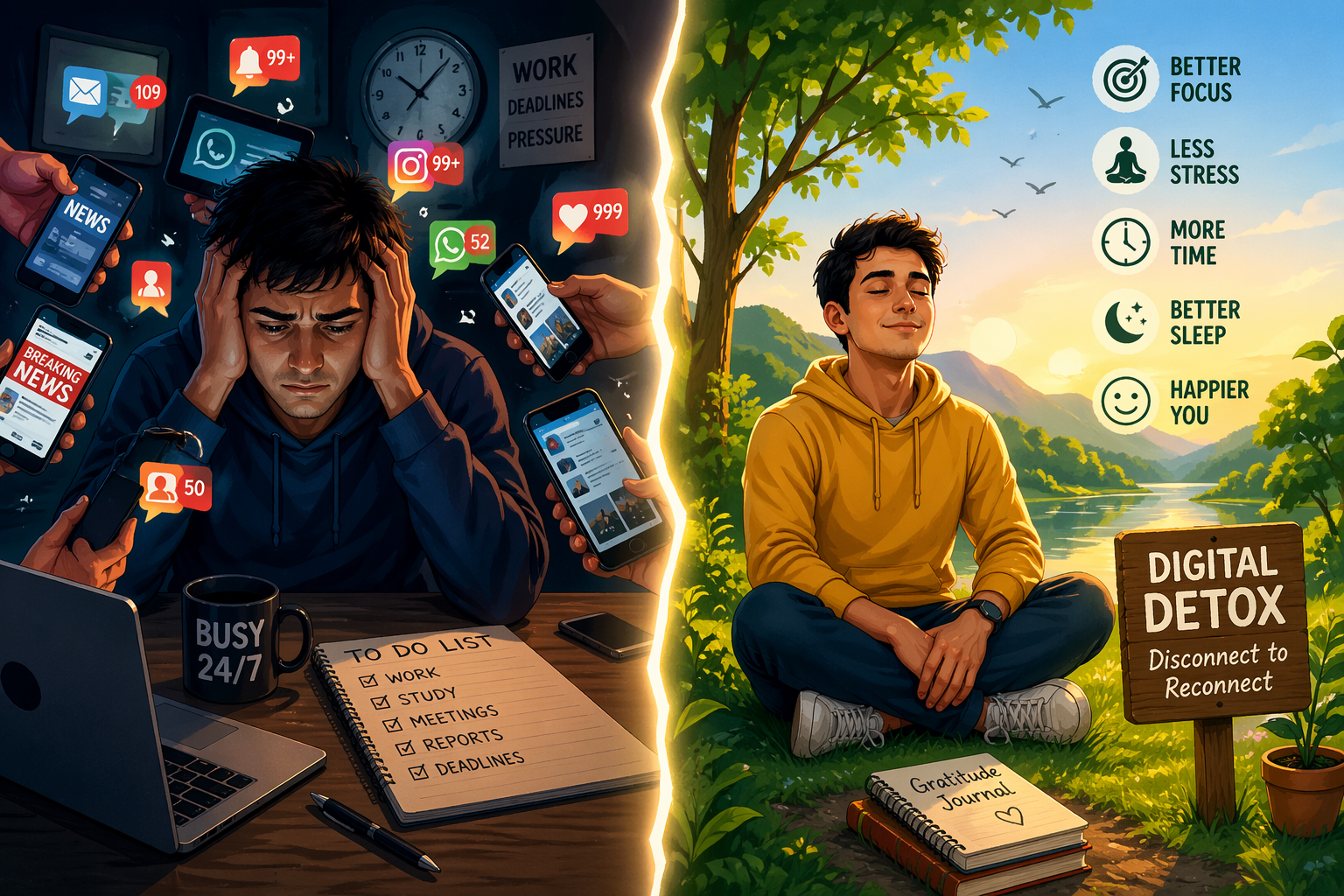
    A digital detox helps you break that cycle. When you create intentional space away from screens, your attention span recovers, your sleep improves, your stress levels drop, and you start to feel more present in your actual life — not just your digital one.

    You don’t have to go cold turkey. Even small, consistent boundaries with your devices create significant improvements in focus and mental clarity over time.

    8 simple steps to start your digital detox

    STEP 01

    Start by understanding your current screen habits

    Before you change anything, spend one day observing how you actually use your devices. Most phones have a built-in screen time tracker — check yours. You’ll likely be surprised. Knowing which apps are consuming the most time and when you reach for your phone most often gives you a clear starting point. You can’t fix what you haven’t measured.

    STEP 02

    Set clear, simple device boundaries

    Rules work best when they’re specific and easy to follow. Start with just two or three boundaries rather than an overwhelming list. Good ones to try: no phone during meals, no screens for the first 30 minutes after waking up, and no scrolling in bed. These three alone will change how your mornings feel and how well you sleep — which are the two times screens do the most damage to your mental state.

    STEP 03

    Start small — 30 minutes at a time

    Trying to go an entire day without your phone when you’re used to checking it constantly is setting yourself up to fail. Instead, start with one 30-minute no-phone window per day. Maybe it’s your morning coffee, your lunch break, or your evening walk. Do that consistently for a week, then extend it. Small wins build the confidence and the habit — then you can gradually expand from there.

    STEP 04

    Replace screen time with something you actually enjoy

    The reason most detox attempts fail is that people just remove the screen without putting anything in its place. Your brain still needs stimulation — so give it something better. Read a book you’ve been putting off. Go for a walk without headphones. Cook a proper meal. Call someone you haven’t spoken to in a while. The goal isn’t to be bored — it’s to discover that life off-screen can be genuinely enjoyable.

    STEP 05

    Build a phone-free morning routine

    Your morning is when your mind is freshest and most impressionable. Spending the first 30 minutes on social media essentially hands that prime mental real estate to strangers on the internet. Instead, use that time for yourself — drink water, stretch, plan your day, or just sit quietly. It’s one of the highest-return habits you can build for focus and mental clarity throughout the day.

    STEP 06

    Reduce social media intentionally

    Social media is designed to be hard to put down — every scroll has the potential for something new, which keeps your brain hooked. To break that pattern, start by turning off all non-essential notifications. Then set a daily time limit directly in your phone settings. Finally, do a quick audit of who you follow — if an account regularly makes you feel worse about yourself or your life, unfollow it without guilt. Your feed should energize you, not drain you.

    STEP 07

    Do a screen-free wind-down before bed

    The blue light from screens suppresses melatonin — the hormone that signals to your body that it’s time to sleep. But the bigger issue is mental: scrolling through news, social media, or messages right before bed floods your brain with information and stimulation at exactly the moment it needs to be winding down. Try keeping screens away for the last 30 to 60 minutes before you sleep. Read, journal, or just rest. The improvement in sleep quality is noticeable within just a few days.

    STEP 08

    Use technology mindfully going forward

    The end goal of a digital detox isn’t to never use technology — it’s to use it on your own terms. Before you open an app, ask yourself: am I doing this intentionally, or just out of habit? That one question creates a pause that breaks the automatic loop. Over time, intentional use becomes your new default, and the compulsive checking gradually fades on its own.

    A simple daily digital detox plan

    Here’s a beginner-friendly structure to follow each day — no drastic changes, just small intentional boundaries:

    Morning No phone for the first 30 minutes. Drink water, stretch, set your intention for the day.

    Meals Eat without screens — phone face down or in another room. Just eat and be present.

    Work hours Turn off social media notifications. Check messages at set times, not constantly.

    Evening One hour of screen-free time — read, walk, journal, or talk to someone.

    Before bed No screens 30 to 60 minutes before sleep. Let your mind wind down naturally.

    If you want to go deeper, check out our 7-Day Digital Detox Plan — a step-by-step weekly guide to reset your relationship with technology completely.

    Common mistakes that derail a digital detox

    The most common mistake is trying to do too much too soon. Going from constant screen use to an entire tech-free day is jarring and unsustainable. Start with small windows and build gradually — that’s what actually sticks.

    The second mistake is treating it as a punishment. A digital detox isn’t about restriction — it’s about reclaiming time and attention for the things that matter more. When you reframe it that way, it feels like something you’re gaining, not something you’re giving up.

     Follow Quiet Growth U for more simple lifestyle improvements.