Tag: brain dump

  • Why Scribbling on a Blank Sheet of Paper Is One of the Best Things You Can Do for Your Brain

    Why Scribbling on a Blank Sheet of Paper Is One of the Best Things You Can Do for Your Brain

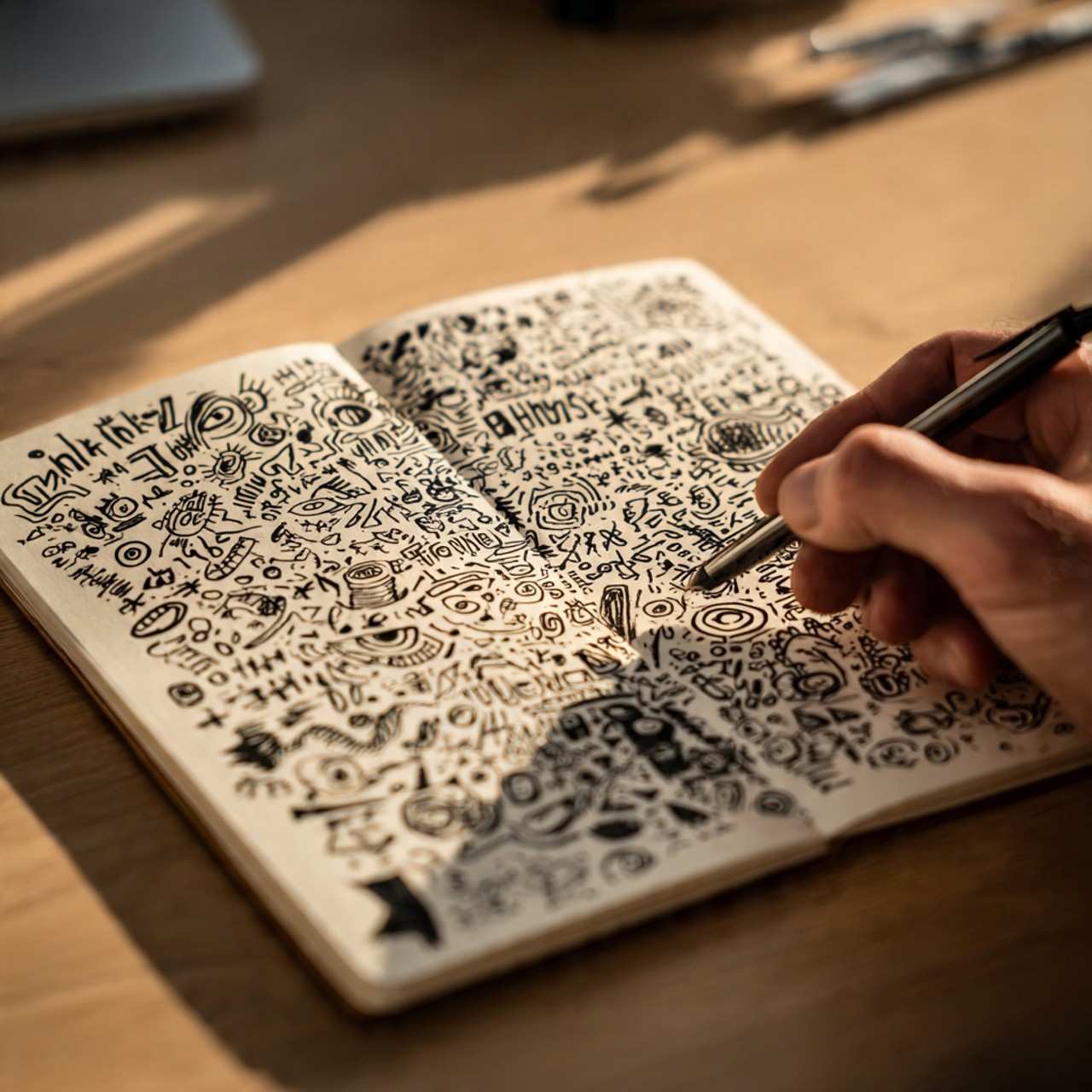
    I used to apologize for it. In meetings, in lectures, in any situation where I found myself with a pen and a piece of paper and nothing specific to write — I would draw. Shapes, mostly. Patterns, arrows, words written and then written again in slightly different ways, faces that weren’t quite faces, geometric forms that had no purpose and no destination. And whenever someone noticed, I would feel faintly embarrassed — as though I had been caught doing something childish, something that signaled I wasn’t paying proper attention.

    What I didn’t know then — and what the research now makes clear — is that I was paying better attention precisely because of the scribbling. And that the random marks accumulating at the margins of my notes were doing something to my brain that sitting still and trying to focus had never quite managed on its own.

    This post is about what happens in your brain when you put a pen to paper without an agenda — and why it might be one of the simplest and most overlooked ways to keep your mind sharp, creative, and genuinely alive.

    The moment I stopped apologizing for it

    The turning point came during a particularly difficult period at work — the kind where there was too much to think about and not enough clarity to think it through. I had been staring at the same problem for days, turning it over in my head without getting anywhere, trying to think my way to a solution through sheer mental effort and producing nothing except a growing sense of frustration.

    One afternoon, without particular intention, I picked up a pen and started drawing on the back of a piece of paper. Not related to the problem. Not a mind map or a brainstorm or anything organized. Just marks — shapes connecting to other shapes, words written without context, lines that went nowhere and came from nowhere. It lasted maybe fifteen minutes. And when I stopped and looked back at the problem, something had shifted. Not dramatically — I hadn’t solved it in the way that happens in films, with a sudden flash of insight and a moment of triumph. But the edges of it had softened. The angles had changed. There was a way through that I couldn’t quite see before, and now, imprecisely but unmistakably, I could.

    I assumed it was coincidence. It happened again the next week. And the week after that. And eventually I stopped assuming it was coincidence and started paying attention to what was actually happening when I picked up the pen.

    “The scribbling wasn’t distraction. It was thinking — just a different kind of thinking than the kind I had been taught to value.”

    What your brain is doing when you scribble

    When you engage in unstructured mark-making — doodling, free writing, random drawing — you activate what neuroscientists call the default mode network. This is the brain’s resting state network, active when you are not focused on a specific external task, and it is associated with some of the most important cognitive functions your brain performs — creative thinking, making connections between unrelated ideas, self-reflection, future planning, and the consolidation of learning and memory.

    The default mode network is suppressed when you are in focused, task-directed thinking — the kind of thinking most of us default to when we are trying to solve a problem or learn something new. That focused thinking is valuable and necessary. But it has a significant limitation — it tends to work within existing frameworks and familiar patterns. It is good at following established paths. It is less good at finding new ones.

    Scribbling activates the default mode network while keeping a light thread of engagement — the physical act of moving the pen — that prevents the mind from fully disengaging. This combination creates a state that researchers have described as productive mind-wandering — a condition in which the brain is free to make novel connections, approach problems from unexpected angles, and generate ideas that focused thinking would never have reached, while remaining just engaged enough to capture and develop them when they arrive.

    This is why the insight that comes while you are doing something else — in the shower, on a walk, while cooking — is such a universal human experience. The default mode network does its best work when focused attention is temporarily released. Scribbling is a portable, controllable, repeatable way to create that release deliberately rather than waiting for it to happen accidentally.

    What handwriting specifically does that typing cannot

    There is something important about the pen and paper specifically — not the keyboard, not the tablet with a stylus, but the physical act of making marks by hand on a physical surface. The research on this is clear and somewhat counterintuitive in an age where typing is faster, more legible, and more convenient in almost every practical respect.

    Handwriting engages significantly more of the brain than typing does. The complex motor movements required to form letters by hand activate neural circuits in the motor cortex, the visual cortex, and areas associated with language processing simultaneously — creating a richer, more integrated pattern of brain activation than the repetitive, simplified movements of keyboard typing. This richer activation is associated with deeper encoding of information, stronger memory formation, and greater retention of what is written.

    Studies comparing students who took notes by hand with those who typed found that hand-writers consistently showed better understanding and retention — not because they wrote more but because the slower pace and the motor engagement forced more active processing of the material. You cannot transcribe everything by hand as you can by keyboard — which means hand-writing forces you to summarize, select, and synthesize in real time. That active processing is learning. The transcription is not.

    Free writing and scribbling take this further. When there is no content to transcribe — when the pen is moving freely without direction — the brain is not processing external information at all. It is generating its own. The motor engagement keeps a light current of neural activation flowing, but the content is entirely internal — memories, associations, half-formed ideas, images and words that surface from below conscious thought and become visible on the page before the analytical mind can intercept and evaluate them. This is why free writing so often produces surprises — things you didn’t know you thought, connections you didn’t know you’d made, insights that feel like they came from somewhere else but were yours all along.

    “Typing captures what you already think. Handwriting — especially free, unstructured handwriting — discovers what you didn’t know you thought.”

    What doodling specifically does for focus and memory

    A study published in Applied Cognitive Psychology found that people who doodled while listening to a monotonous phone message retained 29 percent more information than those who did not doodle. The explanation offered by the researchers is that doodling occupies just enough cognitive capacity to prevent the mind from wandering into full daydreaming — which is a state of significantly lower information retention — while leaving sufficient capacity for the primary task of listening.

    This is the opposite of the assumption most people make about doodling — that it is a symptom of distraction rather than a management of it. In reality, the choice is rarely between doodling and perfect focus. It is almost always between doodling and full mind-wandering. And doodling, by that comparison, is the significantly more productive option.

    I think about all the meetings where doodling was subtly discouraged — where the implicit expectation was that undivided attention meant stillness, and that any movement of the pen that wasn’t note-taking was a sign of disengagement. The research suggests the opposite. The people drawing quietly at the margins of their notebooks were very likely retaining more of what was said than the people sitting still and struggling to maintain focus through sheer will.

    Free writing and what it does to your thinking over time

    Free writing — writing continuously for a set period without editing, without direction, and without stopping to evaluate what is being produced — is one of the oldest creative and cognitive practices available, and one of the most consistently underused. Writers have used it for centuries. Therapists recommend it for emotional processing. Educators use it to unlock thinking that structured prompts cannot reach.

    What it does to your thinking over time is cumulative and significant. The regular practice of putting words on paper without judgement — of externalizing the internal monologue that runs constantly and giving it somewhere to go — gradually builds a relationship with your own mind that is more honest, more fluid, and more creative than the relationship most people have when all their thinking stays internal.

    Internal thinking is constrained by the same patterns it always uses. It circles familiar territory, repeats familiar conclusions, arrives at familiar places. Written thinking — even free, unstructured, apparently purposeless written thinking — escapes those circuits. The act of writing something down makes it concrete enough to examine, question, and build upon in ways that pure mental rumination cannot. Ideas that would have dissolved or looped endlessly in your head become, once written, things you can actually work with.

    Over months and years of this practice, something quietly extraordinary happens. The thinking becomes more original. The problem-solving becomes more lateral. The mind becomes more comfortable with uncertainty, more willing to follow an idea to an unexpected place, more capable of the kind of genuine creativity that most people assume is a talent you either have or don’t. It is not a talent. It is a muscle. And scribbling on blank paper is one of the most straightforward ways to train it.

    How to start — and why the bar is as low as it gets

    You need a pen and a piece of paper. That is the entire equipment list. No special notebook, no particular pen, no dedicated time or space or system. The back of an envelope works. The margin of a receipt works. A cheap notebook bought for a pound works exactly as well as an expensive one.

    Start with five minutes. Set a timer and put pen to paper — drawing, writing, or both — without stopping and without judging what appears. If you are drawing, draw whatever comes — shapes, patterns, faces, things you can see, things you are imagining, things that have no referent in the real world. If you are writing, write whatever arrives — what you are thinking, what you notice, what you feel, what you had for breakfast, the sentence you are struggling to write and why, the problem that has been sitting just out of reach and what it looks like from different angles. Do not edit. Do not stop. Do not evaluate until the timer goes off.

    Then look at what you produced. Not critically — just with curiosity. Notice what surprised you. Notice what appeared that you weren’t expecting. Notice whether anything that arrived on the page is something you want to keep and develop. Most of it won’t be. Some of it will. That some is worth far more than the cost of the five minutes, and it would never have arrived any other way.

    Keep a small notebook and pen somewhere visible — on your desk, on your bedside table, in your bag. The barrier to scribbling is almost entirely about access. When the pen and paper are right there, the practice happens. When they have to be found, it almost never does. Remove the barrier and the habit follows naturally.

    The intelligence that scribbling protects

    There is a kind of intelligence that is not measured by tests and not developed by structured learning — the intelligence of making unexpected connections, of thinking around corners, of finding the non-obvious solution to a problem that the obvious approaches have failed to reach. It is sometimes called creative intelligence, sometimes lateral thinking, sometimes simply wisdom — the accumulated capacity to see things from angles that most people haven’t considered.

    This intelligence atrophies without use. And in a world where most of our cognitive engagement happens on screens — in structured formats, within algorithmic frameworks, consuming content that someone else made rather than generating anything of our own — it is getting less use than it has at almost any other point in human history.

    Scribbling on a blank sheet of paper is one of the most direct ways to exercise it. Not because it is sophisticated or structured or efficient — but precisely because it isn’t. Because it asks your brain to generate rather than consume, to wander rather than follow, to make something from nothing rather than respond to something already made. That generative capacity is the core of human intelligence. And it needs practice, just like everything else worth keeping.

    Pick up a pen today. Put it on paper. See what arrives. That is the entire practice — and it is more than enough.

    Today — not tomorrow, not when you have the right notebook — pick up any pen and any piece of paper and scribble for five minutes. Draw, write, or both. Don’t judge what appears. Just make marks and let your brain do what it was built to do when nobody is telling it what to think. Explore more on Quiet Growth for simple daily habits that support a calmer, more focused life.
  • 10 Journal Prompts for Beginners That Will Change the Way You Think

    10 Journal Prompts for Beginners That Will Change the Way You Think

    New to journaling? Read this first — I Journaled Wrong for Years. Here’s What Actually Works.

    The hardest part of journaling isn’t the writing. It’s the blank page. You sit down with good intentions, pen in hand, and your mind goes completely quiet — or completely chaotic — and you don’t know where to begin.

    That’s where prompts come in. A good journal prompt isn’t just a question — it’s a door. It gives your mind a specific place to enter, a thread to follow, and a direction to move in. The right prompt can unlock thoughts you didn’t even know you were carrying.

    These 10 prompts are designed for people who are just starting out, people who have tried and quit before, and people who want journaling to actually mean something. Each one comes with an explanation of why it works and a follow-up question to go deeper if you want to.

    Pick the prompt that makes you feel slightly uncomfortable when you read it. That discomfort usually means it’s pointing at something worth exploring. Write for just 5 minutes without stopping or editing.

    For when your mind feels full

    PROMPT 01

    “What is taking up the most space in my mind right now — and what would I need to feel at peace with it?”

    Why this works

    This prompt names the thing consuming your mental energy and immediately moves toward resolution. Most anxious thoughts feel huge and shapeless inside your head. Writing them down gives them a specific shape — and that alone reduces their power. The second half of the question shifts you from stuck to forward-facing.

    Follow-up: What is one small thing I could do today that would make me feel even slightly better about this?

    PROMPT 02

    “What am I pretending not to know?”

    Why this works

    This is one of the most powerful prompts you will ever write — and one of the most uncomfortable. We all carry things we know but haven’t admitted to ourselves yet. A relationship that isn’t working. A habit that’s hurting us. A direction we know we need to take but are avoiding. Write without thinking too hard. The first thing that comes up is usually the real answer.

    Follow-up: What would change if I stopped pretending?

    PROMPT 03

    “What did today feel like — and what do I wish it had felt like instead?”

    Why this works

    Most people process their days only on the surface. This prompt goes underneath and asks for something more honest. The second part — what you wish it had felt like — tells you what you actually value and what your day is currently missing. Over time, writing this regularly reveals patterns about what energizes you versus what drains you.

    Follow-up: What is one thing I could change tomorrow to make it feel more like what I want?

    For self-understanding

    PROMPT 04

    “What is one thing I keep avoiding — and what am I actually afraid of underneath it?”

    Why this works

    Avoidance is almost never about the task itself — it’s about the feeling the task creates. This prompt asks you to look underneath the avoidance at the real driver. Once you’ve named the actual fear, it becomes something you can work with rather than something that silently controls your behavior.

    Follow-up: What is the worst realistic outcome — and could I handle it?

    PROMPT 05

    “What do I need more of right now — and what do I need less of?”

    Why this works

    Most people have a vague sense of being out of balance without ever articulating it clearly enough to act on it. Writing it down with specificity turns a feeling into information. More quiet. Less scrolling. More movement. Less guilt. Whatever comes up — write it without judging whether it’s reasonable. Your needs are your needs.

    Follow-up: What is one small step I could take this week toward more of what I need?

    PROMPT 06

    “What would I tell a close friend who was feeling exactly the way I feel right now?”

    Why this works

    Most people are significantly kinder to their friends than to themselves. This prompt creates a small but powerful distance from your own situation — and in that distance, your natural kindness and wisdom emerge. Whatever you write for your imaginary friend is almost always exactly what you need to hear yourself.

    Follow-up: Why is it easier to be kind to others than to myself?

    For growth and forward movement

    PROMPT 07

    “If I could change one thing about how I’m living right now, what would it be?”

    Why this works

    The constraint of choosing just one thing forces prioritization — and priorities reveal values. What you most want to change tells you a great deal about what you most deeply care about. Don’t overthink the answer. The first thing that comes to mind is usually the truest one.

    Follow-up: What is the smallest possible first step toward that change — one I could take this week?

    PROMPT 08

    “What went well today that I didn’t give myself credit for?”

    Why this works

    Our brains are wired to register negative experiences more strongly than positive ones. At the end of most days, the things that went wrong are front and center while the things that went right have barely registered. This prompt deliberately corrects that imbalance — training your brain to scan for evidence of your own competence, effort, and goodness.

    Follow-up: How would I feel about today if I focused only on what went right?

    PROMPT 09

    “What does the version of me I want to become do differently — starting tomorrow?”

    Why this works

    Rather than vaguely wanting to be better, this prompt asks what specifically better looks like in behavior — tomorrow, not eventually. The future version of you isn’t a different person. They’re just you, with slightly different daily choices. Writing this regularly helps close the gap between who you are and who you want to be.

    Follow-up: What is one thing that version of me would do tomorrow that I haven’t been doing?

    PROMPT 10

    “What is one truth I’ve been avoiding — and what would change if I stopped avoiding it?”

    Why this works

    This is the hardest prompt on the list — and often the most valuable. Avoided truths take up enormous mental and emotional energy. When you finally write the thing you’ve been circling around — even just to yourself, in private, in a notebook no one will ever read — something shifts. The truth doesn’t get smaller when you face it. But you get bigger.

    Follow-up: What would my life look like in six months if I stopped avoiding this?

    Screenshot or bookmark this list so you always have a prompt ready before you open your journal. Remove the blank page barrier and the habit becomes dramatically easier to maintain.

    How to use these prompts

    Pick one prompt — just one. Read it slowly. Let it sit for a moment. Then set a timer for 5 minutes and write without stopping, without editing, and without judging what comes out. When the timer goes off, read back what you wrote. Underline anything that surprises you. Then answer the follow-up question if you want to go deeper.

    Some prompts are worth returning to weekly — especially prompts 01, 05, and 08, which give different answers depending on where you are in your life. A prompt that gave you one answer in January might give you something completely different in June. That difference is itself worth writing about.

    Pick one prompt from this list tonight. Just one. Set a timer for five minutes and write without stopping. You don’t need the perfect journal or the perfect moment — you just need a pen, a page, and a willingness to be honest with yourself. That’s where growth begins. Explore more on Quiet Growth for simple daily habits that support a calmer, more focused life.

  • I Journaled Wrong for Years. Here’s What Actually Works.

    I Journaled Wrong for Years. Here’s What Actually Works.

    I had a journal for most of my twenties. Beautiful ones — thick pages, good pens, carefully chosen. And I used them the same way every time. I’d write for a few days, fill pages with long rambling entries about how I was feeling, run out of things to say, feel vaguely guilty about the blank pages that followed, and quietly stop.

    Then a few months later I’d buy a new one and start again. Same pattern. Same result.

    I assumed journaling just wasn’t for me. That I wasn’t introspective enough, or disciplined enough, or that my thoughts weren’t interesting enough to be worth writing down. What I didn’t understand — and what took me years to figure out — is that I wasn’t failing at journaling. I was just doing it wrong.

    What I was doing wrong

    My journals were essentially complaints with no direction. I’d write about how stressed I was, how tired I was, how certain situations felt unfair — and then close the notebook feeling roughly the same as when I opened it. Sometimes worse, because I’d just spent 20 minutes dwelling on everything that was bothering me without doing anything useful with it.

    I also thought journaling had to be long. That a “real” journal entry meant filling at least a page. So on the days when I only had 5 minutes or only had a few sentences worth of thoughts, I felt like I hadn’t done it properly — and that feeling of doing it wrong became its own reason to stop.

    “I wasn’t failing at journaling. I was using it as a place to dump feelings without any structure to process them. A bin, not a tool.”

    The shift came when I stopped treating my journal like a diary and started treating it like a thinking tool. Not a place to record what happened — but a place to figure out what I actually thought and felt about what happened. That one reframe changed everything.

    What journaling actually does — when done right

    Journaling works because writing forces clarity. When a thought stays in your head, it stays vague, circular, and emotionally charged. When you write it down, you have to give it shape — a beginning, a middle, a point. And in that process of shaping it, you almost always understand it better than you did before.

    It also works as a pressure release. The thoughts that loop through your mind at 2am — the unresolved worries, the things left unsaid, the fears you haven’t faced — are so persistent partly because they have nowhere to go. Writing them down gives them somewhere to land. Your brain can let go because the thought is now safe on the page.

    👉 Explore more on Quiet Growth to improve your mindset step by step.

    https://quietgrowthu.wordpress.com/2026/05/01/15-things-to-do-when-anxiety-hits-simple-techniques-that-actually-help/

    And over time, journaling builds self-awareness in a way that’s hard to achieve any other way. When you look back at entries from weeks or months ago and see patterns — the same worries recurring, the same situations triggering the same responses — you start to understand yourself at a level that changes how you navigate your life.

    What I do differently now — and what finally stuck

    SHIFT 01

    I stopped writing for length and started writing for honesty

    Some of my most useful journal entries are three sentences. “I’m dreading tomorrow’s meeting and I don’t know why. Actually — I think I do know why. I’m afraid of being judged.” That’s it. Three sentences that took two minutes and gave me something real to work with. The length of an entry has absolutely nothing to do with its value. The honesty does. If you write one true thing today, that’s a journal entry worth having.

    SHIFT 02

    I started using prompts instead of staring at a blank page

    The blank page was always the hardest part. “Write about your feelings” is not a useful instruction when your feelings are a tangled mess. A specific prompt gives your brain a clear starting point — a door to walk through rather than a wall to stare at. Now I rarely open my journal without a prompt in mind. The words come much more easily and they go somewhere more useful than they did when I was just free-writing into the void. If you need a starting point, check out these 10 journal prompts for beginners — they’re the ones I wish I’d had years ago.

    SHIFT 03

    I stopped journaling about the past and started journaling toward the future

    Recording what happened each day is a diary. Useful in its own way — but not the same as journaling for growth. What changed my experience was shifting from “here’s what happened today” to “here’s what I want to understand, change, or figure out.” Journaling became forward-facing rather than backward-facing. Less “this is what went wrong” and more “what would I do differently, and what do I actually want instead.” That shift made every entry feel productive rather than just cathartic.

    SHIFT 04

    I made it so small I couldn’t say I didn’t have time

    Five minutes. That’s all I committed to. Not a page, not 20 minutes, not a meaningful entry every single day. Five minutes with a prompt, writing whatever came, stopping when the timer went off. On busy days that was enough. On quieter days I often kept going. But the commitment was always just five minutes — small enough that “I don’t have time” stopped being a valid reason not to do it. Consistency at five minutes beats perfection at never.

    SHIFT 05

    I stopped judging what I wrote

    For years I’d reread my entries as I wrote them and edit myself in real time — deleting sentences that sounded too dramatic, softening things that felt too harsh, trying to sound reasonable even to myself. The result was entries that were polished and useless. The whole point of a private journal is that no one else will ever read it. Write the dramatic thing. Write the unreasonable thing. Write the thing you’d never say out loud. That’s where the real thinking happens — in the unedited, unjudged version of your own mind.

    Your journal is the one place where you never have to perform. Not for anyone — including yourself. The messier and more honest it is, the more useful it becomes.

    How to start tonight — in 5 minutes

    Open anything — a notebook, your phone notes, a scrap of paper. Pick one prompt. Set a timer for 5 minutes. Write without stopping, without editing, without judging. When the timer goes off, stop — or keep going if you want to. Close the notebook. That’s it. That’s journaling done right.

    Don’t buy a special journal first. Don’t wait for a quiet moment or a fresh week or the right mood. Start tonight, with whatever you have, for just five minutes. The beautiful journal can come later. The habit comes first.

    If you’ve tried journaling before and given up — you didn’t fail. You just hadn’t found the right way yet. Tonight, pick one prompt, set a timer for five minutes, and write without judgment. That’s all it takes to begin again. Explore more on Quiet Growth for simple daily habits that support a calmer, more focused life.