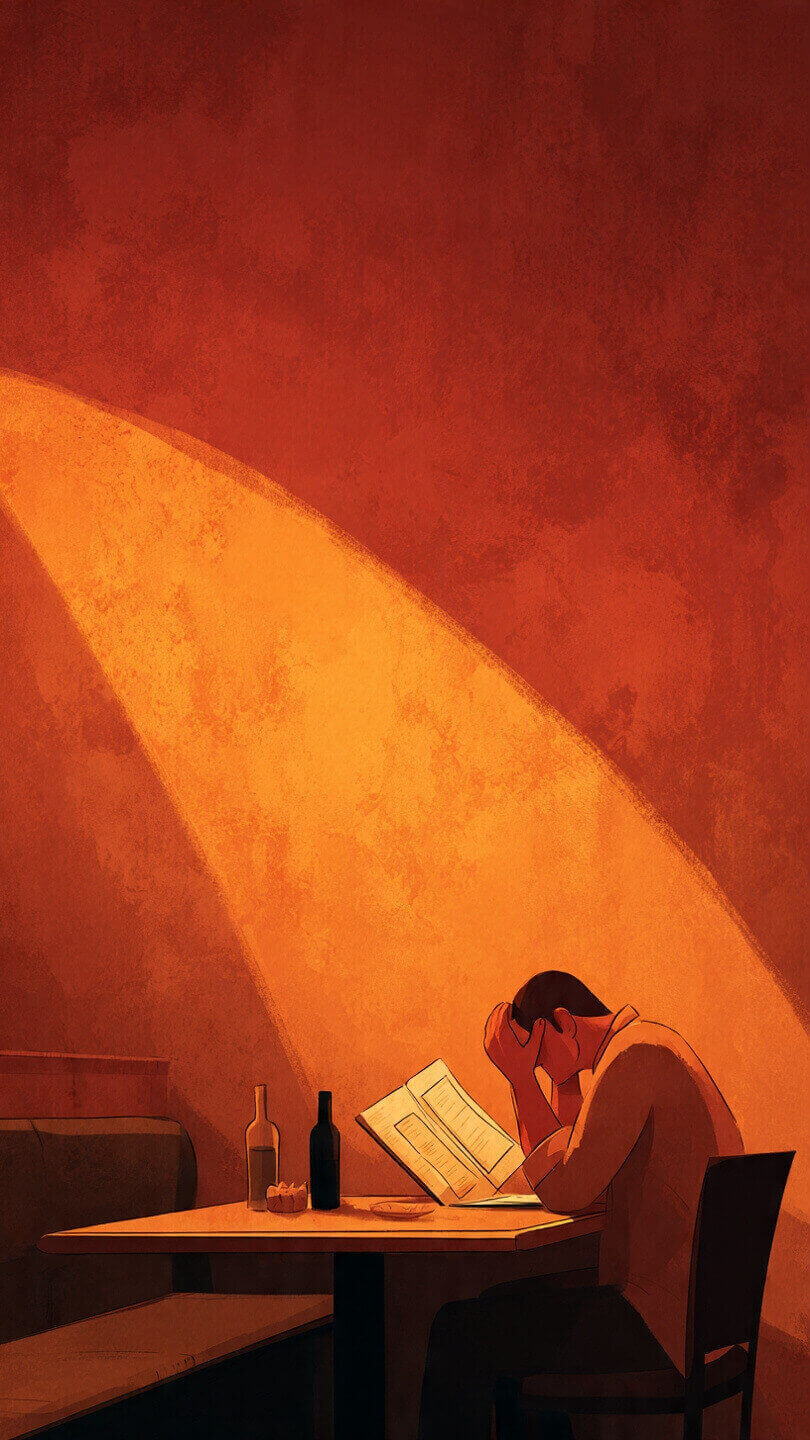
I once spent forty-five minutes deciding what to order at a restaurant. Not a life-changing restaurant. Not a particularly unusual menu. An ordinary Tuesday evening, an ordinary dinner, and somehow forty-five minutes of my finite life went into a decision that I will not remember making in six months and that carried approximately zero consequence either way.
And the frustrating thing — the thing that made it worse — is that I knew it didn’t matter while I was doing it. I knew, intellectually and clearly, that the difference between the pasta and the risotto was not going to alter the trajectory of my life in any meaningful way. And I ordered the pasta anyway, and felt vaguely uncertain about it until the food arrived, at which point I thought about whether I should have ordered the risotto, and then I ate the pasta and it was fine, and I have not thought about it since.
But in the moment — in the forty-five minutes of the moment — it felt like it mattered. Not intensely, not dramatically, but with just enough weight to keep me from simply choosing and moving on. And that feeling — the feeling that a low-stakes decision somehow requires extended deliberation — is something I’ve been trying to understand ever since, because it doesn’t just happen at restaurants. It happens everywhere. What to reply to a message. Which route to take. Whether to bring a jacket. What to say in an email that doesn’t really require that much thought. Small things, ordinary things, things that in any rational assessment of the situation could be decided in thirty seconds and forgotten immediately — and yet somehow aren’t.
“The overthinking was never really about the decision. It was about something else entirely — something wearing the decision’s clothes.”
What I eventually understood is that overthinking small decisions is almost never actually about the decision. The decision is just the surface. Underneath it — running quietly, shaping the whole process without announcing itself — is something more fundamental. For some people it is a deep-rooted fear of making the wrong choice, even in low-stakes situations, because somewhere in the past making the wrong choice had consequences that were painful enough to leave a mark. The nervous system learned that decisions are risky. And now it applies that learning indiscriminately, to the pasta and the risotto, to the jacket and no jacket, to the reply that really doesn’t need this much thought.
For others it is something adjacent to perfectionism — the belief, operating mostly below consciousness, that there is a right answer to every question and that the task is to find it before committing. Which means that even trivial decisions get subjected to the same exhausting search for the optimal outcome that genuinely important decisions warrant. The brain doesn’t automatically calibrate the effort to the stakes. You have to do that manually. And if nobody has ever taught you how — or if the habit of thoroughness was praised often enough that it calcified into a default mode — you end up applying the same cognitive resources to dinner choices that you apply to career decisions, and wondering why you’re tired all the time.
There is also, I think, something about control. Small decisions are one of the few places in life where you have complete authority over the outcome — nobody else’s preferences, no external constraints, just you and the choice. And for people who carry a general background anxiety about the parts of their life they cannot control, that complete authority can paradoxically make the decision harder rather than easier. The stakes feel higher because the responsibility is entirely yours. If it goes wrong — if the pasta is disappointing, if the jacket was unnecessary, if the reply landed badly — there is nobody else to share that with. It was your call. Which means it is your fault. Which means, for an anxious brain, it is worth getting right. Even if right and wrong are essentially indistinguishable from each other.
“An anxious brain does not triage by importance. It treats everything as potentially important — because the cost of missing something is higher, in its calculation, than the cost of overthinking everything.”
Once I understood this — that the overthinking was a symptom rather than a habit, a signal rather than a character flaw — something changed in how I approached it. Not immediately, not completely, but gradually and in a direction that has held. The change was not about making faster decisions, exactly. It was about changing the question I was asking when a decision arrived. Instead of which option is best — a question with no reliable answer for most small choices — I started asking does this actually matter. And if the honest answer was no, I gave myself a rule: decide in thirty seconds and move on. Not because the decision wasn’t worth making carefully but because careful, for something that doesn’t matter, is a form of overthinking disguised as thoroughness.
I started noticing when I was spending more mental energy on a decision than its actual stakes warranted — which is easier to notice than it sounds, because there is usually a moment, somewhere in the middle of an extended deliberation about something trivial, when a part of you becomes aware that this has gone on longer than it needed to. That moment of awareness is the signal. Not to criticize yourself for overthinking, but to recognize it as the signal it is — that something other than the decision itself is driving the process — and to gently, deliberately, choose anyway.
Because here is what I have learned, slowly and through a lot of unnecessarily extended restaurant deliberations: most small decisions are genuinely reversible, and most of the ones that aren’t reversible are still not as consequential as the overthinking makes them feel. The pasta is fine. The reply is fine. The jacket is fine either way. The thirty seconds you save by deciding faster do not add up to very much individually. But the cumulative effect of not spending your cognitive energy on decisions that don’t require it — of reserving that energy for the things that actually do — is significant. You are less tired. Less anxious. More present for the things that matter because you haven’t been depleted by the things that don’t.
And occasionally — when the overthinking returns, as it does, as it probably always will to some extent — I try to remember to be curious about it rather than frustrated. To ask what it is telling me rather than just willing it to stop. Because the overthinking is not random. It shows up more when I’m stressed, more when I’m tired, more when something elsewhere in my life feels uncertain or out of control. It is a signal from a nervous system that is carrying more than it’s letting on — and the pasta was just where it chose to put that down for a moment.
That is worth knowing. Not because it makes the overthinking stop. But because understanding it means you can respond to it with something more useful than frustration — with a little curiosity, a little self-compassion, and eventually, a decision. Any decision. Because almost always, that is genuinely enough.
Next time you catch yourself overthinking something small, ask one question honestly: does this actually matter? If the answer is no — decide in thirty seconds. Not because the decision isn’t real, but because the overthinking is costing you more than the decision ever could.
The overthinking is not the problem. It is the signal. Start listening to what it is telling you — and then make the decision anyway. Any decision. Almost always, that is enough. Explore more on Quiet Growth for simple daily habits that support a calmer, more focused life.