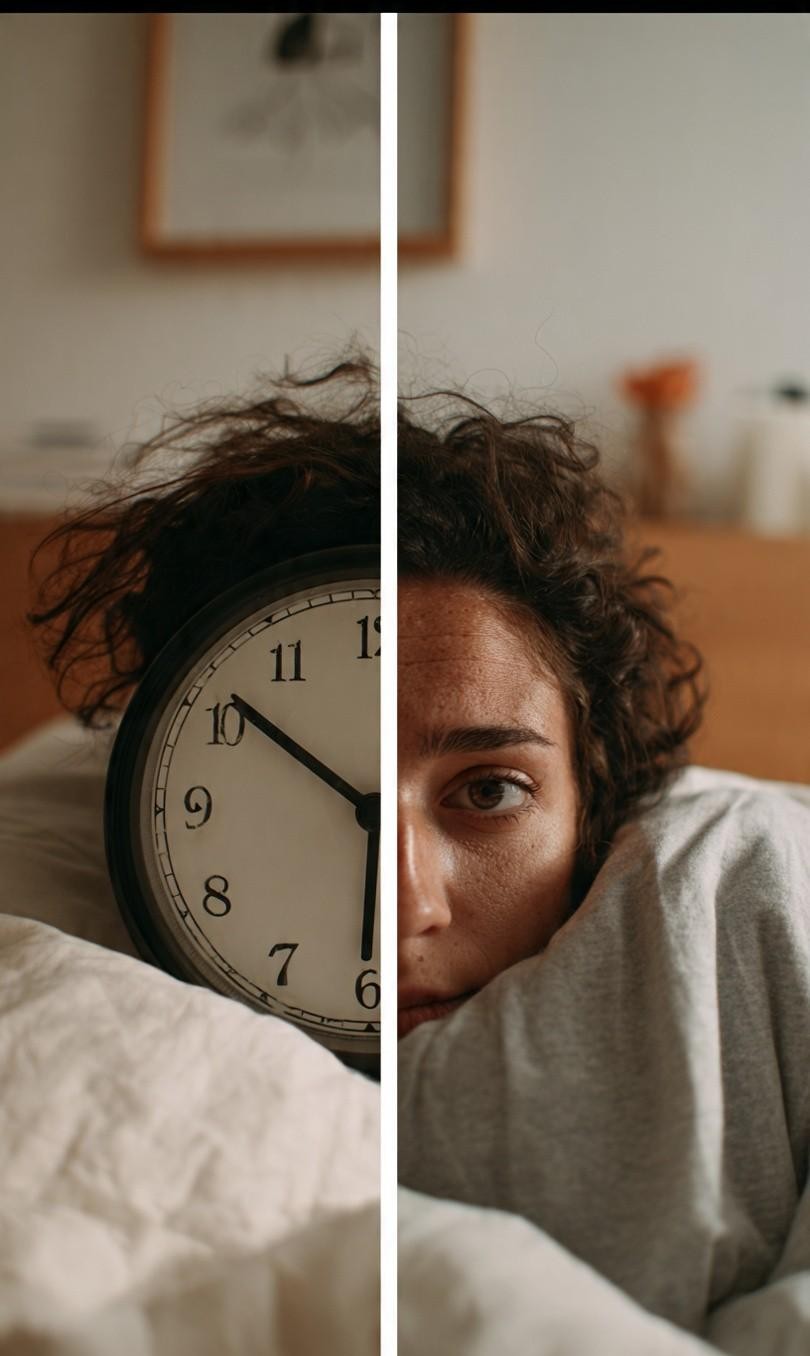
I used to think sleep was simple. You close your eyes, you get your eight hours, you wake up feeling human again.
That was the deal. That was what everyone said. Eight hours and you’re fine.
Except I was getting my eight hours. Sometimes even nine. And I was still waking up every single morning feeling like I hadn’t slept at all. Groggy, heavy, eyes that didn’t want to open, a body that felt like it was made of concrete. The alarm would go off and my first thought — before anything else — was how long until I could go back to sleep.
I thought I was just not a morning person. I thought it was normal. I thought everyone felt this way and just pushed through it better than I did.
I was wrong on all three counts.
The number was never the problem
Here is what I had completely missed — sleep isn’t just about hours. It is about quality. And quality is something you cannot see just by looking at a number on your phone.
You can spend eight hours in bed and still get terrible sleep. You can cycle through light sleep all night, barely dipping into the deep restorative stages your body actually needs, and wake up feeling worse than if you had slept for five hours straight and deeply.
The hours were never the issue. What was happening inside those hours was.
What was actually waking me up tired
Once I started paying attention — really paying attention — I noticed a few things I had been completely ignoring.
I was on my phone right up until the moment I closed my eyes. Sometimes I’d fall asleep mid-scroll, phone still in my hand, screen still glowing. I thought this was fine because I was tired enough to fall asleep anyway. What I didn’t realize was that the blue light from my screen was suppressing my melatonin — the hormone that tells my body it’s time for deep sleep. So even though I was unconscious, my body was not fully switching into the restorative mode it needed.
My room was never fully dark. There was always a little light creeping in — from the street, from a charging light, from the gap under the door. Small things. Things I had stopped noticing. But my brain noticed. Even tiny amounts of light during sleep can disrupt your sleep cycles and pull you into lighter stages when your body should be going deeper.
I was eating too close to bedtime. A late dinner, a snack at 11pm, sometimes both. Your body uses sleep to rest and repair — but if it is still busy digesting, it cannot fully commit to that process. I was asking my body to do two things at once all night and wondering why I woke up exhausted.
My sleep schedule was completely inconsistent. Weekdays I would try to sleep by eleven. Weekends I would be up until two or three and sleep in until ten. I thought the weekend sleep was making up for the week. It wasn’t. It was confusing my body clock, making it harder to fall into deep sleep at the right times, and leaving me feeling jet-lagged every Monday morning without ever getting on a plane.
There is also something called sleep debt — the accumulated tiredness that builds up when your body doesn’t get the quality rest it needs night after night. You cannot repay it with one long sleep on a Sunday. It takes consistent, quality nights over time to actually recover.
And then there is stress. I was carrying a lot of it — the kind that doesn’t feel dramatic, just background noise. A low hum of worry that I had learned to live with. What I didn’t know is that stress keeps your cortisol levels elevated, and high cortisol at night is one of the most reliable ways to destroy sleep quality. Your body is supposed to be in a calm, safe state to sleep deeply. Stress tells it the opposite.
I was falling asleep exhausted every night and waking up exhausted every morning, and the eight hours in between were doing far less for me than I thought.
What I actually changed
I put my phone down thirty minutes before sleeping. Not in another room — I wasn’t ready for that — but face down, notifications off, screen dark. Just thirty minutes of nothing. Reading, lying quietly, letting my mind slow down on its own.
I made my room darker. Blackout curtains changed things more than I expected. The difference between sleeping in a dim room and a properly dark room is something you have to experience to believe.
I fixed my sleep and wake time. Same time every day — including weekends. Not perfectly, but consistently enough that my body started to trust the schedule. Within two weeks I was waking up just before my alarm, which had never happened to me before in my life.
I stopped eating after 8pm. This one was hard. But within days I noticed I was sleeping more deeply and waking up feeling lighter.
I also started winding down intentionally. Not dramatically — no elaborate routines. Just a signal to my body that the day was ending. A warm shower. Dimming the lights an hour before bed. Keeping the evening quieter than the rest of the day.
What changed
I won’t pretend it was instant. The first week of fixing my schedule I felt worse before I felt better — my body was recalibrating and it was uncomfortable.
But by week three something shifted. I started waking up and not immediately wanting to go back to sleep. I started having mornings where I felt — not energetic exactly, but okay. Present. Ready.
That sounds like a small thing. For me it was enormous.
Eight hours of bad sleep will always leave you more tired than six hours of good sleep. The number on the clock means nothing if what is happening inside those hours is working against you.
Your body wants to rest. It wants to recover. It wants to give you the morning you keep hoping for. You just have to stop getting in its way.
I didn’t realize it was happening until it already had.
I’d pick up my phone in the middle of a perfectly fine day — not bored, not sad, just reaching for it out of habit — and within minutes I’d feel this strange, heavy weight settle in my chest. Nothing had changed. My life was exactly the same as it was five minutes ago. But somehow, scrolling through other people’s lives made mine feel like it wasn’t enough.
That is the thing about social media comparison. It doesn’t feel like destruction. It feels like nothing. Just a casual scroll. Just a quick check. And then slowly, quietly, it hollows you out from the inside.
It crept in without warning
I remember when it started feeling different. Not the normal occasional envy that every human being feels — but something heavier. Something that lingered.
I’d see someone my age launching something, achieving something, living somewhere beautiful, and instead of scrolling past, I’d stop. I’d look at their life and then mentally look at mine. And every single time, mine came up short.
Not because my life was bad. But because I was comparing my entire reality to someone else’s most curated moment. Their best photo. Their announcement post. The version of themselves they chose to show the world on a good day.
And I was holding that up against my Tuesday afternoon. My unwashed hair. My half-finished goals and uncertain plans.
That is never going to be a fair fight.
What it does to you over time
Here is the part that nobody really talks about — the long-term damage.
It is not just that comparison makes you feel bad in the moment. It is that over time, it rewrites how you see yourself entirely. Every time you measure yourself against someone online and feel like you fall short, your brain stores that. It builds a quiet case against you. And after enough scrolling sessions, enough comparisons, enough moments of feeling behind — you start to believe it.
You stop trusting your own progress. Things that should feel like wins start to feel ordinary. You finish something you genuinely worked hard on and instead of sitting with that feeling for even a moment, you immediately find someone who did it bigger and use them to erase your own effort.
I did this constantly. I would work on something for weeks, feel a flicker of pride when it was done, and then open my phone and find someone who had done something similar but better, faster, with more followers and a cleaner aesthetic. And just like that, my thing felt like nothing.
That is not motivation. That is self-erasure. And I was doing it to myself every single day.
The version of life you’re comparing yourself to isn’t real
This took me a long time to actually absorb — not just understand intellectually, but feel in my bones.
The people you are comparing yourself to are not showing you their life. They are showing you a version of it. The version that photographs well. The version that got enough likes last time. The version that fits the identity they are building online.
You are not seeing their 3am anxiety. You are not seeing the drafts they deleted, the plans that fell through, the days they couldn’t get out of bed. You are seeing the result and comparing it to your process. You are seeing their edited highlight reel and comparing it to your unfiltered, unedited, still-figuring-it-out everyday life.
And your brain treats that as a fair comparison. It isn’t. It never was.
The moment I got tired of shrinking
There wasn’t a single dramatic moment where everything changed. It was more like I just got exhausted.
Exhausted from feeling small in my own life. Exhausted from working toward something and not being able to feel good about it because someone online had already done it better. Exhausted from picking up my phone feeling okay and putting it down feeling like I was failing.
I started noticing the pattern. The exact moment I’d open a app out of habit. The specific type of content that would leave me feeling the worst. The way a single post could shift my entire mood for the rest of the day without me even realizing it was connected.
Noticing didn’t fix everything. But it was the first honest thing I had done about it.
What I actually changed
I unfollowed ruthlessly. Not out of bitterness — but out of self-preservation. If an account consistently made me feel worse about my own life, it had to go. It didn’t matter how inspiring it was supposed to be. Inspiration that leaves you feeling inadequate is not inspiration. It is just a prettier kind of damage.
I started setting limits on when I picked up my phone. Not dramatic hour-long detoxes — just boundaries. No scrolling first thing in the morning before I had even had a chance to exist in my own life. No reaching for my phone when I was already feeling low, because I knew what would happen.
And most importantly, I changed the question I was asking myself. Instead of “how am I doing compared to them?” I started asking “how am I doing compared to who I was six months ago?” That single shift changed everything about how I measured my days.
You will still feel it sometimes
I am not going to tell you comparison never touches me anymore. It does. Someone will share news and that familiar hollow feeling will flicker for just a second. But it doesn’t stay. Because now I know what it is — not a sign that I am behind, but a sign that I forgot to come back to myself.
Social media is not going anywhere. And comparison is a deeply human thing — it existed long before Instagram, long before any of this. But the version of it we are living with now is something different. It is constant, it is curated, and it is designed to keep you looking outward.
The most radical thing you can do is look inward instead.
Your life is not a highlight reel. It is not supposed to be. It is messy and slow and real and yours. And no filtered, perfectly-lit, algorithmically-boosted post will ever be able to tell you what that is worth.
You didn’t plan to eat that. You walked into the kitchen for a glass of water and somehow ended up standing over the sink finishing leftover pasta straight from the container. No plate. No intention. Just you, a fork, and a kitchen that felt too chaotic to think clearly in.
It wasn’t a lack of willpower. It was your environment.
Research connects the state of your physical space to the choices you make inside it.
Your kitchen is making decisions for you
When your kitchen is cluttered — dishes piled in the sink, counters covered, the fridge a mystery box of forgotten leftovers — your brain reads it as a stressful environment. And stress, as most of us know, is one of the most reliable triggers for poor eating.
A study in Environment and Behavior found that people in a chaotic kitchen ate significantly more cookies than those in a tidy one.
When your space feels out of control, you feel out of control. And when you feel out of control, you reach for whatever is easiest, most comforting, and requires the least amount of thought. That usually means processed food, takeout, or mindless snacking.
The path of least resistance
We follow the path of least resistance almost every time.. If healthy food is hard to access and unhealthy food is easy, we will choose the unhealthy option. Not because we are lazy or undisciplined, but because our brains are wired to conserve energy.
A cluttered kitchen makes healthy eating harder. When the counter is covered, there is no space to chop vegetables. When the fridge is disorganized, you cannot see what you have. When every meal requires you to first clear a space, cooking starts to feel like a chore before you’ve even picked up a knife.
So you order in. Or you grab whatever requires no preparation at all.
What a calm kitchen does differently
A tidy kitchen lowers the barrier to cooking. When the counter is clear, you are more likely to use it. When the fridge is organized and you can actually see your fruits and vegetables, you are more likely to reach for them. When your healthy snacks are at eye level and the less nutritious options are tucked away, you will naturally gravitate toward the better choice.
This is not about perfection. It is not about having a kitchen that looks like a magazine spread. It is about removing the friction that stands between you and a meal you actually feel good about eating.
You do not need to overhaul your entire kitchen in one afternoon. Start small and let the momentum build.
Clear one counter completely. Just one. Give yourself a surface that is always clean and always ready. This alone changes how you feel when you walk into the kitchen.
Reorganize your fridge so that healthy food is visible. Fruits, vegetables, and prepped meals go at eye level. Move the leftovers and less nutritious options to the back or the bottom drawer.
Keep a fruit bowl on the counter. It sounds almost too simple, but visible healthy food gets eaten. Hidden healthy food gets forgotten.
Do the dishes before you go to bed. Walking into a clean kitchen in the morning changes the tone of the entire day. It signals order. It signals intention. And it makes breakfast feel like a choice rather than a scramble.
Your environment is your habit
We spend so much energy trying to change our behavior through sheer willpower — telling ourselves we will eat better, make healthier choices, stop reaching for the biscuits at midnight. But willpower is a limited resource. Your environment is not.
When you design your kitchen to support the choices you want to make, you stop fighting yourself. The healthy option becomes the easy option. And the easy option is almost always the one you take.
Your kitchen is not just a room. It is a system. And like any system, when it is running smoothly, everything it produces is better.
I once spent forty-five minutes deciding what to order at a restaurant. Not a life-changing restaurant. Not a particularly unusual menu. An ordinary Tuesday evening, an ordinary dinner, and somehow forty-five minutes of my finite life went into a decision that I will not remember making in six months and that carried approximately zero consequence either way.
And the frustrating thing — the thing that made it worse — is that I knew it didn’t matter while I was doing it. I knew, intellectually and clearly, that the difference between the pasta and the risotto was not going to alter the trajectory of my life in any meaningful way. And I ordered the pasta anyway, and felt vaguely uncertain about it until the food arrived, at which point I thought about whether I should have ordered the risotto, and then I ate the pasta and it was fine, and I have not thought about it since.
But in the moment — in the forty-five minutes of the moment — it felt like it mattered. Not intensely, not dramatically, but with just enough weight to keep me from simply choosing and moving on. And that feeling — the feeling that a low-stakes decision somehow requires extended deliberation — is something I’ve been trying to understand ever since, because it doesn’t just happen at restaurants. It happens everywhere. What to reply to a message. Which route to take. Whether to bring a jacket. What to say in an email that doesn’t really require that much thought. Small things, ordinary things, things that in any rational assessment of the situation could be decided in thirty seconds and forgotten immediately — and yet somehow aren’t.
“The overthinking was never really about the decision. It was about something else entirely — something wearing the decision’s clothes.”
What I eventually understood is that overthinking small decisions is almost never actually about the decision. The decision is just the surface. Underneath it — running quietly, shaping the whole process without announcing itself — is something more fundamental. For some people it is a deep-rooted fear of making the wrong choice, even in low-stakes situations, because somewhere in the past making the wrong choice had consequences that were painful enough to leave a mark. The nervous system learned that decisions are risky. And now it applies that learning indiscriminately, to the pasta and the risotto, to the jacket and no jacket, to the reply that really doesn’t need this much thought.
For others it is something adjacent to perfectionism — the belief, operating mostly below consciousness, that there is a right answer to every question and that the task is to find it before committing. Which means that even trivial decisions get subjected to the same exhausting search for the optimal outcome that genuinely important decisions warrant. The brain doesn’t automatically calibrate the effort to the stakes. You have to do that manually. And if nobody has ever taught you how — or if the habit of thoroughness was praised often enough that it calcified into a default mode — you end up applying the same cognitive resources to dinner choices that you apply to career decisions, and wondering why you’re tired all the time.
There is also, I think, something about control. Small decisions are one of the few places in life where you have complete authority over the outcome — nobody else’s preferences, no external constraints, just you and the choice. And for people who carry a general background anxiety about the parts of their life they cannot control, that complete authority can paradoxically make the decision harder rather than easier. The stakes feel higher because the responsibility is entirely yours. If it goes wrong — if the pasta is disappointing, if the jacket was unnecessary, if the reply landed badly — there is nobody else to share that with. It was your call. Which means it is your fault. Which means, for an anxious brain, it is worth getting right. Even if right and wrong are essentially indistinguishable from each other.
“An anxious brain does not triage by importance. It treats everything as potentially important — because the cost of missing something is higher, in its calculation, than the cost of overthinking everything.”
Once I understood this — that the overthinking was a symptom rather than a habit, a signal rather than a character flaw — something changed in how I approached it. Not immediately, not completely, but gradually and in a direction that has held. The change was not about making faster decisions, exactly. It was about changing the question I was asking when a decision arrived. Instead of which option is best — a question with no reliable answer for most small choices — I started asking does this actually matter. And if the honest answer was no, I gave myself a rule: decide in thirty seconds and move on. Not because the decision wasn’t worth making carefully but because careful, for something that doesn’t matter, is a form of overthinking disguised as thoroughness.
I started noticing when I was spending more mental energy on a decision than its actual stakes warranted — which is easier to notice than it sounds, because there is usually a moment, somewhere in the middle of an extended deliberation about something trivial, when a part of you becomes aware that this has gone on longer than it needed to. That moment of awareness is the signal. Not to criticize yourself for overthinking, but to recognize it as the signal it is — that something other than the decision itself is driving the process — and to gently, deliberately, choose anyway.
Because here is what I have learned, slowly and through a lot of unnecessarily extended restaurant deliberations: most small decisions are genuinely reversible, and most of the ones that aren’t reversible are still not as consequential as the overthinking makes them feel. The pasta is fine. The reply is fine. The jacket is fine either way. The thirty seconds you save by deciding faster do not add up to very much individually. But the cumulative effect of not spending your cognitive energy on decisions that don’t require it — of reserving that energy for the things that actually do — is significant. You are less tired. Less anxious. More present for the things that matter because you haven’t been depleted by the things that don’t.
And occasionally — when the overthinking returns, as it does, as it probably always will to some extent — I try to remember to be curious about it rather than frustrated. To ask what it is telling me rather than just willing it to stop. Because the overthinking is not random. It shows up more when I’m stressed, more when I’m tired, more when something elsewhere in my life feels uncertain or out of control. It is a signal from a nervous system that is carrying more than it’s letting on — and the pasta was just where it chose to put that down for a moment.
That is worth knowing. Not because it makes the overthinking stop. But because understanding it means you can respond to it with something more useful than frustration — with a little curiosity, a little self-compassion, and eventually, a decision. Any decision. Because almost always, that is genuinely enough.
Next time you catch yourself overthinking something small, ask one question honestly: does this actually matter? If the answer is no — decide in thirty seconds. Not because the decision isn’t real, but because the overthinking is costing you more than the decision ever could.
The overthinking is not the problem. It is the signal. Start listening to what it is telling you — and then make the decision anyway. Any decision. Almost always, that is enough. Explore more on Quiet Growth for simple daily habits that support a calmer, more focused life.
It hits you at random. In the shower, on the commute, in the ten minutes before sleep when your brain apparently decides it is an excellent time to replay every embarrassing thing you have ever said or done. A memory surfaces — something you said in a meeting three years ago, a message you sent that you would never send now, a version of yourself that felt completely fine at the time and makes you physically wince to think about today. The shoulders tense. The eyes close. You make a sound that isn’t quite a word. You would very much like to not have been the person who did that.
And here is the thing nobody says out loud about that feeling — the cringe, the retroactive embarrassment, the quiet horror at who you used to be. Nobody tells you that it is one of the clearest signs of growth you will ever experience. Because you cannot cringe at a version of yourself you haven’t grown beyond. The reason that old message makes you wince, the reason that photo from five years ago makes you laugh-grimace, the reason certain memories produce that very specific kind of embarrassment — is that you are not that person anymore. You have moved. And the cringe is just the distance between then and now, made visible.
Think about it for a moment. The things from your past that don’t make you cringe — the choices you’re still proud of, the things you said that still sound right, the decisions that hold up — those are the places where your past self and your present self are in alignment. The cringe only happens at the gap. And a gap requires movement. You are cringing because you have grown. That feeling you have been treating as evidence of your fundamental terribleness is actually evidence of your development — just wearing very uncomfortable clothes.
“You cannot cringe at who you no longer are unless you have become someone different. The cringe is not the proof of your failure. It is the proof of your distance from it.”
But knowing that doesn’t always make it easier to feel. In the actual moment of cringe — when the memory is vivid and the embarrassment is sitting right there in your chest — it does not feel like growth. It feels like confirmation of everything you have quietly suspected about yourself. And most people handle it the way you probably handle it — by avoiding it. Not looking at old photos from certain periods. Not rereading old journals. Not talking about who you were before you knew better. Keeping the past self at a careful distance, as though the further you push them away the less they have to do with you.
The trouble is that hiding from your past self is not the same as moving past them. The memories you avoid are the ones that keep the most power over you. The past self you refuse to look at continues to shape how you feel about yourself today — precisely because you have never properly sat with them, accounted for them, or made any kind of peace with the fact that they existed and were you. And they were you. That is the part that makes it hard. Not the specific thing they did or said or believed — but the fact that it was your face, your voice, your name attached to it.
Here is what your past self was actually doing, though. They were navigating life with the information, the maturity, the self-awareness, and the emotional resources they had at the time. Which were less than you have now. Not because they were lesser — but because they were earlier. The confident opinion you held at twenty that makes you cringe today was held confidently because you didn’t yet have the experiences that would complicate it. The thing you said that landed badly was said without the communication skills that would have caught it. The decision that looks obviously wrong in retrospect was made without the information that retrospect provides.
Your past self was not stupid. They were earlier. And there is a meaningful difference between those two things that most of the shame surrounding the cringe ignores entirely. Stupidity implies an absence of capacity. Earliness implies an absence of experience. You had the capacity. You hadn’t yet had the life that would teach you what to do with it. Nobody arrives at wisdom without passing through every version of themselves that didn’t have it yet — including the ones that are currently making your future self cringe in ways you cannot yet imagine.
“Your past self was not a worse version of you. They were an earlier version — doing their best with what they had, which was less than you have now, which is less than you will have later.”
The shift that changes everything — from cringing with shame to something closer to laughing with affection — requires only one thing to change: the relationship you have with imperfection. Shame treats imperfection as evidence of fundamental inadequacy. Affection treats it as evidence of being human — which is inevitable, forgivable, and even a little endearing when seen from enough distance. You can see this in the way other people tell stories about their past selves. The friend who recounts their most catastrophic phase with genuine warmth and laughter — that person has found the distance that turns cringe into story. And story is something you can share. Something that connects rather than isolates. Something that makes other people exhale and quietly think — me too.
Your past self deserves that treatment. Not the sanitizing version — not pretending they didn’t say the thing or hold the misguided opinion or make the questionable choice. The honest version. The one that sees them clearly, understands what they were working with, and responds with the same patient warmth you would offer to anyone who was earlier in their journey and doing their imperfect best.
When the cringe comes — and it will — try something different this time. Instead of immediately flinching away from it, let it sit for just a moment. Ask it what it is showing you. What do you understand now that you didn’t understand then? What has changed? What does that gap tell you about how you have moved? Because the cringe, examined rather than avoided, becomes one of the most honest and specific measures of your own growth available to you. It shows you exactly where you have been and how far you have come — which is something a habit tracker or a journal prompt cannot always do.
And when you can — tell the stories. The ones you have been keeping private because they are embarrassing, because they don’t fit the version of yourself you prefer to present. Tell them with the honesty and warmth that distance makes possible. You will find, almost without exception, that the stories you were most ashamed of are the ones that most reliably make other people say — quietly, with relief — I thought it was just me.
It was never just you. It was never a sign that you were uniquely broken or uniquely behind or uniquely incapable of getting it right. It was the universal, unglamorous, entirely necessary experience of being a person who is still growing — which is all any of us are, at every stage, in every version of ourselves we have ever been or will ever be.
Your past self did their best. Your present self is doing theirs. And your future self will look back at today — at this version of you, with your current certainties and your current blind spots and your current confident opinions that will later complicate — with exactly the same mixture of affection and mild amusement you now bring to your past. That is not failure. That is the shape of a life that keeps growing. Quiet, continuous, imperfect, entirely human growth.
The cringe, when you learn to read it right, is just the sound of it happening.
Next time a cringe memory surfaces — instead of fleeing it, ask one question: what do I know now that I didn’t know then? The answer is your growth made visible. That gap between who you were and who you are is not something to be ashamed of. It is something to be grateful for.
Your past self did their best. Your present self is doing theirs. And your future self will look back at today with the same affection and mild amusement you now bring to your past. That is not failure — that is growth. Quiet, continuous, entirely human growth. Explore more on Quiet Growth for simple daily habits that support a calmer, more focused life.
You are rarely alone. Even when there is nobody physically present, you are accompanied — by your phone, by music, by podcasts, by the background noise of something playing that you’re not quite watching. The silence that used to exist between one thing and the next has been almost entirely filled in. The commute, the meal, the five minutes before sleep, the moment between waking and beginning the day — all of it occupied, all of it accompanied, none of it quiet.
And you have gotten very good at not noticing that this is the case. Because the noise is comfortable. Because the silence, when it occasionally arrives, feels faintly uncomfortable — like a room that’s slightly too empty, like a conversation that has paused a beat too long. Because somewhere along the way, without particularly deciding to, you learned to be slightly afraid of your own company.
This post is about what happens when you stop filling the silence. When you sit with yourself — genuinely, without a screen or a soundtrack or anything to hide behind — and discover that the person you meet there is someone worth knowing.
The life that never had a quiet moment
Think about the last time you were genuinely alone with your own thoughts — not distracted, not occupied, not consuming anything. Not falling asleep, not doing something that required attention. Just sitting, or walking, or existing, without any input from outside yourself.
For most people, the honest answer is that they cannot remember. Not because solitude is impossible but because it has become unfamiliar — and unfamiliar things are easy to avoid without quite realizing you are avoiding them. The phone fills the gap before the discomfort of the gap has time to register. The earbud goes in before the silence has a chance to say anything. The scroll begins before the stillness can settle.
And what gets lost in all of that filling — what quietly disappears when every moment is accompanied — is your relationship with yourself. Because that relationship, like any other, requires time and attention and the willingness to simply be present with the other person. When you never give yourself that time, never sit with your own thoughts long enough to hear what they actually are, you end up living at a slight remove from your own inner life. Functioning, relating, producing — but not quite knowing, at any deep level, what you actually think, feel, want, or are.
“You can spend an entire life in the company of other people and the noise of the world and never once properly meet yourself. Solitude is where that meeting happens.”
Solitude is not loneliness. This distinction matters more than it might initially seem, because the two feel similar from the outside — both involve being alone — but they are entirely different experiences from the inside. Loneliness is the pain of unwanted isolation, the feeling of being disconnected from others against your will. Solitude is the deliberate, chosen experience of being with yourself — and it is, when genuinely accessed, not painful at all. It is nourishing in a way that almost nothing else is.
Solitude is also not the same as being physically alone. You can be alone in a room and not be in solitude — if your phone is in your hand and your attention is fractured across seventeen different inputs, you are alone but not solitary. And you can be in a crowded place and find something approaching solitude — in a moment of genuine internal stillness, a few minutes of walking without headphones, a pause in which you are actually present with yourself rather than present with whatever the screen is showing you.
What defines solitude is not the absence of other people. It is the presence of yourself — your full, undistracted, unhurried attention turned inward rather than outward. That experience is rarer than being physically alone, and more valuable. And it is almost entirely unavailable to people who have filled every quiet moment with noise.
What you find when you sit with yourself
The first thing most people find, when they first attempt genuine solitude, is discomfort. Thoughts that had been kept at bay by noise and occupation start surfacing — worries, memories, questions without answers, feelings that were easier to not feel while something else had your attention. This discomfort is real and it is the primary reason most people reach for the phone within minutes of any extended quiet. It is not weakness. It is simply the experience of meeting a backlog — the accumulated internal material that has been waiting, patiently, for a moment of stillness in which to be acknowledged.
If you stay with the discomfort — if you resist the reflex to fill it — something shifts. The thoughts that felt threatening become, gradually, just thoughts. The feelings that seemed too big to sit with reveal themselves to be manageable when actually felt rather than avoided. The noise inside, which seemed to require external noise to drown it out, gradually quiets on its own. Not completely, not permanently — but enough for something else to become audible beneath it.
That something else is you. Not the performed version — the one that knows what to say in conversations, that functions well and presents appropriately and meets the expectations of other people. The actual version. The one that has opinions you haven’t articulated, preferences you haven’t honored, values you haven’t examined, fears you haven’t named, and a perspective on your own life that is more honest and more useful than anything anyone else can offer you — if you are willing to be still long enough to hear it.
Solitude is where self-knowledge lives. Not the self-knowledge that comes from personality tests or other people’s observations or the image you present to the world. The self-knowledge that comes from being genuinely, quietly present with yourself — noticing what you feel when nobody is watching, what you think when nobody is asking, what you want when the noise has quieted enough for want to surface at all.
“In the noise, you know what everyone else thinks and feels and wants. In the silence, you find out what you do.”
What regular solitude does over time
The first and most significant thing it does is make you more honest with yourself. When you spend regular time in your own company — genuinely, without distraction — you gradually become less able to sustain the comfortable fictions that constant occupation makes easy. The situation you have been telling yourself is fine reveals itself, in quiet, as not fine. The direction you have been moving in shows itself, in stillness, as not quite the direction you actually want. The relationship, the job, the habit, the belief — things that were easier to not examine while everything was loud become harder to avoid when the noise is gone. This is uncomfortable. It is also one of the most valuable things that can happen to a person.
The second thing solitude does is make you more creative. The default mode network — the brain’s resting state, associated with creative thinking and the making of novel connections — activates most fully in quiet and stillness. Ideas that would never have arrived in a scheduled brainstorm, solutions that focused effort cannot reach, perspectives that only emerge when the analytical mind is briefly at rest — these are the products of genuine solitude. Some of the most significant thinking in human history has happened in quiet — in walks, in silence, in the deliberate absence of external stimulation. That capacity is available to you in any quiet moment you are willing to protect.
The third thing is that it makes you significantly better company for other people. This is perhaps the most counterintuitive gift of solitude — that time spent alone, genuinely and intentionally, makes your time with others richer, more present, and more genuinely connected. When you know yourself well — when you have spent enough time in your own company to understand what you actually think and feel and want — you bring that clarity into your relationships. You are less reactive, less dependent on others to tell you who you are, less likely to lose yourself in the noise of what other people need and expect from you. You arrive in conversations as someone who is actually there — not performing presence, but genuinely present.
How to begin — and why five minutes is enough
You do not need a retreat or a meditation practice or a significant restructuring of your life to access solitude. You need five minutes and the willingness to not fill them.
Tomorrow morning, before your phone, sit somewhere quiet for five minutes. Not to meditate, not to journal, not to plan — just to sit. Let whatever thoughts arrive arrive. Notice them without following them. Notice the room, the light, the sounds outside. Notice how your body feels. Notice what surfaces when there is nothing to respond to and nothing to consume. Stay with it even if it feels slightly uncomfortable. Five minutes is short enough that the discomfort never becomes overwhelming — and long enough to make contact with something real.
Do it again the next morning. And the one after that. Extend it slightly when it starts to feel more comfortable — to ten minutes, then fifteen. Take a walk without headphones once a week. Eat one meal without a screen. Sit in a park or beside a window for a few minutes without anything to do. Create small, regular pockets of genuine quiet in a life that has been filling every gap with noise.
What you are building, in those small pockets, is a relationship — the most important one you will ever have. The one with yourself. And like any relationship worth having, it requires time, attention, and the willingness to show up even when it is slightly uncomfortable — especially when it is slightly uncomfortable. Because the discomfort, almost always, is where the most useful things live.
The quality of your relationship with yourself determines the quality of everything else — your relationships, your work, your decisions, your sense of direction and purpose. Solitude is not a luxury or an indulgence. It is maintenance for the most important relationship in your life. Give it five minutes today.
The thing about quiet growth
The name of this blog is not accidental. Quiet growth — the kind that happens slowly, internally, without performance or announcement — is almost entirely dependent on solitude. You cannot grow quietly if you are never quiet. You cannot evolve silently if the silence is always filled. The most significant changes in how you understand yourself, how you move through the world, what you choose and why — these happen in the spaces between the noise. In the moments you protect from occupation. In the five minutes before the phone, the walk without the podcast, the evening without the screen.
Solitude is not the absence of growth. It is the condition in which growth becomes possible. Give yourself some. Today, if you can. Five minutes. A quiet room. No phone. Just you — and the version of yourself that has been waiting, patiently, for you to show up and listen.
Today — before your phone, before the noise begins — sit somewhere quiet for five minutes. Don’t meditate, don’t plan, don’t journal. Just sit. Let whatever arrives arrive. That is the beginning of the most important relationship you will ever build. Explore more on Quiet Growth for simple daily habits that support a calmer, more focused life.
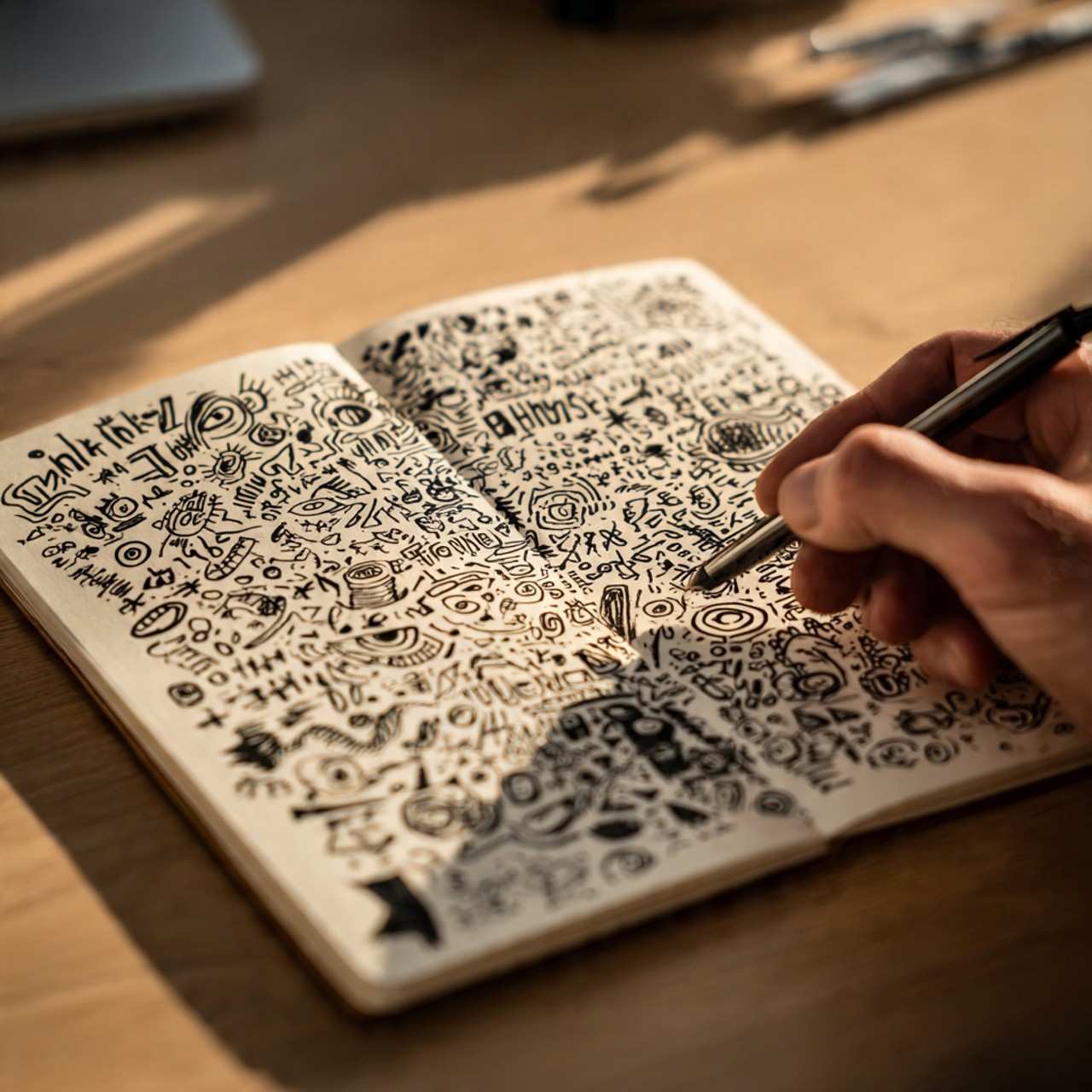
I used to apologize for it. In meetings, in lectures, in any situation where I found myself with a pen and a piece of paper and nothing specific to write — I would draw. Shapes, mostly. Patterns, arrows, words written and then written again in slightly different ways, faces that weren’t quite faces, geometric forms that had no purpose and no destination. And whenever someone noticed, I would feel faintly embarrassed — as though I had been caught doing something childish, something that signaled I wasn’t paying proper attention.
What I didn’t know then — and what the research now makes clear — is that I was paying better attention precisely because of the scribbling. And that the random marks accumulating at the margins of my notes were doing something to my brain that sitting still and trying to focus had never quite managed on its own.
This post is about what happens in your brain when you put a pen to paper without an agenda — and why it might be one of the simplest and most overlooked ways to keep your mind sharp, creative, and genuinely alive.
The moment I stopped apologizing for it
The turning point came during a particularly difficult period at work — the kind where there was too much to think about and not enough clarity to think it through. I had been staring at the same problem for days, turning it over in my head without getting anywhere, trying to think my way to a solution through sheer mental effort and producing nothing except a growing sense of frustration.
One afternoon, without particular intention, I picked up a pen and started drawing on the back of a piece of paper. Not related to the problem. Not a mind map or a brainstorm or anything organized. Just marks — shapes connecting to other shapes, words written without context, lines that went nowhere and came from nowhere. It lasted maybe fifteen minutes. And when I stopped and looked back at the problem, something had shifted. Not dramatically — I hadn’t solved it in the way that happens in films, with a sudden flash of insight and a moment of triumph. But the edges of it had softened. The angles had changed. There was a way through that I couldn’t quite see before, and now, imprecisely but unmistakably, I could.
I assumed it was coincidence. It happened again the next week. And the week after that. And eventually I stopped assuming it was coincidence and started paying attention to what was actually happening when I picked up the pen.
“The scribbling wasn’t distraction. It was thinking — just a different kind of thinking than the kind I had been taught to value.”
What your brain is doing when you scribble
When you engage in unstructured mark-making — doodling, free writing, random drawing — you activate what neuroscientists call the default mode network. This is the brain’s resting state network, active when you are not focused on a specific external task, and it is associated with some of the most important cognitive functions your brain performs — creative thinking, making connections between unrelated ideas, self-reflection, future planning, and the consolidation of learning and memory.
The default mode network is suppressed when you are in focused, task-directed thinking — the kind of thinking most of us default to when we are trying to solve a problem or learn something new. That focused thinking is valuable and necessary. But it has a significant limitation — it tends to work within existing frameworks and familiar patterns. It is good at following established paths. It is less good at finding new ones.
Scribbling activates the default mode network while keeping a light thread of engagement — the physical act of moving the pen — that prevents the mind from fully disengaging. This combination creates a state that researchers have described as productive mind-wandering — a condition in which the brain is free to make novel connections, approach problems from unexpected angles, and generate ideas that focused thinking would never have reached, while remaining just engaged enough to capture and develop them when they arrive.
This is why the insight that comes while you are doing something else — in the shower, on a walk, while cooking — is such a universal human experience. The default mode network does its best work when focused attention is temporarily released. Scribbling is a portable, controllable, repeatable way to create that release deliberately rather than waiting for it to happen accidentally.
What handwriting specifically does that typing cannot
There is something important about the pen and paper specifically — not the keyboard, not the tablet with a stylus, but the physical act of making marks by hand on a physical surface. The research on this is clear and somewhat counterintuitive in an age where typing is faster, more legible, and more convenient in almost every practical respect.
Handwriting engages significantly more of the brain than typing does. The complex motor movements required to form letters by hand activate neural circuits in the motor cortex, the visual cortex, and areas associated with language processing simultaneously — creating a richer, more integrated pattern of brain activation than the repetitive, simplified movements of keyboard typing. This richer activation is associated with deeper encoding of information, stronger memory formation, and greater retention of what is written.
Studies comparing students who took notes by hand with those who typed found that hand-writers consistently showed better understanding and retention — not because they wrote more but because the slower pace and the motor engagement forced more active processing of the material. You cannot transcribe everything by hand as you can by keyboard — which means hand-writing forces you to summarize, select, and synthesize in real time. That active processing is learning. The transcription is not.
Free writing and scribbling take this further. When there is no content to transcribe — when the pen is moving freely without direction — the brain is not processing external information at all. It is generating its own. The motor engagement keeps a light current of neural activation flowing, but the content is entirely internal — memories, associations, half-formed ideas, images and words that surface from below conscious thought and become visible on the page before the analytical mind can intercept and evaluate them. This is why free writing so often produces surprises — things you didn’t know you thought, connections you didn’t know you’d made, insights that feel like they came from somewhere else but were yours all along.
“Typing captures what you already think. Handwriting — especially free, unstructured handwriting — discovers what you didn’t know you thought.”
What doodling specifically does for focus and memory
A study published in Applied Cognitive Psychology found that people who doodled while listening to a monotonous phone message retained 29 percent more information than those who did not doodle. The explanation offered by the researchers is that doodling occupies just enough cognitive capacity to prevent the mind from wandering into full daydreaming — which is a state of significantly lower information retention — while leaving sufficient capacity for the primary task of listening.
This is the opposite of the assumption most people make about doodling — that it is a symptom of distraction rather than a management of it. In reality, the choice is rarely between doodling and perfect focus. It is almost always between doodling and full mind-wandering. And doodling, by that comparison, is the significantly more productive option.
I think about all the meetings where doodling was subtly discouraged — where the implicit expectation was that undivided attention meant stillness, and that any movement of the pen that wasn’t note-taking was a sign of disengagement. The research suggests the opposite. The people drawing quietly at the margins of their notebooks were very likely retaining more of what was said than the people sitting still and struggling to maintain focus through sheer will.
Free writing and what it does to your thinking over time
Free writing — writing continuously for a set period without editing, without direction, and without stopping to evaluate what is being produced — is one of the oldest creative and cognitive practices available, and one of the most consistently underused. Writers have used it for centuries. Therapists recommend it for emotional processing. Educators use it to unlock thinking that structured prompts cannot reach.
What it does to your thinking over time is cumulative and significant. The regular practice of putting words on paper without judgement — of externalizing the internal monologue that runs constantly and giving it somewhere to go — gradually builds a relationship with your own mind that is more honest, more fluid, and more creative than the relationship most people have when all their thinking stays internal.
Internal thinking is constrained by the same patterns it always uses. It circles familiar territory, repeats familiar conclusions, arrives at familiar places. Written thinking — even free, unstructured, apparently purposeless written thinking — escapes those circuits. The act of writing something down makes it concrete enough to examine, question, and build upon in ways that pure mental rumination cannot. Ideas that would have dissolved or looped endlessly in your head become, once written, things you can actually work with.
Over months and years of this practice, something quietly extraordinary happens. The thinking becomes more original. The problem-solving becomes more lateral. The mind becomes more comfortable with uncertainty, more willing to follow an idea to an unexpected place, more capable of the kind of genuine creativity that most people assume is a talent you either have or don’t. It is not a talent. It is a muscle. And scribbling on blank paper is one of the most straightforward ways to train it.
How to start — and why the bar is as low as it gets
You need a pen and a piece of paper. That is the entire equipment list. No special notebook, no particular pen, no dedicated time or space or system. The back of an envelope works. The margin of a receipt works. A cheap notebook bought for a pound works exactly as well as an expensive one.
Start with five minutes. Set a timer and put pen to paper — drawing, writing, or both — without stopping and without judging what appears. If you are drawing, draw whatever comes — shapes, patterns, faces, things you can see, things you are imagining, things that have no referent in the real world. If you are writing, write whatever arrives — what you are thinking, what you notice, what you feel, what you had for breakfast, the sentence you are struggling to write and why, the problem that has been sitting just out of reach and what it looks like from different angles. Do not edit. Do not stop. Do not evaluate until the timer goes off.
Then look at what you produced. Not critically — just with curiosity. Notice what surprised you. Notice what appeared that you weren’t expecting. Notice whether anything that arrived on the page is something you want to keep and develop. Most of it won’t be. Some of it will. That some is worth far more than the cost of the five minutes, and it would never have arrived any other way.
Keep a small notebook and pen somewhere visible — on your desk, on your bedside table, in your bag. The barrier to scribbling is almost entirely about access. When the pen and paper are right there, the practice happens. When they have to be found, it almost never does. Remove the barrier and the habit follows naturally.
The intelligence that scribbling protects
There is a kind of intelligence that is not measured by tests and not developed by structured learning — the intelligence of making unexpected connections, of thinking around corners, of finding the non-obvious solution to a problem that the obvious approaches have failed to reach. It is sometimes called creative intelligence, sometimes lateral thinking, sometimes simply wisdom — the accumulated capacity to see things from angles that most people haven’t considered.
This intelligence atrophies without use. And in a world where most of our cognitive engagement happens on screens — in structured formats, within algorithmic frameworks, consuming content that someone else made rather than generating anything of our own — it is getting less use than it has at almost any other point in human history.
Scribbling on a blank sheet of paper is one of the most direct ways to exercise it. Not because it is sophisticated or structured or efficient — but precisely because it isn’t. Because it asks your brain to generate rather than consume, to wander rather than follow, to make something from nothing rather than respond to something already made. That generative capacity is the core of human intelligence. And it needs practice, just like everything else worth keeping.
Pick up a pen today. Put it on paper. See what arrives. That is the entire practice — and it is more than enough.
Today — not tomorrow, not when you have the right notebook — pick up any pen and any piece of paper and scribble for five minutes. Draw, write, or both. Don’t judge what appears. Just make marks and let your brain do what it was built to do when nobody is telling it what to think. Explore more on Quiet Growth for simple daily habits that support a calmer, more focused life.
For a long time I thought of my gut and my brain as separate systems that occasionally communicated in obvious ways — the nervous stomach before a difficult conversation, the loss of appetite when something went wrong, the way stress could make digestion uncomfortable. Those connections seemed self-evident and relatively minor. Background noise between two systems that otherwise operated independently.
What I didn’t know — and what I found genuinely shocking when I first encountered it — is that the communication between your gut and your brain is not occasional, not minor, and not operating in the direction most people assume. Your gut is not just responding to your brain. Your gut is talking to your brain constantly, through a dedicated neural highway containing more nerve cells than your spinal cord, and it is influencing your mood, your anxiety levels, your stress response, and your cognitive function in ways that are measurable, significant, and almost entirely below the level of your conscious awareness.
I discovered this not through research but through noticing — which is often how the most useful health discoveries happen. I noticed that my mood on days when my digestion was poor was consistently lower than on days when it wasn’t. I noticed that periods of high anxiety were almost always accompanied by gut discomfort, and that I had always assumed the anxiety caused the gut problem rather than considering that the relationship might run both ways. And I noticed that when I changed what I ate — gradually, imperfectly, without any dramatic protocol — something shifted in how I felt emotionally that I hadn’t been expecting and couldn’t initially explain.
The second brain you didn’t know you had
Your gut contains what neuroscientists call the enteric nervous system — a network of approximately 500 million neurons lining your gastrointestinal tract. This is why it is sometimes called the second brain. It is capable of operating independently of your central nervous system, regulating digestion without input from your head. But it is also in constant two-way communication with your brain through the Vagus nerve — one of the longest nerves in the body, running directly from your brainstem to your gut.
What travels along this nerve is not just digestive information. It is mood-relevant neurochemical information. Your gut produces approximately 90 to 95 percent of the body’s serotonin — the neurotransmitter most associated with feelings of wellbeing, stability, and calm. It also produces significant quantities of dopamine, GABA, and other neurochemicals that directly affect how you feel. These are not produced in your brain and sent to your gut. They are produced in your gut and sent, via the Vagus nerve, to your brain.
This means that the health of your gut microbiome — the trillions of bacteria, fungi, and other microorganisms living in your digestive tract — directly affects the quantity and quality of the neurochemicals available to your brain. A healthy, diverse microbiome supports robust neurotransmitter production. A depleted, imbalanced microbiome — caused by poor diet, chronic stress, antibiotics, or a lack of dietary fiber — produces less of the raw material your brain needs to regulate mood, manage anxiety, and maintain the baseline sense of emotional stability that most people take for granted until it starts to waver.
“I had been treating my anxiety as a brain problem for years — with therapy and mindfulness and habit building. Nobody had suggested it might also be a gut problem. The research suggests it almost certainly was, at least in part.”
What changed when I started paying attention to my gut
The changes I made were not dramatic and they were not instant. I didn’t overhaul my diet overnight or start taking handfuls of supplements or follow a strict gut health protocol. I made a small number of consistent changes over several months and paid attention to what happened — which is a slower and less exciting story than most wellness content offers, but a more honest one.
The first change was eating more fiber — specifically more diverse plant foods. The gut microbiome feeds on plant fiber, and dietary diversity directly supports microbial diversity, which is the single most important marker of a healthy gut. I added vegetables I hadn’t been eating, included more legumes, ate more whole grains. Not perfectly, not all at once — just more consistently than before. Over several weeks I noticed my digestion become more regular and less uncomfortable. And then, more gradually and more surprisingly, I noticed my baseline mood stabilize in a way I hadn’t expected.
The second change was reducing ultra-processed food — not eliminating it, just reducing it. Ultra-processed foods are low in fibre and high in additives that research increasingly links to gut microbiome disruption. Eating less of them was, in effect, removing something that had been actively working against the microbial community my mood depends on. The effect was subtle but real — a reduction in the digestive discomfort that I had always assumed was just how my body worked, and which turned out to be at least partly a response to what I was regularly feeding it.
The third change was managing stress differently — specifically because I learned that chronic stress directly damages the gut microbiome. The gut-brain axis runs in both directions, which means that just as gut health affects mood, chronic stress and anxiety affect gut health. This bidirectional relationship creates a cycle that can be difficult to interrupt from either end alone. The journaling, the breathing practices, the movement — things I had been doing for their direct mental health benefits — were also, it turned out, supporting my gut health indirectly. Everything connected in ways I hadn’t understood when I was treating each habit as a separate intervention.
“Your gut and your brain are not separate systems that occasionally talk to each other. They are one interconnected system — and what you do for one, you do for the other.”
The things that quietly damage gut health without you realizing
Chronic stress is one of the most significant — and most overlooked — contributors to poor gut health. When your body is in a sustained state of stress, it reduces blood flow to the digestive system, alters gut motility, increases intestinal permeability, and directly disrupts the microbial balance of the gut. The anxiety that feels like a purely mental experience is simultaneously doing measurable damage to the physical system that produces a significant portion of your mood-regulating neurochemicals. This is one of the most compelling biological arguments for stress management that exists — not because stress is bad for your mind, which is obvious, but because it is bad for your gut, which then makes it worse for your mind.
Poor sleep is another. Gut microbiome composition follows a circadian rhythm — the population and activity of gut bacteria changes in predictable patterns over the course of a day, regulated in part by your sleep-wake cycle. Disrupted sleep disrupts this rhythm, reducing microbial diversity and impairing the gut’s ability to produce the neurotransmitters your brain needs. Another bidirectional relationship — poor gut health also disrupts sleep, creating a cycle that neither system can easily break without the other being addressed.
Antibiotics, while sometimes necessary, significantly deplete gut microbial diversity — and the recovery of that diversity after a course of antibiotics can take months without deliberate dietary support. This is not an argument against antibiotics. It is an argument for being aware of their effect on a system that matters for your mental health and taking active steps to support recovery afterwards.
What actually supports gut health — simply and consistently
Eat more plants — specifically more different kinds of plants. The research consistently points to dietary diversity as the most important driver of microbial diversity. Thirty different plant foods per week is the number most cited in the gut health research as a meaningful target — which sounds like a lot until you count individual spices, herbs, nuts, seeds, fruits, vegetables, and legumes as separate items. You are probably closer than you think, and moving meaningfully closer requires less dietary change than most people expect.
Eat fermented foods regularly — yogurt, kefir, kimchi, sauerkraut, miso, kombucha. These introduce beneficial bacteria directly into the gut and have been shown in clinical research to increase microbial diversity and reduce inflammatory markers. You don’t need all of them. One or two incorporated consistently into your diet is enough to make a meaningful contribution.
Manage stress — not just for your mind but explicitly for your gut. Every stress management practice you already do is also a gut health practice. Reframing it that way might make consistency easier on the days when the mental health motivation isn’t quite enough.
Sleep consistently — for your gut as much as for your brain. The circadian regulation of your microbiome depends on predictable sleep-wake timing. Irregular sleep schedules disrupt gut function in ways that cascade into mood and cognition. Protecting your sleep is protecting your second brain.
Drink water. Hydration supports gut motility, the transport of nutrients across the gut wall, and the overall health of the intestinal environment. Chronic mild dehydration — the kind most people experience daily — impairs gut function in ways that are subtle but cumulative.
You don’t need a dramatic gut health protocol. You need consistent small improvements in what you eat, how you sleep, and how you manage stress — applied over months rather than days. The gut microbiome responds to sustained patterns, not short-term interventions. Start with one thing: add one new plant food to your diet this week. Just one. That is a meaningful beginning.
The conversation nobody is having loudly enough
Mental health conversations have become significantly more open and more honest in recent years — and that is genuinely important progress. But they still tend to focus almost exclusively on the psychological and the behavioral — on how we think, how we talk about our feelings, how we build habits and manage our minds. The biological substrate on which all of that psychology sits — the gut, the microbiome, the enteric nervous system, the Vagus nerve, the 90% of serotonin produced outside the brain — barely features in those conversations.
I am not suggesting that gut health is the only factor in mental health, or that improving your diet will cure depression or resolve anxiety on its own. The picture is more complex than that and professional support remains important and valuable. But I am suggesting that a complete approach to mental wellbeing — one that actually addresses all the systems involved in how you feel — has to include the gut. Not as a replacement for everything else but as a foundational layer beneath it. The brain you are trying to take care of is deeply, biologically connected to the gut you have probably been ignoring. Taking care of one is taking care of the other.
Start there. One more plant food this week. One serving of yogurt or kimchi. One night of consistent sleep. One less processed meal. Small, sustained, and over time — more significant than you currently expect.
Your gut is talking to your brain right now — influencing how you feel, how you think, and how you respond to the day. The question is what you are giving it to work with. Start small. One more plant food this week. One fermented food added to your routine. That is enough to begin a conversation with your second brain. Explore more on Quiet Growth for simple daily habits that support a calmer, more focused life.
I never thought of myself as someone with a skincare routine. For most of my life, washing my face was something I did when I remembered to — a functional act, quick and thoughtless, squeezed between other things. The idea of a routine felt indulgent. Like something that required a certain kind of person, a certain amount of time, a certain level of caring about yourself that I wasn’t sure I had permission to access.
What changed it wasn’t a new product or a beauty influencer or a sudden interest in how I looked. It was a particularly difficult period — the kind where everything feels slightly out of control and your grip on your own days feels loose and unreliable. And in the middle of that period, almost by accident, I started washing my face properly every morning and every night. Taking a full two minutes. Doing it slowly. Paying attention to what I was doing instead of rushing through it.
And something shifted that I didn’t expect and couldn’t quite explain at first.
What I noticed first
The shift wasn’t in my skin — at least not initially. It was in how the day began and ended. There was something about having a small, consistent ritual at the bookends of my day that created a structure I hadn’t realized I was missing. The morning routine signaled that the day had properly begun — not with a screen, not with the immediate weight of everything that needed doing, but with two quiet minutes of doing something simple and kind for myself. The evening routine signaled that the day was over — that whatever had happened, whatever hadn’t been finished, whatever was waiting for tomorrow, could wait. Right now there was just this. Warm water. A clean face. The quiet end of one day and the beginning of the space before sleep.
It sounds almost too small to matter. And I would have dismissed it entirely if I hadn’t noticed, with genuine surprise, how much calmer I felt on the days I did it versus the days I didn’t. The days I skipped — rushing straight from bed to screen in the morning, falling asleep without the evening ritual — had a slightly more chaotic quality. A feeling of having started and ended without intention. The days I kept the routine felt more mine. More deliberate. More like I was living them rather than being carried along by them.
“A two-minute skincare routine didn’t fix anything that was wrong. But it gave me two minutes twice a day that were entirely mine — and in a difficult period, that turned out to matter enormously.”
There is a well-established psychological principle behind what I was experiencing without knowing it had a name. Routine and ritual create what psychologists call predictability — a sense that certain things will happen in a certain order regardless of what else the day brings. And predictability, particularly during periods of stress or uncertainty, is deeply calming to the nervous system. It is the opposite of chaos. It is a signal to your brain that not everything is unpredictable, that some things can be relied upon, that you have some agency over at least this small corner of your day.
The skincare routine worked not because of what it did to my skin but because of what it did to my sense of structure. It was an anchor — a small, physical, sensory act that happened at the same time every day and required nothing from me except presence. No performance, no outcome, no measure of success or failure. Just the water, the products, the two minutes of attention. In a life that can feel like it is constantly demanding more than you have — more focus, more productivity, more discipline, more growth — those two minutes asked for nothing except that I show up for myself in the simplest possible way.
And showing up for yourself in simple ways turns out to be more significant than it sounds. Because the accumulation of small acts of self-care — not grand gestures, not complicated routines, just consistent small things done with intention — gradually builds a relationship with yourself that is kinder and more reliable than the one most people have. Every time you keep the routine, you are sending yourself a message. I am worth two minutes of attention. I am worth this small act of care. I matter enough to do this consistently. Those messages, repeated twice daily over weeks and months, change something in how you feel about yourself in ways that are quiet and real and almost impossible to trace back to their source.
What the routine actually taught me
The first thing it taught me was presence. Skincare, done slowly and with attention, is inherently a mindfulness practice — though nobody calls it that. You are touching your own face. You are noticing temperature, texture, sensation. You are present in your body in a way that most of the day — spent in your head, in screens, in plans and worries and the future — does not require. Those two minutes of sensory attention are two minutes of genuine grounding, available every morning and every night without any additional effort, equipment or expertise.
The second thing it taught me was consistency without pressure. A skincare routine is one of the only self-improvement habits that has no performance anxiety attached to it. You cannot do it wrong. There is no metric by which you can fail at washing your face. You either do it or you don’t — and if you don’t, tomorrow morning is right there, offering exactly the same opportunity without judgment. That forgiving quality made it easy to maintain in a way that more ambitious habits rarely are — and maintaining it, day after day, rebuilt my confidence in my own ability to be consistent with something, at a time when that confidence had taken some damage.
The third thing was the physical act of caring for something. Your face is the part of yourself you present to the world every day. Taking care of it — not obsessively, not expensively, just consistently and with attention — is a form of respect for yourself that operates below the level of conscious thought. You are treating yourself as something worth maintaining. Worth paying attention to. Worth the two minutes it takes to do this properly. That sounds like a small thing. Over time, it does not feel small at all.
“I didn’t start a skincare routine to look better. I kept it because it made me feel better — calmer, more structured, more like someone who takes care of themselves. The skin improved eventually. The mental shift came first.”
What a mental health skincare routine actually looks like
It does not need to be complicated or expensive. The mental health benefits of a skincare routine have nothing to do with the number of products or their price. They come entirely from the consistency, the intention, and the two minutes of undivided attention you give to yourself twice a day. A cleanser and a moisturizer — morning and night, every day, done slowly and with presence — is the complete version of this practice. Everything else is optional.
What matters is that you do it at the same time every day — immediately after waking, before your phone, and immediately before sleep, after your phone is put away. These timings are not arbitrary. They make the routine a transition ritual — a physical signal that one state of the day is ending and another is beginning. The morning routine wakes you up gently and gives you something to do before the day’s demands arrive. The evening routine winds you down and creates a clear boundary between the day and sleep. Both of these functions are valuable for mental health regardless of what products you use to achieve them.
Do it without your phone nearby. Do it in front of a mirror. Let it be the one part of your day where you look at yourself — not critically, not with assessment, just with the simple attention of someone doing something kind for themselves. That quality of attention, offered to yourself consistently, is rarer than it should be. And it matters more than most people expect.
Tonight before you sleep, wash your face slowly. Two minutes. No phone, no rushing, no multitasking. Just the water and the quiet and the simple act of caring for yourself at the end of the day. Notice how it feels. Then do it again tomorrow morning. That is the entire practice — and it is enough.
The thing nobody says about self-care
Self-care has become a word so overused that it has almost lost its meaning — associated with bubble baths and expensive face masks and the performance of treating yourself rather than the substance of it. But real self-care is not a reward you give yourself after sufficient suffering. It is not a luxury for people with more time and money and mental health than you currently have. It is the daily practice of treating yourself as someone worth caring for — in small, consistent, unglamorous ways that nobody else will see and that do not require any particular resources except attention and intention.
A skincare routine is one of the smallest and most accessible versions of that practice available to anyone. Two minutes. Twice a day. The same simple acts, repeated consistently, until they become a ritual — and a ritual, once established, becomes an anchor. And an anchor, in a life that can feel like it is constantly moving and shifting and demanding more than you have, is worth more than it looks like from the outside.
Start tonight. Two minutes. That is all this asks.
Tonight before you sleep — wash your face. Slowly, with attention, without your phone. Let those two minutes be entirely yours. Then do it again tomorrow morning. That small consistent act of caring for yourself is where it begins. Explore more on Quiet Growth for simple daily habits that support a calmer, more focused life.
I spent years thinking about exercise the way most people do — as something you do to change how your body looks. A means to an end that had nothing to do with how I felt on the inside. When I exercised, I was thinking about weight, about fitness levels, about the gap between where I was and where I thought I should be physically. And because that framing made exercise feel like a punishment for not being enough, I avoided it as often as I engaged with it.
What changed everything was a period when I couldn’t exercise — an injury that kept me largely still for six weeks. And in those six weeks, without the thing I’d been treating as optional and mildly unpleasant, my mental state deteriorated in ways I hadn’t predicted and couldn’t fully explain. The anxiety that had always been background noise became foreground. The low mood that I could usually manage became harder to lift. The sleep that had been imperfect became genuinely poor. The thinking that had felt clear enough became foggy in a way that made even simple decisions feel effortful.
I had removed one variable from my life and watched everything get harder. And when I returned to movement — slowly, carefully, nothing dramatic — I watched it gradually get better again.
That was the moment I stopped thinking about exercise as a body tool and started understanding it as a brain tool. And that reframe changed not just how I exercised but why — and whether I actually did it consistently for the first time in my life.
What exercise is actually doing to your brain
The mental health benefits of exercise are not motivational talking points. They are measurable, biological, and significant — and they operate through mechanisms that are now well understood by neuroscience, even if they haven’t fully made it into the mainstream conversation about mental health.
When you move your body, you trigger the release of a cascade of neurochemicals that directly affect your mood, anxiety levels, stress response, and cognitive function. Endorphins — the ones most people have heard of — are part of this. But the more significant players are less famous. Brain-derived neurotrophic factor, or BDNF, is sometimes called Miracle-Gro for the brain — it promotes the growth of new neurons, strengthens existing neural connections, and has been shown to be particularly important in the hippocampus, the region most associated with memory, learning, and emotional regulation. Exercise is one of the most reliable ways to increase BDNF levels. Antidepressants, by comparison, increase it more slowly and less consistently.
Serotonin and dopamine — the neurotransmitters most directly associated with mood and motivation — are both released during exercise and for a period afterwards. This is why the mood lift after a workout is not imagined and not placebo. It is neurochemical. It is real. And it is available to you every single day, without a prescription, without side effects, and without anything more sophisticated than moving your body for a sustained period.
Exercise also directly reduces cortisol — the primary stress hormone — and over time, regular movement trains your stress response system to be less reactive. People who exercise consistently don’t experience less stress. They experience stress differently — with a nervous system that has been repeatedly exposed to physical challenge and repeatedly recovered from it, building a biological resilience that carries over into how they handle the non-physical challenges of daily life.
“I had been managing my mental health with journaling and meditation and talking and thinking — all of which helped. None of which changed my brain chemistry the way twenty minutes of movement did.”
Why I had been avoiding the one thing that helped most
Looking back, the reasons I avoided exercise were almost entirely about framing. I thought of it as something for fit people, or motivated people, or people with more time and energy than I had. I thought of it as something that had to be intense to count — that a gentle walk didn’t really qualify, that ten minutes wasn’t worth bothering with, that if I couldn’t do it properly I might as well not do it at all. I thought of it as something I’d get around to when things were better — when I had more energy, more time, more motivation.
What I didn’t understand is that the energy, time and motivation I was waiting for are partly produced by the exercise I was waiting to have them before doing. The fog that made moving feel impossible was partly caused by not moving. The low mood that made effort feel pointless was partly maintained by the sedentary state I was staying in while I waited to feel better. I was waiting for a feeling that only the action could generate — which meant I was waiting indefinitely for something that would never arrive on its own.
The other thing I didn’t understand is how little is actually required for the mental health benefits to be real and significant. The research is consistent on this point — thirty minutes of moderate intensity exercise three to five times per week produces mental health benefits comparable to antidepressant medication in people with mild to moderate depression. But even ten minutes of brisk walking measurably improves mood and reduces anxiety. Even a single session produces neurochemical changes that last for hours. The threshold for benefit is far lower than most people realize — which means the bar for starting is far lower than most people set it for themselves.
What changed when I changed the reason
The shift from exercising for my body to moving for my mind changed everything about how I approached it. The goal was no longer a physical outcome weeks or months away — it was a mental state available within twenty minutes of starting. That immediacy made consistency dramatically easier. I wasn’t exercising toward something distant and uncertain. I was moving toward a feeling I knew I would have today, reliably, as a direct result of the doing.
It also changed what counted. A thirty-minute walk counted. Ten minutes of stretching counted. Cycling to somewhere I needed to go counted. Dancing badly in my kitchen for fifteen minutes counted. Any movement that elevated my heart rate moderately and sustained it for a meaningful period counted — because the brain doesn’t care about the aesthetics of how you moved. It cares about the chemistry that movement produces. And that chemistry is available from almost any form of movement, at almost any intensity above a gentle stroll, for almost any duration above ten minutes.
I stopped going to the gym because I thought I should and started moving in whatever way felt accessible that day. Some days that was a proper workout. Most days it was a walk — sometimes long, sometimes short, always outside if possible. On the worst days it was ten minutes of movement at home before I’d given myself permission to do nothing else. And on those worst days, those ten minutes reliably produced a shift in how I felt that the hour of sitting and trying to think my way to feeling better had never managed.
“The days I least wanted to move were almost always the days I most needed to. And the days I least wanted to move were almost always the days it helped most.”
The one thing I wish someone had told me earlier
Exercise is not a supplement to mental health care. For many people, in many circumstances, it is mental health care — as effective as therapy for some conditions, more effective than medication for others, and uniquely powerful in that it addresses the biological substrate of mood and cognition directly rather than working around it.
This does not mean it replaces professional support when professional support is needed. It doesn’t. But it does mean that treating movement as optional — as something nice to do when you have the time and energy and motivation — is treating one of your most powerful mental health tools as though it were a luxury. And most people who are struggling mentally are doing exactly that. Not because they are lazy or don’t care. Because nobody told them clearly enough what movement actually does to the brain — and why that matters more than what it does to the body.
I am telling you now. Not to motivate you with enthusiasm you don’t currently feel. But to give you the information I wish I’d had earlier — so that the next time you are sitting with low mood, or anxiety that won’t quiet, or fog that won’t lift, or a stress response that feels out of proportion to what triggered it, you know that there is something available to you right now that will measurably change how you feel within twenty minutes.
You just have to be willing to move.
Where to start if this resonates
Start smaller than you think you need to. Not a gym membership, not a running programe, not a complete fitness overhaul. Just movement — any movement, today, for as long as feels manageable. Ten minutes of walking. A short stretch. A cycle around the block. Something that gets your heart rate moderately elevated and keeps it there for a sustained period.
Do it for your brain, not your body. Notice how you feel before and notice how you feel after. That difference — reliable, biological, available every single day — is the only motivation you actually need. Everything else builds from there.
You do not need to enjoy exercise for it to work. You do not need to be good at it, consistent with it, or committed to a specific form of it. You just need to do some version of it today. The neurochemistry doesn’t care about your enthusiasm. It just responds to the movement.
Today, before you do anything else for your mental health — before the journaling, before the meditation, before the self-help content — move your body for ten minutes. Walk, stretch, dance, cycle — anything. Then notice how you feel. That feeling is your brain telling you what it needed. Give it that more often. Explore more on Quiet Growth for simple daily habits that support a calmer, more focused life.